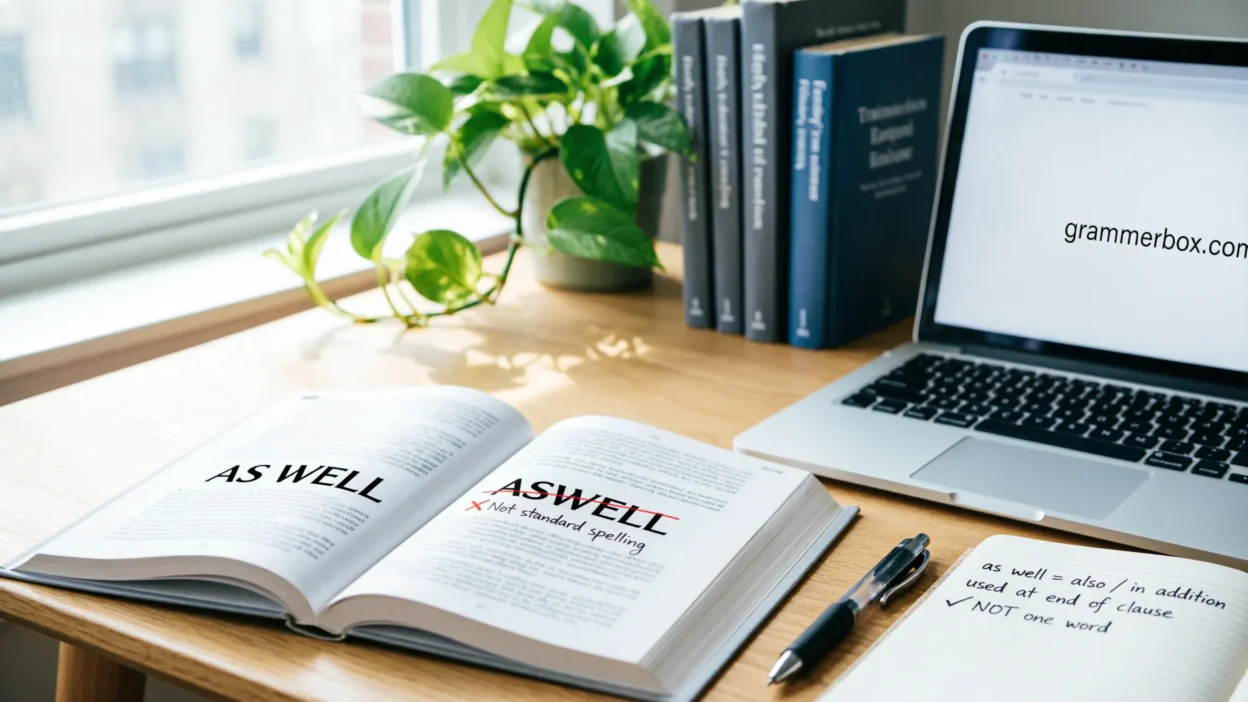
If you have ever wondered whether to write “as well” or “aswell,” you are not alone. These two forms look almost identical, but only one is considered correct in standard English. The confusion usually happens because “as well” is commonly pronounced quickly in everyday speech, making the two words sound like a single unit. When writing, however, the distinction is important.
The correct spelling is “as well”—two separate words. It is commonly used to mean “also,” “too,” or “in addition.” You will see it frequently in conversations, emails, essays, social media posts, and professional writing. “Aswell” is not the standard spelling and should generally be avoided. In this guide, you will learn why people confuse these forms, how to use as well correctly, common mistakes to avoid, and easy examples that will help you remember the difference.
Quick Answer
“As well” is the correct form in standard English. It usually means “also,” “too,” or “in addition.” “Aswell” is incorrect because it combines two separate words into one. Always write as well as two words.
Why People Confuse It
The confusion between as well and aswell mainly comes from pronunciation and informal writing.
When native speakers say “as well” quickly, the words can sound closely connected. This may make learners think that aswell is a single word.
Another reason is that English contains many common words that were created by combining older words. For example, already, always, and altogether are written as single words. However, as well has not become a standard one-word expression.
Remember that spelling should not always be based on pronunciation. Some expressions sound like one unit when spoken but remain separate words in writing.
First Word: As Well
As well is the correct expression.
It is usually used as an adverbial phrase meaning:
- Also
- Too
- In addition
- Additionally
Examples
- I want to come as well.
- She speaks Spanish as well.
- He bought a new laptop as well.
- We invited Sarah as well.
- I enjoyed the movie as well.
In many sentences, as well can be replaced with too or also without changing the basic meaning.
Example:
I enjoyed the concert as well.
This means essentially the same thing as:
I enjoyed the concert too.
However, word placement can differ. As well commonly appears at the end of a sentence or clause.
Second Word: Aswell
Aswell is not the standard English spelling.
Although you may occasionally see it in informal online writing, texting, comments, or user-generated content, it is generally considered a spelling error rather than an accepted standard form.
Incorrect:
I want to go aswell.
Correct:
I want to go as well.
The important point is simple: do not combine “as” and “well” into one word when you mean “also” or “too.”
If you are writing an essay, email, article, résumé, application, or professional message, always use as well.
As Well vs Aswell: Comparison Table
| Form | Correct? | Meaning | Usage |
|---|---|---|---|
| as well | Yes | Also, too, in addition | Standard English |
| aswell | No | Intended to mean “also” | Common spelling mistake |
The easiest rule
As well = correct
Aswell = incorrect
When to Use Each
There is really only one standard choice when you mean “also” or “too.”
Use “as well” when you mean “also”
Tom is coming as well.
Use “as well” when adding another item or idea
We need bread as well.
Use “as well” in professional writing
Please send the updated document as well.
Use “as well” in casual conversation
Can I come as well?
The phrase works in both formal and informal English, which makes it extremely useful.
Aswell should not be used as the standard spelling in either formal or informal writing.
Examples of As Well in Sentences
Here are more examples showing how as well works naturally in everyday English.
- I would like some coffee as well.
- She plays the piano as well.
- We visited the museum as well.
- Can you bring your brother as well?
- He wants to join the team as well.
- I finished my homework as well.
- They sell fresh bread as well.
- My sister speaks French as well.
- We should invite our neighbors as well.
- I enjoyed reading the book as well.
- The hotel offers breakfast as well.
- She is a talented writer as well.
- You can choose the blue one as well.
- He knows how to cook as well.
- We need to consider the cost as well.
Notice that as well frequently appears near the end of a sentence.
Common Mistakes
1. Writing “aswell” as one word
This is the most common mistake.
❌ I want to come aswell.
✅ I want to come as well.
2. Assuming pronunciation determines spelling
Because as well can sound connected in rapid speech, learners sometimes spell it as one word.
English spelling does not always match pronunciation exactly, so it is better to remember the standard written form.
3. Using “aswell” in formal writing
Even if the meaning is clear, aswell can make your writing look careless.
Avoid it in:
- Academic essays
- Business emails
- Résumés
- Cover letters
- Reports
- Articles
- Formal applications
4. Confusing “as well” with “as well as”
These expressions are related but have different grammatical functions.
As well generally means also:
I want to go as well.
As well as means in addition to:
She speaks English as well as French.
Memory Trick
Use this simple memory trick:
“As well” is two words because it adds something to what has already been mentioned.
Think:
You can also remember the phrase “well” as an independent word. Since as and well have their own meanings and functions, keep them separate.
Quick test
Whenever you want to write aswell, replace it with also.
If the sentence still makes sense, write:
as well
For example:
I want to go also.
Therefore:
I want to go as well.
American vs British English
There is no major difference between American and British English regarding the spelling of this expression.
Both varieties use:
as well
Both American and British writers generally treat aswell as a spelling error when it is intended to mean also or too.
You may encounter aswell online because of typos, informal posts, or nonstandard usage, but that does not make it the accepted spelling.
So whether you are writing for an American audience or a British audience, the safe and standard choice is:
as well
Similar Words and Expressions
Several words and phrases can express a similar idea to as well.
Also
She is coming also.
Also is common in both formal and informal writing, although its position in a sentence differs from as well.
Too
She is coming too.
Too is especially common in conversational English and often appears at the end of a sentence.
Additionally
Additionally, we need more information.
This is more formal and is often used in academic or professional writing.
In addition
In addition, we need another copy.
This phrase is useful when introducing an additional point or item.
Furthermore
Furthermore, the plan is affordable.
This is more formal and is common in essays, reports, and formal discussions.
FAQs:
Is “aswell” one word?
No. Aswell is not the standard spelling when you mean “also” or “too.” The correct form is as well, written as two separate words.
Is “as well” correct grammar?
Yes. As well is a standard English phrase commonly used to mean also, too, or in addition.
Can I use “as well” at the end of a sentence?
Yes. This is one of the most common positions for as well.
I would like to come as well.
Is “aswell” acceptable in texting?
You may see aswell in informal messages or online posts, usually because of a spelling mistake. However, as well is the standard form and is the better choice.
What is the difference between “as well” and “also”?
Both can mean also, but their usual positions differ. As well frequently comes at the end of a sentence, while also often appears before the main verb.
I like tea as well.
I also like tea.
What is the difference between “as well” and “too”?
Both can mean also or in addition. They are often interchangeable, especially when placed at the end of a sentence.
I want to come as well.
I want to come too.
Is “as well as” the same as “as well”?
No. As well generally means also, while as well as commonly means in addition to.
She sings as well.
She sings as well as dances.
Final Verdict
When choosing between as well or aswell, the answer is straightforward: as well is correct.
Use as well when you want to express the idea of also, too, or in addition. Keep as and well as two separate words.
Aswell is a common spelling mistake, but it is not the standard form. Whether you are writing a casual message, academic assignment, professional email, or website article, choosing as well will keep your writing accurate and polished.
Remember This
When you mean “also” or “too,” always write as well as two words.
Example:
✅ I would like to come as well.
❌ I would like to come aswell.
Conclusion
The difference between as well and aswell is simple once you know the standard spelling. As well is the correct two-word expression and is widely used to add information or show that something applies to another person or thing. It can usually be understood as also, too, or in addition.
Although aswell may appear in online writing, it should not be used in standard English. Remember the easy rule: as well is always two words when it means “also” or “too.” Keeping this small distinction in mind will help you avoid a common spelling mistake and make your English writing clearer and more professional.