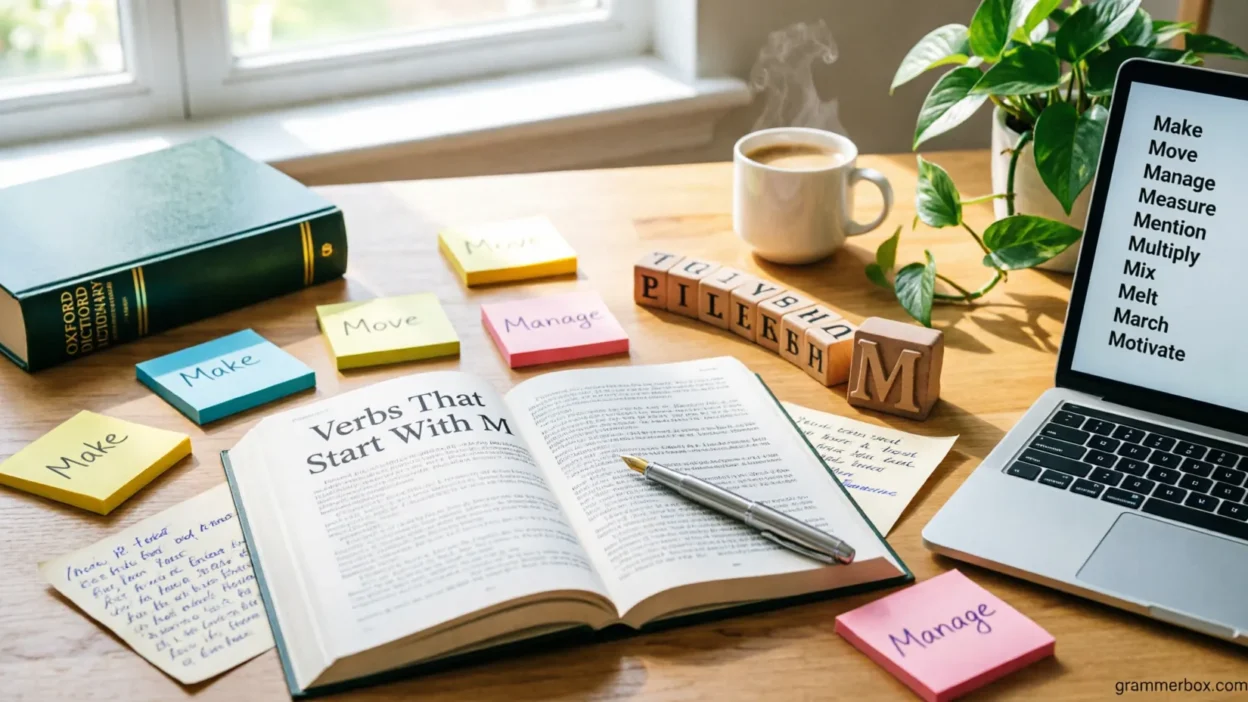
Learning verbs that start with M is an excellent way to improve your vocabulary, writing, and speaking skills. If you’re a student, English learner, teacher, or writer, expanding your verb knowledge helps you communicate more clearly and creatively.
From everyday actions like make and move to advanced verbs like manifest and moderate, M verbs appear in daily conversations and professional writing.
In this guide, you’ll discover a carefully selected list of verbs beginning with M, along with their meanings, example sentences, and practical usage tips. You’ll also learn how similar M verbs differ, common mistakes to avoid, and memory tricks that make learning easier.
Quick Answer
Verbs that start with M are action, state, or helping words beginning with the letter M. Common examples include make, move, meet, manage, measure, mention, mix, motivate, memorize, and multiply. Learning these verbs strengthens vocabulary, improves sentence variety, and makes your English sound more natural.
Why People Confuse Verbs That Start With M
Many M verbs have similar meanings or are used in related situations. For example, learners often confuse:
- Make vs. Manufacture
- Meet vs. Mingle
- Move vs. Migrate
- Mention vs. Mutter
- Manage vs. Monitor
The confusion usually happens because these verbs describe related actions but differ in purpose, intensity, or context.
First Word: Make
Meaning: To create, build, produce, or cause something to happen.
Examples
- She will make dinner tonight.
- They made a beautiful sculpture.
- Hard work can make a difference.
Best used for: Creating, producing, or causing results.
Second Word: Manage
Meaning: To organize, control, supervise, or successfully handle something.
Examples
- She manages a large company.
- Can you manage the project alone?
- He managed to finish on time.
Best used for: Leadership, organization, and handling responsibilities.
Comparison Table
| Verb | Meaning | Best Used For | Example |
|---|---|---|---|
| Make | Create or produce | Creating something | Make a cake |
| Manage | Organize or control | Leadership | Manage a team |
| Meet | Come together | Appointments | Meet a friend |
| Move | Change position | Physical movement | Move the chair |
| Mention | Refer briefly | Conversation | Mention your idea |
| Measure | Find size or amount | Calculations | Measure the room |
| Mix | Combine | Cooking or science | Mix the ingredients |
| Memorize | Learn by heart | Studying | Memorize the poem |
| Motivate | Encourage | Inspiration | Motivate students |
| Multiply | Increase by arithmetic | Mathematics | Multiply the numbers |
When to Use Each
Use different M verbs depending on the situation.
- Make when creating something.
- Manage when supervising people or tasks.
- Meet when seeing someone.
- Move for changing position.
- Measure when checking size or quantity.
- Mix when combining things.
- Mention when briefly referring to something.
- Memorize while studying.
- Motivate when inspiring others.
- Multiply in mathematics.
Examples of Verbs That Start With M (10+)
Here are more useful M verbs with example sentences.
| Verb | Meaning | Example Sentence |
|---|---|---|
| Make | Create | I will make breakfast. |
| Manage | Control | She manages the office well. |
| Meet | Come together | Let’s meet tomorrow. |
| Move | Change position | Please move your bag. |
| Measure | Calculate size | Measure the table carefully. |
| Mention | Refer briefly | He mentioned your name. |
| Mix | Combine | Mix the flour and water. |
| Memorize | Learn by heart | Students memorize vocabulary daily. |
| Motivate | Inspire | Good teachers motivate learners. |
| Multiply | Increase mathematically | Multiply six by four. |
| Melt | Become liquid | Ice melts in the sun. |
| Mend | Repair | He mended the torn shirt. |
| Migrate | Move permanently | Birds migrate every winter. |
| March | Walk together | Soldiers marched proudly. |
| Manifest | Show clearly | Success manifests through effort. |
Common Mistakes
Avoid these frequent errors.
❌ Make a meeting
✅ Hold a meeting or Arrange a meeting
❌ Manage to someone
✅ Manage someone or Manage a team
❌ Mention about it
✅ Mention it
❌ Mix with together
✅ Mix together
Memory Trick
Remember this simple phrase:
“Make, Move, Meet, Mix, Manage—all the important M actions happen every day.”
Grouping similar verbs together helps you remember them faster.
American vs British English
Most verbs that start with M have the same meaning in both American and British English.
Small differences may appear in style rather than grammar.
| American English | British English |
|---|---|
| Meet with someone | Meet someone |
| Memorize | Memorise (spelling variation in related noun/adjective forms, but the verb is commonly memorize in American English and memorise in British English) |
| Manage a business | Manage a business |
Overall, these verbs are understood worldwide.
Similar Words
If you’re expanding your vocabulary, these related verbs are also useful.
- Motivate
- Manipulate
- Manufacture
- Monitor
- Maintain
- Modify
- Mark
- Match
- Mobilize
- Merge
- Magnify
- Mimic
- Motivate
- Muster
- Mold
Final Verdict
Learning verbs that start with M helps you express actions more accurately in everyday English. If you’re writing essays, preparing presentations, or improving conversation skills, these verbs make your language richer and more precise. Practice using them in real sentences to remember them naturally.
FAQs:
1. What are verbs that start with M?
They are action or state words beginning with the letter M, such as make, move, meet, manage, and measure.
2. What is the most common M verb?
Make is one of the most frequently used verbs in English.
3. Are M verbs useful for students?
Yes. They improve vocabulary, writing, reading comprehension, and speaking skills.
4. How can I remember M verbs easily?
Practice them in sentences, group similar meanings together, and review them regularly.
5. Which M verb means to inspire someone?
Motivate means to encourage or inspire someone to take action.
6. What verb starting with M means to repair?
Mend means to fix or repair something.
7. Which M verb is used in mathematics?
Multiply is commonly used in arithmetic and mathematics.
Conclusion
Verbs beginning with the letter M are among the most practical words in English. They describe everyday activities, professional responsibilities, academic tasks, and personal interactions. From making and moving to motivating and memorizing, these verbs appear in countless real-life situations.
The best way to master them is through regular practice. Read them aloud, write your own example sentences, and use them in conversations whenever possible. Over time, these verbs will become a natural part of your vocabulary, making your English more fluent, confident, and expressive.
Remember This
The easiest way to learn verbs that start with M is to connect each verb with a real-life action. The more you use them in speaking and writing, the faster they become part of your everyday English.