English has many words that look or sound surprisingly similar but have completely different meanings. Bespectacled and bespeckle are a good example. Both begin with “bespec-,” yet they describe entirely different things. If you have ever wondered whether someone can be “bespeckled” with glasses or whether a surface can be “bespectacled,” you are not alone.
The key difference is simple once you see how each word works. Bespectacled is an adjective describing someone who wears spectacles or glasses. Bespeckle, on the other hand, is a verb meaning to cover or mark something with many small spots or specks. Understanding their meanings, parts of speech, and sentence patterns will help you avoid common spelling and vocabulary mistakes. This guide explains bespectacled vs bespeckle with clear definitions, examples, a comparison table, memory tricks, and practical usage tips.
Quick Answer
Bespectacled is an adjective meaning “wearing glasses or spectacles.” Bespeckle is a verb meaning “to cover or mark with small spots or specks.” They are not interchangeable: a person can be bespectacled, while a surface can be bespeckled with paint, dust, or stars.
Why People Confuse It
The confusion comes mainly from their similar spelling and pronunciation.
Both words begin with “bespec-”, which makes them look closely related. However, their meanings are completely different:
- Bespectacled → connected with spectacles (glasses)
- Bespeckle → connected with speckles (small spots)
- Bespectacled is an adjective.
- Bespeckle is a verb.
- Bespeckled is the past participle/adjectival form of bespeckle.
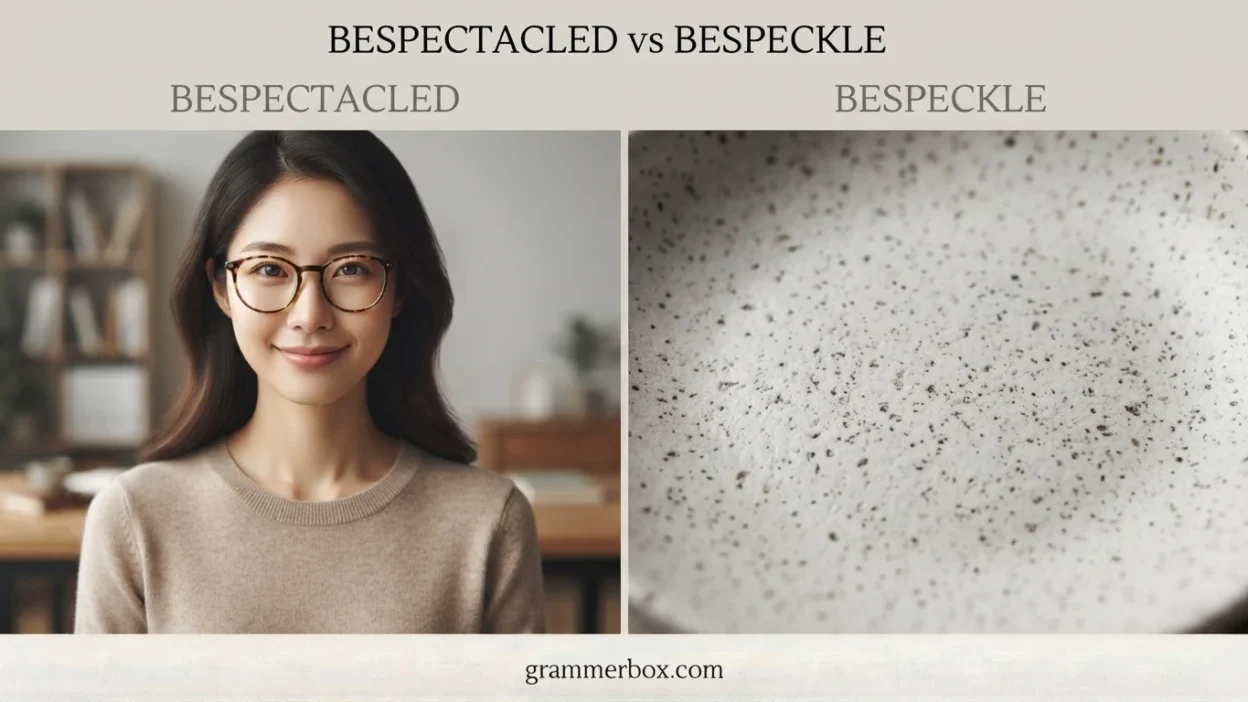
A useful distinction is that spectacles are glasses, while speckles are tiny spots.
First Word: Bespectacled
Bespectacled is an adjective that means wearing spectacles or eyeglasses.
It is usually used to describe a person who wears glasses.
Examples
- The bespectacled teacher entered the classroom.
- A bespectacled man was sitting near the window.
- She recognized the bespectacled professor immediately.
- The photograph shows a young, bespectacled student.
- The bespectacled librarian helped me find the book.
The word often has a slightly descriptive or literary tone. In everyday conversation, wearing glasses is usually more natural.
Simple meaning:
Bespectacled = wearing glasses.
Second Word: Bespeckle
Bespeckle is a verb meaning to cover or mark something with many small spots or specks.
It can be used for physical things such as paint, mud, dust, or light.
Examples
- Rain bespeckled the window.
- The artist bespeckled the canvas with blue paint.
- Stars bespeckled the night sky.
- Mud bespeckled his shoes after the walk.
- Tiny flowers bespeckled the hillside.
The common forms are:
- Bespeckle — base form
- Bespeckles — present tense, third person
- Bespeckled — past tense/past participle
- Bespeckling — -ing form
Simple meaning:
Bespeckle = to cover something with small spots or specks.
Bespectacled vs Bespeckle: Comparison Table
| Feature | Bespectacled | Bespeckle |
|---|---|---|
| Part of speech | Adjective | Verb |
| Meaning | Wearing glasses | Covering with small spots |
| Related word | Spectacles | Speckles |
| Usually describes | A person | A surface, object, or scene |
| Example | A bespectacled student | Paint bespeckled the wall |
| Common form | Bespectacled | Bespeckled |
| Everyday alternative | Wearing glasses | Spotted / covered with specks |
When to Use Each
Use “bespectacled” for people wearing glasses
Choose bespectacled when you want to describe someone who has spectacles or eyeglasses on.
The bespectacled woman was reading a newspaper.
Here, the word describes the woman’s appearance.
Use “bespeckle” for small spots
Choose bespeckle when something becomes covered with numerous small marks or spots.
Paint bespeckled the artist’s apron.
Here, bespeckled describes the apron as being marked with small spots of paint.
Quick test
Ask yourself:
Are you talking about glasses? → Bespectacled
Are you talking about tiny spots? → Bespeckle / bespeckled
Examples: Bespectacled and Bespeckle in Sentences
- The bespectacled student raised her hand.
- A bespectacled scientist appeared in the documentary.
- The bespectacled man smiled at the camera.
- The novel features a clever, bespectacled detective.
- The bespectacled child carefully read the instructions.
- Rain bespeckled the glass door.
- The old wall was bespeckled with patches of moss.
- The painter bespeckled the paper with ink.
- Golden lights bespeckled the distant skyline.
- Mud bespeckled the car after the storm.
- Snow bespeckled the dark branches.
- The fabric was bespeckled with tiny white dots.
Notice how bespectacled normally describes a person, while bespeckled describes something covered with small spots.
Common Mistakes
1. Using “bespeckled” to mean wearing glasses
Incorrect:
The bespeckled professor walked into the room.
If you mean the professor wears glasses, bespectacled is the appropriate word.
Correct:
The bespectacled professor walked into the room.
2. Using “bespectacled” for spotted surfaces
Incorrect:
The wall was bespectacled with paint.
Correct:
The wall was bespeckled with paint.
3. Confusing “bespeckle” with “bespeckled”
Bespeckle is the base verb:
The artist will bespeckle the canvas with paint.
Bespeckled is the past form or participle:
The canvas was bespeckled with paint.
4. Assuming similar spelling means similar meaning
The shared beginning can be misleading. Their roots provide the best clue:
- spectacles → bespectacled
- speckles → bespeckle
Memory Trick
Use this easy memory trick:
Spectacles = glasses → Bespectacled = wearing glasses.
Speckles = tiny spots → Bespeckle = cover with tiny spots.
You can remember it as:
Spectacles go on your face; speckles go on things.
If you see “spectac”, think spectacles.
If you see “speck”, think small spots.
American vs British English
There is no major difference in meaning between bespectacled and bespeckle in American and British English.
Both varieties recognize bespectacled as a word describing someone who wears glasses or spectacles. Bespeckle also has the same basic meaning in both forms of English: to cover something with small spots or specks.
The main difference is that spectacles itself is more common in British English as a term for glasses, while American English more often uses glasses or eyeglasses in everyday speech.
For example:
- British English: a bespectacled man
- American English: a bespectacled man
The adjective remains the same even though everyday vocabulary may differ.
Similar Words
Words similar to “bespectacled”
- Eyeglass-wearing
- Glasses-wearing
- Spectacled
- Wearing glasses
Spectacled is particularly close in meaning to bespectacled.
Words similar to “bespeckle”
Depending on context, you might use:
- Spot
- Speckle
- Fleck
- Dot
- Mark
- Sprinkle
- Stipple
- Cover with spots
- Mottle
These alternatives are not always exact synonyms, so choose based on the sentence and the type of marks being described.
FAQs:
Is “bespectacled” a real word?
Yes. Bespectacled is a standard English adjective meaning wearing spectacles or glasses.
What does “bespeckle” mean?
Bespeckle is a verb meaning to cover or mark something with many small spots or specks.
Is “bespeckled” the same as “bespectacled”?
No. Bespeckled means covered with small spots or specks, while bespectacled means wearing glasses.
Can I use “bespectacled” for an object?
Generally, no. It is normally used to describe a person wearing spectacles. For something covered with small marks, bespeckled is the appropriate word.
Is “bespectacled” formal?
It can sound somewhat literary or formal compared with the everyday phrase wearing glasses, but it is perfectly standard English.
What is the past tense of “bespeckle”?
The past tense is bespeckled.
For example:
The rain bespeckled the window.
What is the easiest way to remember the difference?
Connect spectacles with bespectacled and speckles with bespeckle. Glasses are spectacles; tiny spots are speckles.
Final Verdict
Bespectacled and bespeckle are different words with different grammatical roles and meanings.
- Bespectacled = wearing glasses or spectacles.
- Bespeckle = to cover something with small spots or specks.
- Bespeckled = covered with small spots or specks.
The easiest way to avoid confusion is to look at the middle of each word. “Spectac” points to spectacles, while “speck” points to speckles.
Remember This
Bespectacled = glasses.
Bespeckle = small spots.
If you’re describing a person wearing eyeglasses, use bespectacled. If you’re describing something covered in tiny marks, use bespeckle or bespeckled.
Conclusion
Although bespectacled vs bespeckle can look confusing at first glance, their meanings become clear when you connect each word with its related noun. Bespectacled comes from the idea of spectacles and describes someone wearing glasses. Bespeckle, meanwhile, is associated with specks and describes the action of covering something with small spots.
Remember the simple distinction: spectacles are glasses, while speckles are spots. Once you make that connection, choosing between these words becomes much easier. Use bespectacled for people with glasses and bespeckled for things marked with tiny spots.