
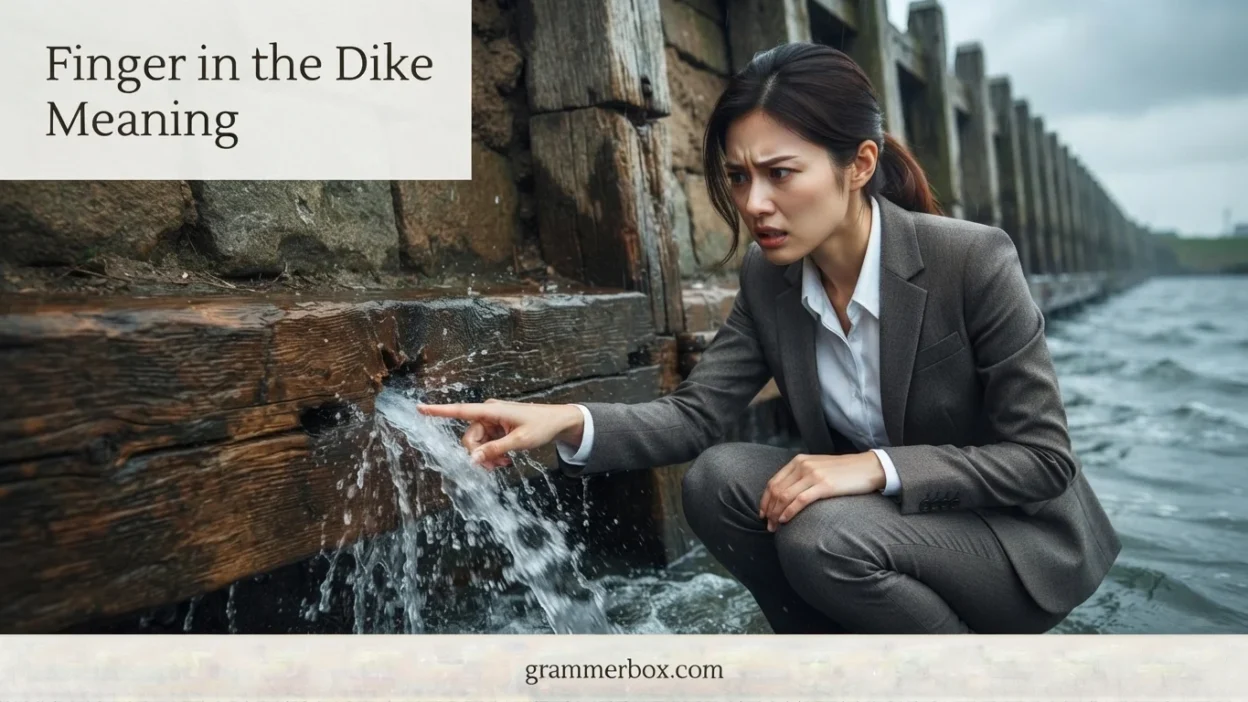
When someone has their “finger in the dike,” they are trying to stop a small problem from becoming a much bigger one, often by taking temporary action. The expression comes from the image of a person plugging a hole in a dike with a finger to prevent water from breaking through. In everyday English, it describes a desperate or short-term effort to contain a growing problem.
The phrase “finger in the dike” can be used literally in a historical or storytelling context, but it is much more common as an idiom. You might hear it when someone is dealing with repeated problems at work, managing a financial crisis, fixing technical issues, or trying to control an overwhelming situation. Understanding its meaning, origin, and modern usage will help you recognize this colorful expression and use it naturally.
Quick Answer
“Finger in the dike” means taking a temporary or desperate action to prevent a small problem from becoming a serious one. It often suggests that the underlying problem remains unsolved. The expression comes from the image of plugging a hole in a dike to stop floodwater.
Why People Confuse It
People sometimes find “finger in the dike” confusing because its literal meaning sounds unusual. Why would someone put a finger into a wall?
The expression is based on a vivid metaphor. A dike is a structure designed to hold back water. If a hole develops, water can begin rushing through it. Someone might try to block the opening until a proper repair can be made.
The idiom therefore describes situations where:
- A person is temporarily containing a problem.
- A quick fix is being used instead of a permanent solution.
- Small problems are appearing faster than they can be solved.
- Someone is trying to prevent a crisis from getting worse.
For example:
“Answering every customer complaint individually is just putting a finger in the dike.”
This means the complaints are being handled one by one, but the larger problem causing them has not been fixed.
Finger
In the expression, finger represents a small, immediate action taken to block or control a problem.
The image is intentionally dramatic: one tiny finger is being used to stop something much larger, such as a wall of water.
This creates the idea of an effort that is:
- Immediate
- Temporary
- Often inadequate
- Focused on preventing further damage
So, when someone says they are “putting a finger in the dike,” they usually mean they are keeping a problem under control for now rather than solving its root cause.
Dike
A dike is a barrier built to control or hold back water.
In the metaphor behind the idiom, water represents a growing problem, while the dike represents the system or boundary that is supposed to contain it.
If the dike develops a hole, someone may try to plug it temporarily. That image gives us the modern figurative meaning of “finger in the dike.”
The word dike is also commonly spelled dyke in some contexts, although dike is the traditional spelling in the expression in American English.
Finger in the Dike vs. Similar Expressions
| Expression | Meaning | Main Idea |
|---|---|---|
| Finger in the dike | Temporarily containing a problem | Emergency fix |
| Band-Aid solution | A quick but incomplete solution | Temporary repair |
| Put out fires | Deal with urgent problems as they arise | Crisis management |
| Plug the hole | Stop a specific problem from getting worse | Immediate containment |
| Treat the symptoms | Address effects rather than the cause | Not solving the root issue |
| Paper over the cracks | Hide or temporarily cover problems | Concealing weaknesses |
The expressions overlap, but “finger in the dike” strongly emphasizes the idea of trying to hold back a potentially overwhelming problem.
When to Use “Finger in the Dike”
Use the expression when you want to emphasize that someone is containing problems rather than solving the underlying cause.
At work
“The IT team is putting a finger in the dike by fixing individual system errors.”
The team is handling immediate problems, but the larger technical issue remains.
In business
“Cutting expenses every month is just a finger in the dike if sales continue to fall.”
The cost-cutting may help temporarily, but it does not address the declining sales.
In everyday conversation
“I’m answering emails all morning, but it feels like I’m just putting a finger in the dike.”
The speaker cannot keep up with the growing workload.
In politics or public policy
“The new regulation may be a finger in the dike rather than a long-term solution.”
The regulation might control one problem without addressing its broader causes.
Finger in the Dike Examples
Here are some natural examples showing how the idiom works in context:
- “Hiring another temporary worker is just putting a finger in the dike.”
- “We keep repairing the old machine, but that’s only a finger in the dike.”
- “Deleting unwanted emails every day feels like putting a finger in the dike.”
- “The company needs a permanent solution instead of constantly putting a finger in the dike.”
- “Adding another security guard may be a finger in the dike if the building’s security system remains broken.”
- “We’re fixing individual bugs, but we’re really just putting a finger in the dike.”
- “Borrowing money to cover every month’s losses is like putting a finger in the dike.”
- “The teacher’s extra tutoring sessions were helpful, but they were only a finger in the dike.”
- “Replacing one damaged pipe at a time is becoming a finger-in-the-dike strategy.”
- “We need to address the root cause instead of putting another finger in the dike.”
- “Customer support is overwhelmed and can only put a finger in the dike by answering the most urgent complaints.”
- “The emergency funding helped, but it was essentially a finger in the dike.”
Common Mistakes
1. Taking the phrase literally
The expression is normally figurative, not advice to put your actual finger into a dike.
2. Thinking it means solving a problem permanently
It usually suggests the opposite. A person is containing a problem temporarily.
3. Using it for a completely successful solution
If someone permanently fixes the underlying issue, “finger in the dike” is generally not the best description.
4. Confusing it with “a finger in every pie”
These expressions have different meanings.
- Finger in the dike: trying to contain a problem.
- Finger in every pie: being involved in many different activities or matters.
5. Assuming the problem must involve water
The modern idiom can describe financial, technical, organizational, social, or personal problems. Water is only part of its metaphorical origin.
Memory Trick
Think of this simple picture:
Huge problem = floodwater
Small temporary fix = finger
Barrier = dike
Imagine a person desperately using one finger to stop water from flooding through a hole.
That makes the meaning easy to remember:
“Finger in the dike” = a small temporary effort holding back a much bigger problem.
American vs. British English
“Finger in the dike” is understood in both American and British English, although related wording and spelling can vary.
In American English, dike is commonly used for the barrier, while dyke can also appear as an alternative spelling in some contexts.
The idiomatic idea remains the same: someone is trying to prevent a problem from becoming worse with a temporary measure.
You may also encounter the phrase “putting a finger in the dyke” in British or international writing. Context is important because dyke has another modern meaning as a term referring to a lesbian, so dike is often preferred when discussing the water-control structure.
Similar Words and Expressions
If you want alternatives to “finger in the dike,” consider:
- Temporary fix
- Quick fix
- Band-Aid solution
- Stopgap measure
- Emergency measure
- Short-term solution
- Put out fires
- Plug the hole
- Contain the damage
- Treat the symptoms
- Paper over the cracks
- Patch the problem
The best synonym depends on the context. “Stopgap measure” is especially useful in formal writing, while “putting out fires” is common in casual workplace conversation.
Final Verdict
“Finger in the dike” means making a small, usually temporary effort to prevent a larger problem from getting out of control. It comes from the memorable image of using a finger to block a hole in a water-retaining dike.
The phrase is especially useful when describing temporary fixes, crisis management, damage control, and problems that keep multiplying. If the real cause has not been addressed, calling the solution “a finger in the dike” highlights that limitation.
FAQs:
What does “finger in the dike” mean?
It means making a temporary or desperate effort to prevent a problem from becoming much worse, without necessarily solving its underlying cause.
Is “finger in the dike” an idiom?
Yes. It is an English idiom based on the image of plugging a hole in a dike to prevent floodwater from breaking through.
What is an example of “finger in the dike”?
“Fixing one computer at a time isn’t enough; we’re just putting a finger in the dike.” The sentence means the individual fixes are not addressing the larger technical problem.
Is “finger in the dike” negative?
It can have a negative or critical tone because it often suggests that an action is inadequate or temporary. However, it can also simply describe emergency damage control.
What is another word for “finger in the dike”?
Depending on the context, alternatives include stopgap measure, temporary fix, Band-Aid solution, damage control, and short-term solution.
What is the origin of “finger in the dike”?
The expression comes from a famous story about a Dutch boy who supposedly notices a hole in a dike and blocks it with his finger to prevent flooding. The story is widely associated with Dutch flood-control folklore, although its exact historical basis is uncertain.
Does “finger in the dike” mean solving a problem?
Not usually. It generally means temporarily containing or delaying a problem, while the underlying issue still needs a proper solution.
Remember This
Finger in the dike = a small, temporary action used to hold back a much bigger problem.
If you’re containing the damage but not fixing the root cause, you’re essentially putting a finger in the dike.
Conclusion
The meaning of “finger in the dike” becomes much clearer when you picture its metaphor: a tiny finger attempting to stop a powerful flow of water. The phrase describes efforts to keep a growing problem under control, especially when a permanent solution has not yet been found.
If you’re talking about workplace stress, financial difficulties, technical failures, or everyday problems, this idiom can add color and precision to your English. Just remember that it usually carries the idea of temporary containment rather than genuine resolution.