
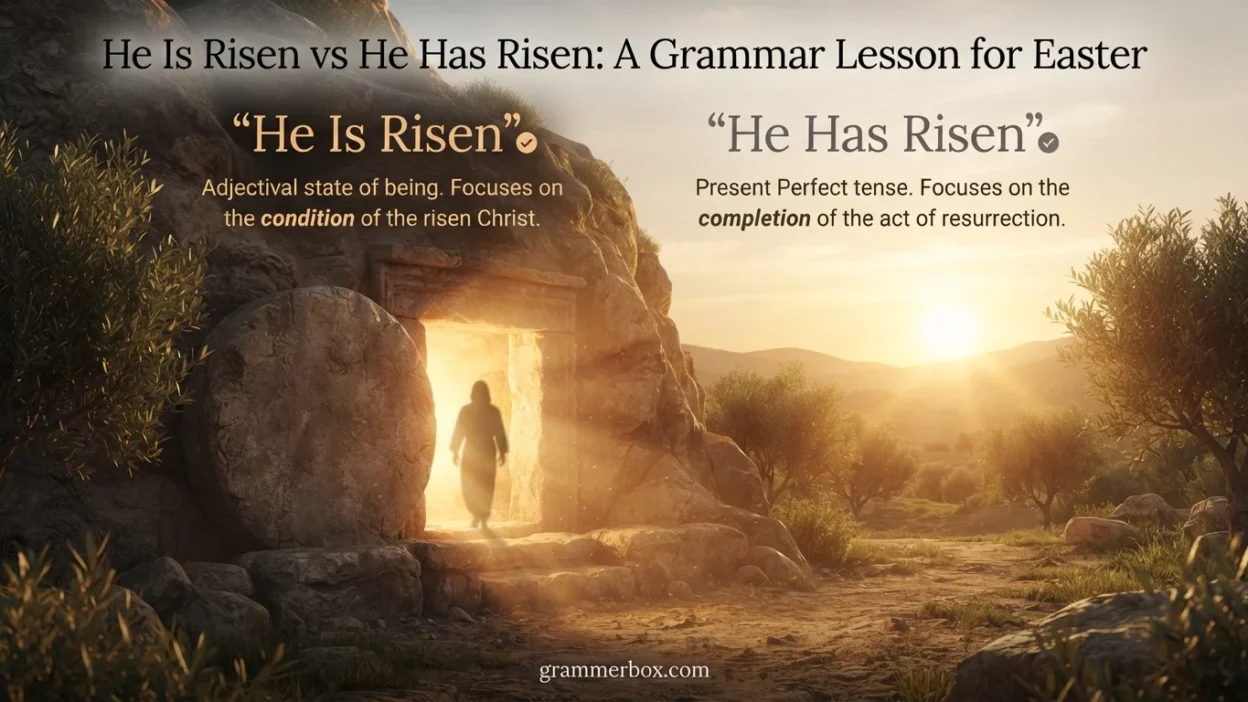
“He is risen” and “he has risen” look almost identical, but they come from different grammatical patterns and can carry slightly different tones. If you have encountered both expressions in religious writing, Easter messages, Bible translations, or everyday English, you may wonder whether one is grammatically correct and the other is wrong. The answer is more interesting than a simple yes or no.
Both expressions can be correct, but they are not always used in the same way. “He has risen” is the standard modern English present perfect construction, while “he is risen” is an older, more traditional form that is especially associated with Christian language.
Understanding the difference helps you choose the right expression for formal writing, conversation, religious contexts, and historical quotations. In this guide, we’ll examine their meanings, grammar, examples, common mistakes, and usage in American and British English.
Quick Answer
“He has risen” is the standard modern English form, meaning that he rose and is now risen. “He is risen” is also correct in traditional or religious English, especially in Easter and biblical contexts. The choice depends mainly on context and style.
Why People Confuse It
The confusion comes from the unusual structure of “he is risen.”
Modern English normally forms the present perfect with has + past participle:
- He has risen.
- She has arrived.
- They have returned.
So, naturally, many speakers assume that “he is risen” must be grammatically incorrect.
However, “risen” has historically been used as a participial adjective or in an older perfect construction with “be.” This is why phrases such as “He is risen” survived in traditional religious English.
There is also an important difference in style:
- He has risen → modern, grammatical, and widely understood.
- He is risen → traditional, biblical, ceremonial, or literary.
First Word: “He Is Risen”
“He is risen” is a traditional expression meaning that he has risen or he has come back to life and is now risen.
The phrase is strongly associated with Christian Easter traditions and the resurrection of Jesus Christ.
For example:
- “He is risen indeed!”
- “Christ is risen!”
- “The Lord is risen.”
Here, “risen” functions in a way that describes the person’s resulting state.
Why does “is” appear instead of “has”?
Older forms of English sometimes used forms of “be” with verbs of movement or change of state where modern English generally uses “have.” This historical pattern can still be seen in traditional expressions.
Today, however, “he is risen” sounds noticeably more formal, archaic, or religious outside those contexts.
Second Word: “He Has Risen”
“He has risen” follows the standard modern present perfect construction:
has + past participle
The verb rise has these principal forms:
- Present: rise
- Past: rose
- Past participle: risen
Therefore:
He has risen.
This construction tells us that the rising happened in the past and has a relevant connection to the present.
In a religious context, “He has risen” can refer to the resurrection while using ordinary contemporary English grammar.
It can also be used literally:
- “The sun has risen.”
- “The temperature has risen.”
- “The balloon has risen.”
- “He has risen from his chair.”
Comparison Table
| Expression | Grammar | Meaning | Typical Context | Style |
|---|---|---|---|---|
| He is risen | Traditional/historical construction | He has risen; he is now risen | Religious, biblical, ceremonial | Archaic/traditional |
| He has risen | Present perfect | He rose and is now risen | Modern English, religious, everyday contexts | Standard/modern |
| He rose | Simple past | He rose at a particular past time | Narratives and historical events | Standard |
| He is rising | Present progressive | He is rising now | Ongoing action | Modern |
| He has been raised | Present perfect passive | Someone has raised him | Passive construction | Modern/formal |
When to Use Each
Use “He Is Risen” When:
Choose “he is risen” when you deliberately want traditional or religious wording.
It works particularly well in:
- Easter greetings
- Christian worship
- Religious ceremonies
- Biblical quotations
- Hymns
- Traditional Christian writing
- Formal religious messages
Example:
“He is risen! Rejoice and celebrate.”
The phrase has a strong traditional and ceremonial quality.
Use “He Has Risen” When:
Use “he has risen” when you want natural, modern English.
It is appropriate for:
- Everyday conversation
- Contemporary articles
- Modern explanations
- News-style writing
- General descriptions
- Modern religious writing
Example:
“The disciples discovered that he has risen.”
The construction sounds natural to contemporary English speakers.
Examples of “He Is Risen”
- He is risen, just as the scriptures foretold.
- The message announced that he is risen.
- He is risen indeed!
- The church celebrated the belief that Christ is risen.
- The Easter service opened with the words, “He is risen.”
- The congregation proclaimed that the Lord is risen.
- The traditional hymn declares that Christ is risen.
- The priest reminded the congregation that he is risen.
- The Easter card simply read, “He is risen!”
- For centuries, Christians have repeated the phrase “He is risen.”
- The ceremony concluded with the traditional declaration that he is risen.
- The phrase “He is risen” remains central to many Easter celebrations.
Examples of “He Has Risen”
- He has risen from the dead.
- The Easter message says that he has risen.
- According to the story, he has risen.
- The disciples learned that he has risen.
- Christ has risen, and believers celebrate his resurrection.
- The announcement confirmed that he has risen.
- He has risen and appeared to his followers.
- The story explains how he has risen from the tomb.
- The pastor said that Christ has risen.
- The news that he has risen brought hope to his followers.
- The speaker explained why Christians believe that he has risen.
- The Easter service focused on the message that he has risen.
Common Mistakes
1. Writing “He Has Rose”
This is incorrect.
Rose is the simple past form, while risen is the past participle.
- ❌ He has rose.
- ✅ He has risen.
- ✅ He rose.
2. Assuming “He Is Risen” Is Always Wrong
It is not necessarily wrong. “He is risen” is an established traditional expression, particularly in Christian language.
3. Using “He Is Rose”
This is incorrect when you mean the verb rise.
- ❌ He is rose.
- ✅ He is risen.
- ✅ He has risen.
4. Confusing “Rise” and “Raise”
Rise is normally intransitive: something rises by itself.
Raise normally takes an object: someone raises something.
- The sun has risen.
- They have raised the flag.
5. Changing a Traditional Quote Unnecessarily
If you are quoting a traditional religious phrase, changing “He is risen” to “He has risen” may remove some of its traditional character. Both can communicate the same basic idea, but the wording and register differ.
Memory Trick
Think of it this way:
HAS RISEN = modern grammar
IS RISEN = traditional religious wording
Another easy trick is to remember the verb forms:
So:
- He rose yesterday.
- He has risen today.
- “He is risen” is the traditional expression.
If you are writing ordinary modern English and are unsure which one to choose, “he has risen” is usually the safest option.
American vs British English
There is no major American-versus-British grammar difference that makes one expression exclusively American or British.
“He has risen” is standard in both American and British English.
“He is risen” is also understood in both varieties, but it has a traditional, religious, biblical, or archaic flavor. Its use is more closely connected to register and historical usage than to geographical English.
For modern general writing, speakers of both varieties would normally favor:
For a traditional Easter declaration, both American and British Christians may encounter:
Similar Words and Expressions
Several expressions are related to “he is risen” and “he has risen.”
“He rose”
This is the simple past:
He rose from the tomb.
It describes a completed event in the past.
“He has risen”
This is the modern present perfect:
He has risen from the dead.
It emphasizes the completed action and its present significance.
“He is rising”
This describes an action that is currently happening:
He is rising from his seat.
“He was raised”
This is passive:
He was raised from the dead.
The focus is on the person or power that performed the action.
“Christ is risen”
This is the traditional religious expression and is closely related to “He is risen.”
“Christ has risen”
This is the modern present perfect version.
Final Verdict
Both “he is risen” and “he has risen” can be correct, but they belong to different styles of English.
“He has risen” is the normal modern construction. It uses the present perfect form has + risen and works naturally in contemporary English.
“He is risen” is a traditional expression, especially associated with Christian Easter language and biblical or ceremonial contexts. It should not automatically be treated as a grammatical error.
If you are writing modern English, choose “he has risen.” If you are intentionally using traditional Christian wording, “he is risen” is perfectly appropriate.
FAQs:
Is “he is risen” grammatically correct?
Yes. “He is risen” is an established traditional expression, particularly in religious English. It is less common in ordinary modern conversation.
Is “he has risen” correct?
Yes. “He has risen” is the standard modern English present perfect construction.
Which is better: “he is risen” or “he has risen”?
For modern general English, “he has risen” is usually better. For traditional Christian or Easter language, “he is risen” is especially appropriate.
Why do Christians say “He is risen”?
The phrase comes from traditional Christian language surrounding the resurrection of Jesus. It has been preserved in worship, scripture-related language, hymns, and Easter celebrations.
Is “he has rose” correct?
No. The correct form is “he has risen.” The verb forms are rise, rose, risen.
Can I say “Christ has risen”?
Yes. “Christ has risen” is grammatically correct modern English and is commonly used in contemporary religious writing.
Does “he is risen” mean the same thing as “he has risen”?
They communicate essentially the same basic idea in the relevant religious context, but “he is risen” has a more traditional or ceremonial tone.
Is “he is risen” old English?
It is better described as a traditional or historical English construction, rather than simply calling it “Old English.” Modern speakers still use the expression, especially in religious contexts.
Conclusion
The difference between “he is risen” and “he has risen” is mainly one of grammatical style and historical usage. “He has risen” follows the familiar modern present perfect pattern and is the natural choice for most contemporary writing. Meanwhile, “he is risen” carries a distinctive traditional and religious tone that makes it especially recognizable during Easter and Christian worship.
When choosing between them, think about your audience and purpose. If you want straightforward modern English, use “he has risen.” If you are writing a traditional Easter greeting, quoting religious language, or aiming for a ceremonial tone, “he is risen” may be the better choice.
Remember This
- He has risen = standard modern English.
- He is risen = traditional/religious English.
- He rose = simple past.
- He has risen ≠ “He has rose.”
- Rise → rose → risen
- For everyday modern writing, “he has risen” is usually the safest choice.