
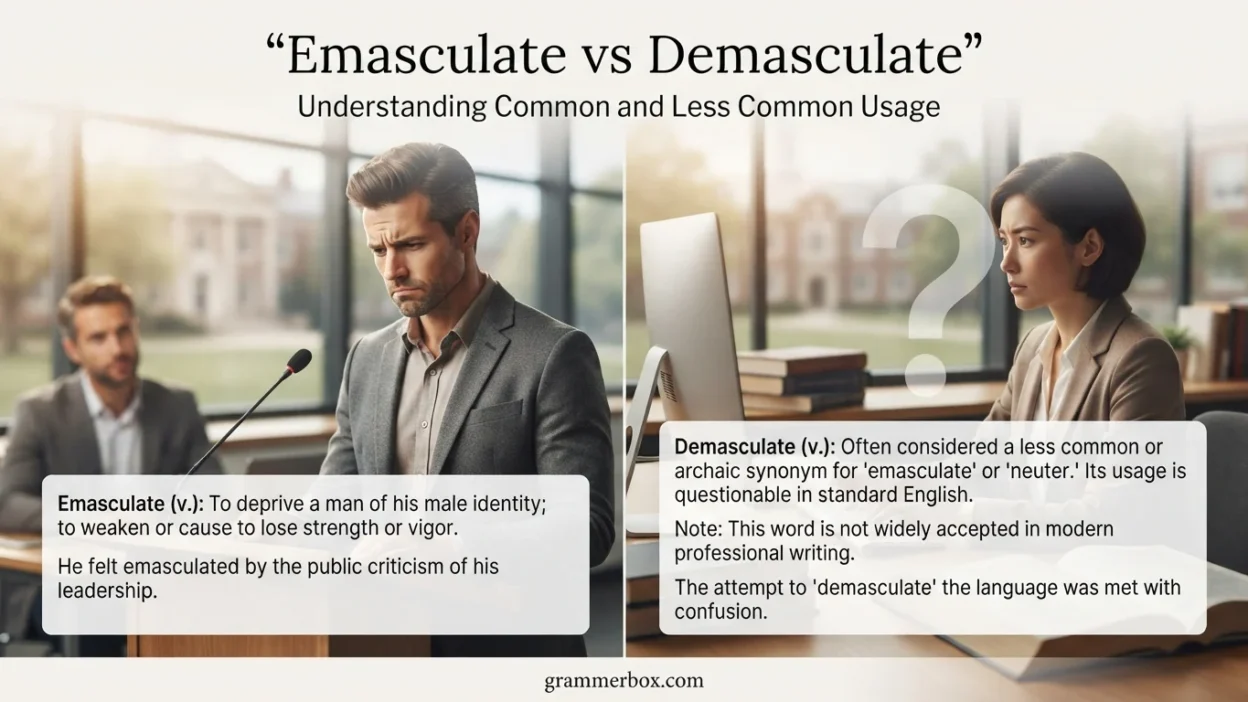
When you come across emasculate vs demasculate, the two words can look almost interchangeable. Both seem to suggest removing masculinity or making someone less powerful, so it is easy to assume that they are simply alternative spellings. However, there is an important difference: emasculate is the established English word, while demasculate is not generally recognized as a standard English word in major dictionaries.
The confusion is understandable because English uses the prefix de- in many verbs that mean to remove, reverse, or reduce something. As a result, “demasculate” may sound perfectly logical. But if you are writing an essay, article, report, professional email, or academic paper, emasculate is the safe and standard choice. In this guide, you will learn the difference, see practical examples, understand common mistakes, and discover an easy way to remember which form to use.
Quick Answer
Emasculate is the standard English word. It can mean to weaken someone’s power or confidence, make a man feel less masculine, or, in specialized contexts, castrate a male or remove the male parts of a plant. Demasculate is not established as a standard English equivalent and should generally be avoided in formal writing.
Why People Confuse It
The confusion between emasculate and demasculate mainly comes from the appearance of the words.
English has many words beginning with de- that express removal or reversal:
- deactivate
- defrost
- devalue
- deconstruct
- demoralize
Because emasculate means to remove masculine strength or weaken something, some speakers naturally assume that demasculate should be the correct form.
There is another reason for the confusion: demasculate does appear occasionally in English-language usage, and it has been defined in some non-mainstream lexical resources as meaning “to remove the masculinity from” someone.
However, that does not make it the preferred standard word. Major dictionaries such as Cambridge, Merriam-Webster, Oxford, and Collins recognize emasculate.
For standard English, choose emasculate.
First Word: Emasculate
Emasculate is a legitimate, established English verb.
It has several related meanings.
1. To weaken or reduce effectiveness
You can use emasculate for laws, organizations, policies, institutions, arguments, or other things whose power has been reduced.
The amendments could emasculate the new law.
Here, emasculate does not refer to masculinity. It means to weaken or make less effective.
Cambridge defines this sense as reducing the effectiveness of something, while Merriam-Webster describes it as depriving something of strength, vigor, or spirit.
2. To make someone feel less masculine
The word can also describe a situation in which a man feels that his masculinity, authority, confidence, or traditional male role has been undermined.
He felt emasculated after being publicly criticized by his colleagues.
Oxford specifically recognizes the meaning of making a man feel that he has lost his male role or qualities.
3. A specialized biological meaning
In medical, veterinary, or biological contexts, emasculate can mean to castrate a male or remove male reproductive parts.
In botany, it can also mean removing the stamens from a flower to prevent self-pollination during plant breeding.
Word forms:
- Present: emasculate
- Past: emasculated
- -ing form: emasculating
- Noun: emasculation
Second Word: Demasculate
Demasculate is not the standard word you should normally use in formal English.
It is understandable because its construction seems logical: de- + masculine. Some lexical sources do record it as an English verb meaning to remove masculinity from someone.
However, it is far less established than emasculate and is absent from the major mainstream dictionaries consulted for this comparison.
So if your goal is:
- correct standard English
- academic writing
- professional writing
- formal communication
- polished SEO content
- exams and essays
use emasculate, not demasculate.
For example:
Preferred:
The experience made him feel emasculated.
Avoid:
The experience made him feel demasculated.
The second sentence may be understandable, but it is not the conventional standard-English choice.
Emasculate vs Demasculate: Comparison Table
| Feature | Emasculate | Demasculate |
|---|---|---|
| Standard English word? | Yes | Generally no |
| Recognized by major dictionaries? | Yes | Not generally |
| Meaning: weaken effectiveness | Yes | Not standard |
| Meaning: undermine masculinity | Yes | Intended by some users |
| Specialized biological meaning | Yes | No established standard meaning |
| Suitable for academic writing | Yes | No |
| Suitable for professional writing | Yes | No |
| Recommended spelling | Emasculate | Avoid |
The distinction is therefore simple: emasculate is the established standard form; demasculate is a nonstandard or uncommon formation that should generally be replaced with emasculate.
When to Use Each
Use “emasculate” when:
Use emasculate whenever you mean to weaken someone’s authority, confidence, masculine identity, or the effectiveness of something.
Examples:
- The criticism emasculated him.
- The new restrictions emasculated the agency.
- The policy was emasculated by several amendments.
- He felt emasculated by the situation.
- The researchers emasculated the flowers before pollination.
What about “demasculate”?
In ordinary standard English, there is little reason to choose demasculate.
Even if a reader understands what you mean, it can distract from your message because many readers will recognize emasculate as the established form.
Best practice: Replace “demasculate” with emasculate unless you are specifically discussing the rare/nonstandard word itself.
Examples of Emasculate vs Demasculate
Here are practical examples showing how the correct word works.
- Correct: The criticism made him feel emasculated.
Not preferred: The criticism made him feel demasculated. - Correct: The proposed amendment could emasculate the law.
Not preferred: The proposed amendment could demasculate the law. - Correct: He worried that losing his job would emasculate him.
Not preferred: He worried that losing his job would demasculate him. - Correct: The organization was emasculated by years of budget cuts.
- Correct: The committee argued that the changes would emasculate the policy.
- Correct: She believed the restrictions had emasculated the department.
- Correct: The character feels emasculated by his sudden loss of authority.
- Correct: The researchers emasculated the flowers before cross-pollination.
- Correct: The manager did not want to emasculate his team by removing all decision-making power.
- Correct: The revised proposal was criticized for emasculating the original plan.
- Correct: He described the experience as deeply emasculating.
- Correct: The court rejected changes that would have emasculated the legislation.
Notice that emasculate can describe both people and things. When used figuratively with a person, it often refers to a perceived loss of power, confidence, authority, or masculinity.
Common Mistakes
Mistake 1: Assuming “demasculate” is the normal opposite of “masculate”
The construction looks logical, but English vocabulary does not always follow predictable prefix patterns.
The established word is emasculate.
Mistake 2: Using “demasculate” in formal writing
Because the word is uncommon and not established in major mainstream dictionaries, it can make formal writing sound awkward or nonstandard.
Choose emasculate instead.
Mistake 3: Thinking emasculate only refers to men
Although the word has a strong connection with masculinity, it can also describe weakening an organization, law, policy, argument, or other thing.
The amendment emasculated the legislation.
Mistake 4: Forgetting the biological meaning
In specialized contexts, emasculate can have a literal biological meaning involving removal of male reproductive structures. In botany, it can refer to removing stamens from a flower.
Memory Trick
Here is a simple way to remember the correct word:
Think: “EMASculate = remove masculine power.”
The word contains masculine in its history and spelling:
EMAS + CULATE → EMASCULATE
When you want to say that someone or something has been weakened, think of emasculate.
A second trick:
If you are tempted to write “demasculate,” use “emasculate” instead.
That one substitution will prevent most spelling and usage errors.
American vs British English
There is no major American-versus-British spelling distinction between emasculate and demasculate.
Emasculate is recognized in both American and British English. Cambridge, Oxford, Merriam-Webster, and Collins all document the word.
Pronunciation can vary slightly between accents, but the spelling remains emasculate.
The important point is that changing from American English to British English does not make “demasculate” the preferred alternative.
Similar Words
Depending on the context, several words can replace emasculate.
When you mean “weaken”
- weaken
- undermine
- diminish
- impair
- debilitate
- enervate
- cripple
- reduce
- erode
When you mean “take away power”
- disempower
- undermine
- incapacitate
- neutralize
- subdue
- weaken
When you mean “make someone feel less masculine”
- unman
- undermine
- disempower
- humiliate
- diminish
Be careful, though: these words are not always exact synonyms. Emasculate can carry a specific implication of masculinity when applied to a person, while weaken is much more general. Merriam-Webster notes that emasculate emphasizes depriving something of characteristic force by removing something essential.
FAQs:
Is “demasculate” a correct English word?
Demasculate is a rare and nonstandard formation. Some lexical resources record it, but it is not established in major mainstream dictionaries in the same way as emasculate. For standard formal English, use emasculate.
What is the correct word, emasculate or demasculate?
Emasculate is the established and recommended word. Use it in academic, professional, journalistic, and everyday standard English.
What does emasculate mean?
Emasculate can mean to weaken something, make someone feel less masculine or powerful, or, in specialized biological contexts, castrate a male or remove the male parts of a flower.
Is emasculate a negative word?
It can have a negative or sensitive implication when describing a person’s masculinity, especially when suggesting that someone has lost power, confidence, or a traditional male role. When used for laws or institutions, it generally means weakened or made less effective.
Can you emasculate a law?
Yes. Emasculate is commonly used figuratively for laws, policies, regulations, organizations, and similar things.
The amendment emasculated the original legislation.
This means the amendment significantly reduced its strength or effectiveness.
Is “emasculate” only used for men?
No. When referring to a person, the word can relate specifically to masculinity, but it can also describe weakening something such as a law, organization, policy, or argument.
What is the noun form of emasculate?
The noun is emasculation.
For example:
The emasculation of the agency reduced its ability to enforce the rules.
Final Verdict
When choosing between emasculate vs demasculate, the answer is straightforward: use emasculate.
Emasculate is the established English verb meaning to weaken, deprive of strength or effectiveness, undermine someone’s sense of masculinity, or, in specialized contexts, castrate or remove male reproductive structures.
Demasculate may appear because it seems like a logical word formation, and some lesser-used lexical sources record it. Nevertheless, it is not the standard choice for polished English. If you want your writing to sound natural, authoritative, and grammatically conventional, emasculate is the better word.
Remember This
Emasculate = the standard English word.
Use emasculate when you mean:
- to weaken something
- to reduce effectiveness
- to undermine someone’s power or confidence
- to make a man feel less masculine
- to castrate in a specialized biological context
Demasculate = avoid in standard formal English.
The easiest rule is: When in doubt, choose “emasculate.”
Conclusion
The difference between emasculate and demasculate is less complicated than it first appears. Although “demasculate” may seem logical because English often uses de- to express removal or reversal, emasculate is the established word recognized by major English dictionaries. It is the form you should use in professional, academic, and general standard writing.
Learning this distinction can also help you understand the wider meaning of emasculate. It does not simply refer to masculinity; it can describe weakening a law, organization, policy, argument, or institution. Once you remember that emasculate is the standard choice, the emasculate vs demasculate confusion becomes easy to avoid.