
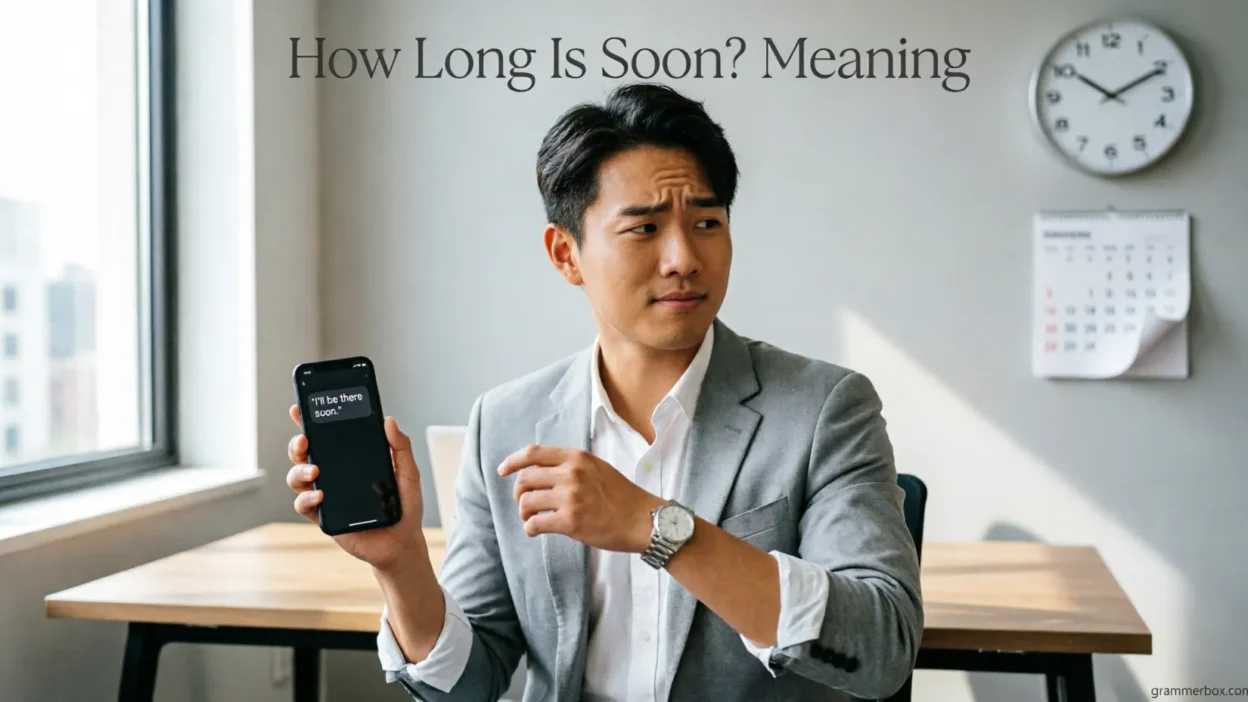
Have you ever received a message saying, “I’ll be there soon,” and wondered if that meant five minutes, an hour, or even tomorrow? The phrase how long is soon meaning is one of the most searched language questions because “soon” has no fixed definition.
Its meaning depends on the speaker, the situation, and the expectations of the people involved.
Understanding the word soon can help you communicate more clearly in conversations, emails, texts, and professional settings.
In this guide, you’ll learn what soon really means, why people often misunderstand it, how it compares with similar time expressions, and when you should use more specific wording instead.
Quick Answer
The word soon generally means in a short amount of time, but it does not refer to a specific number of minutes or hours. Depending on the situation, “soon” could mean a few minutes, later today, or even several days if the context allows. Always rely on context to understand its intended meaning.
Why People Confuse It
The word soon is intentionally flexible, which makes it useful but sometimes frustrating.
People often interpret it differently because:
- It has no official time limit.
- Different situations require different expectations.
- Personal habits influence how people use it.
- Cultural and workplace communication varies.
- Text messages often lack context.
For example:
- “Dinner will be ready soon.” (Probably 10–30 minutes.)
- “We’ll launch the feature soon.” (Possibly weeks or months.)
What Does “Soon” Mean?
Soon is an adverb that means after a short time or before long.
It suggests that something will happen relatively quickly without giving an exact time.
Examples
- I’ll call you soon.
- The meeting will begin soon.
- We hope to see results soon.
- Spring will arrive soon.
How Long Is “Soon”?
There is no universal answer.
Typical interpretations include:
| Situation | Possible Meaning of “Soon” |
|---|---|
| Text message | 5–30 minutes |
| Cooking | 10–20 minutes |
| Doctor’s office | Within the hour |
| Business email | Same day or few days |
| Project update | Days to weeks |
| Product launch | Weeks or months |
The surrounding context determines the expected timeframe.
Comparison Table
| Word | Typical Meaning | Time Precision |
|---|---|---|
| Soon | After a short time | Low |
| Immediately | Right now | Very High |
| Shortly | In a little while | Medium |
| Later | At an unspecified future time | Low |
| Eventually | After a long time | Very Low |
| Promptly | Without unnecessary delay | High |
When to Use “Soon”
Use soon when:
- The exact time is unknown.
- You expect something to happen relatively quickly.
- The precise timing is not important.
- You want natural, casual communication.
Avoid using soon if:
- A deadline matters.
- Someone needs an exact arrival time.
- Instructions require precision.
Instead of saying:
“I’ll send it soon.”
Say:
“I’ll send it by 3 PM.”
Examples of “Soon” (10+)
Here are common examples:
- I’ll be home soon.
- We’ll talk soon.
- The movie starts soon.
- Your package should arrive soon.
- She recovered soon after surgery.
- Rain will stop soon.
- They hope to expand soon.
- I’ll reply soon.
- The bus should be here soon.
- Graduation is coming soon.
- We expect an announcement soon.
- He’ll finish his homework soon.
Common Mistakes
Many English learners misuse soon in these ways:
Expecting an Exact Time
Incorrect assumption:
“Soon always means 10 minutes.”
Reality:
Its meaning changes depending on context.
Using It in Formal Deadlines
Less clear:
“The report will arrive soon.”
Better:
“The report will arrive by Friday afternoon.”
Assuming Everyone Understands It the Same Way
Different people may interpret “soon” differently.
Memory Trick
Remember this simple phrase:
If someone needs an exact time, replace soon with a specific deadline.
American vs British English
Both American English and British English use soon with the same meaning.
Minor differences may appear in conversation style, but the definition remains identical.
Examples:
- American: I’ll see you soon.
- British: I’ll see you soon.
Neither version changes the actual meaning of the word.
Similar Words
Depending on the context, you can use:
- Shortly
- Before long
- In a little while
- Presently
- Promptly
- Immediately
- Later
- Eventually
- In no time
- Right away (stronger meaning)
Each has a different level of urgency.
Final Verdict
The phrase how long is soon meaning has no single answer because soon is a relative expression. In everyday conversations, it often means within minutes or hours. In business or long-term projects, it may refer to days, weeks, or even months.
Whenever clarity matters, replacing soon with an exact date or time is always the better choice.
FAQs:
Is “soon” a specific amount of time?
No. It simply means after a short period relative to the situation.
Can “soon” mean tomorrow?
Yes. If the context supports it, tomorrow may reasonably be considered “soon.”
Does “soon” always mean within an hour?
No. It may refer to minutes, hours, days, or longer depending on the conversation.
Is “soon” formal or informal?
It works in both formal and informal English, although formal writing often benefits from more precise timing.
What is the difference between “soon” and “shortly”?
Shortly usually sounds slightly more formal and often implies a somewhat shorter wait.
Is “soon” vague?
Yes. It is intentionally vague unless additional context explains the expected timeframe.
Should I avoid using “soon” at work?
Not necessarily. However, when deadlines matter, giving an exact date or time is more professional.
Conclusion
The word soon is one of the most common yet flexible expressions in English.
Rather than referring to a fixed number of minutes or hours, it simply indicates that something is expected to happen after a relatively short period. The actual timeframe depends entirely on context, expectations, and the situation being discussed.
If you want to avoid misunderstandings, especially in professional communication, replace soon with a specific time whenever possible.
Understanding this simple distinction will help you communicate more clearly, interpret messages more accurately, and use English with greater confidence.
Remember This
“Soon” does not have a fixed time limit. It means after a short while, and its exact length always depends on the context. When precision matters, give a specific time instead of saying “soon.”