
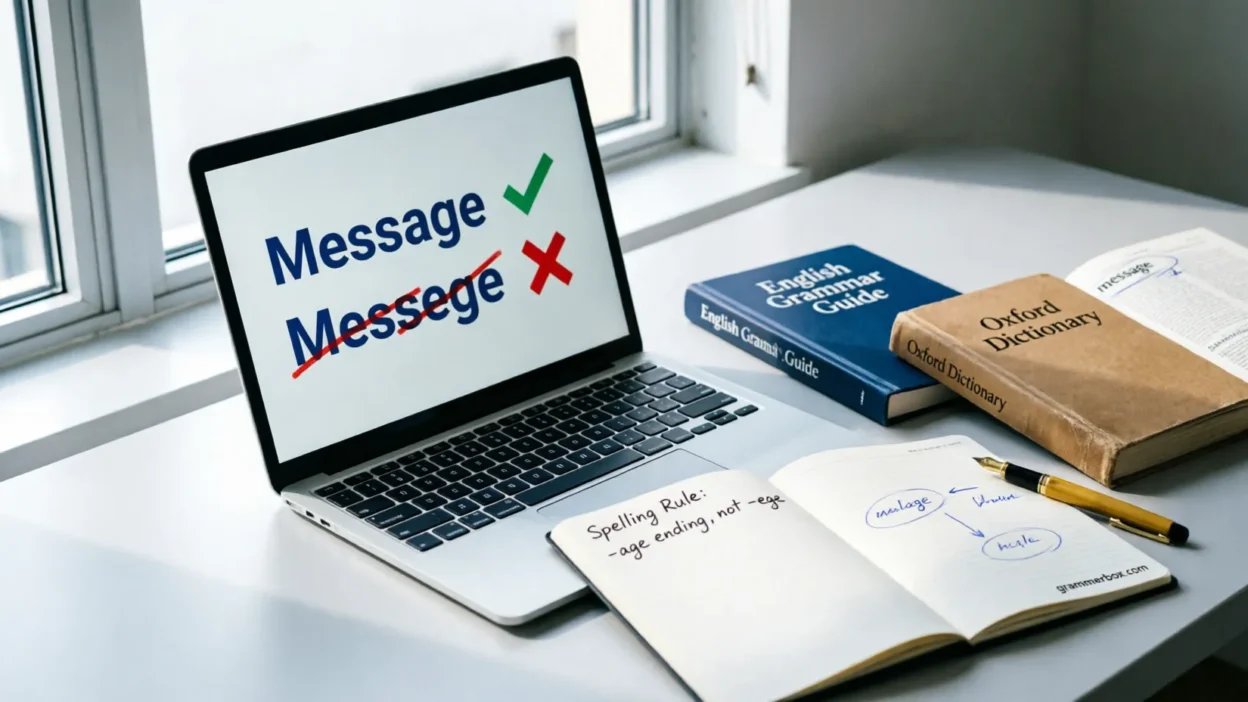
Have you ever paused while typing and wondered whether message or messege is the correct spelling? You’re not alone.
This is one of the most common English spelling mistakes because the pronunciation can make both versions seem believable. Students, professionals, and even native English speakers occasionally type the wrong form.
In reality, only one spelling is accepted in standard English. Understanding the difference helps you write more confidently in emails, text messages, essays, social media posts, and professional documents.
This guide explains message vs messege in simple language, provides memorable examples, and shares practical tricks to ensure you never confuse them again.
Quick Answer
Message is the correct English spelling. Messege is a misspelling and should never be used in formal or informal writing. Whenever you mean a written, spoken, or digital communication, always write message. Spell-check tools will also recognize message as the correct form.
Why People Confuse Message vs Messege
Many people spell message as messege because English vowels can be unpredictable. The middle sound is pronounced quickly, making it difficult to remember whether it contains “a” or “e.”
Other reasons include:
- Fast typing
- Autocorrect mistakes
- Learning English as a second language
- Phonetic spelling habits
- Lack of proofreading
Fortunately, once you know the correct spelling pattern, the confusion disappears.
Message
Message is the correct spelling.
Meaning
A message is information sent from one person to another through speech, writing, email, text, social media, or another communication method.
Examples
- I received your message this morning.
- Please leave a message after the beep.
- She sent an important message to her manager.
- Your message made my day.
- The teacher shared a motivational message.
Messege
Messege is incorrect.
It is simply a spelling mistake that appears because people replace the letter a with e.
Examples of incorrect usage:
- ❌ I sent you a messege.
- ❌ Did you read my messege?
Correct versions:
- ✅ I sent you a message.
- ✅ Did you read my message?
Message vs Messege Comparison Table
| Feature | Message | Messege |
|---|---|---|
| Correct spelling | ✅ Yes | ❌ No |
| Found in dictionaries | ✅ Yes | ❌ No |
| Used in professional writing | ✅ Yes | ❌ Never |
| Accepted in exams | ✅ Yes | ❌ No |
| Grammarly approved | ✅ Yes | ❌ No |
| Meaning | Communication sent to someone | Misspelling |
When to Use Each
Use message whenever you refer to communication.
Examples include:
- Text message
- Voice message
- Email message
- Error message
- Secret message
- Welcome message
- Marketing message
- Inspirational message
Never use messege, regardless of the context.
Examples of Message in Sentences
Here are more than ten examples showing the correct spelling.
- She replied to my message immediately.
- I forgot to read your message yesterday.
- Please send me a message later.
- His farewell message touched everyone.
- The app displayed an error message.
- I left a voice message after the call.
- Thank you for your thoughtful message.
- Your birthday message was wonderful.
- The company shared an important message with customers.
- I received your message during lunch.
- The teacher posted a message on the class website.
- Every message should be clear and polite.
Common Mistakes
Avoid these common errors:
- ❌ Messege
- ❌ Mesage
- ❌ Messsage
- ❌ Messag
- ❌ Messeege
Correct spelling:
- ✅ Message
Another common mistake is forgetting to proofread before sending emails or assignments.
Memory Trick
A simple trick is to remember:
MessAGE contains AGE.
Think of this sentence:
“As you AGE, you send more MESSAGES.”
Since AGE appears inside message, you’ll remember that the correct spelling uses A, not E.
American vs British English
There is no difference between American and British English.
| American English | British English |
|---|---|
| Message | Message |
Both varieties use the same spelling.
Similar Words
If you are learning English vocabulary, these related words may also help:
- Communication
- Note
- Text
- Letter
- Notification
- Announcement
- Memo
- Information
- Correspondence
- Statement
- Reply
These words are useful depending on the context but do not replace message in every situation.
Final Verdict
When comparing message vs messege, the answer is simple.
- Message ✅ Correct
- Messege ❌ Incorrect
If you want accurate English spelling, always choose message.
FAQs:
Is “messege” ever correct?
No. It is always considered a spelling mistake.
Which spelling should I use in school assignments?
Always use message.
Why do people write “messege”?
Mostly because they spell the word based on pronunciation or type too quickly.
Is “message” correct in British English?
Yes. British English and American English both use message.
Does Grammarly accept “messege”?
No. Grammarly marks messege as incorrect and suggests message.
Is “message” a noun?
Yes. It is primarily a noun meaning a piece of communication.
Can “message” also be a verb?
Yes. For example:
“I’ll message you tonight.”
Remember This
Only “message” is correct.
Whenever you’re writing about communication—whether it’s a text, email, letter, notification, or chat—always spell it message. If you see messege, correct it immediately because it is not an accepted English word.
Conclusion
Spelling mistakes like messege are extremely common, but they’re also easy to fix once you understand the correct form.
The only accepted spelling in modern English is message, and it is used across schools, workplaces, websites, and everyday conversations. Learning this small distinction improves both your writing accuracy and your confidence.
If you’re unsure, remember the simple memory trick that message contains “AGE.” A quick proofread before sending an email or publishing content can prevent embarrassing spelling mistakes.
By consistently using message, you’ll write clearer, more professional English every time.