
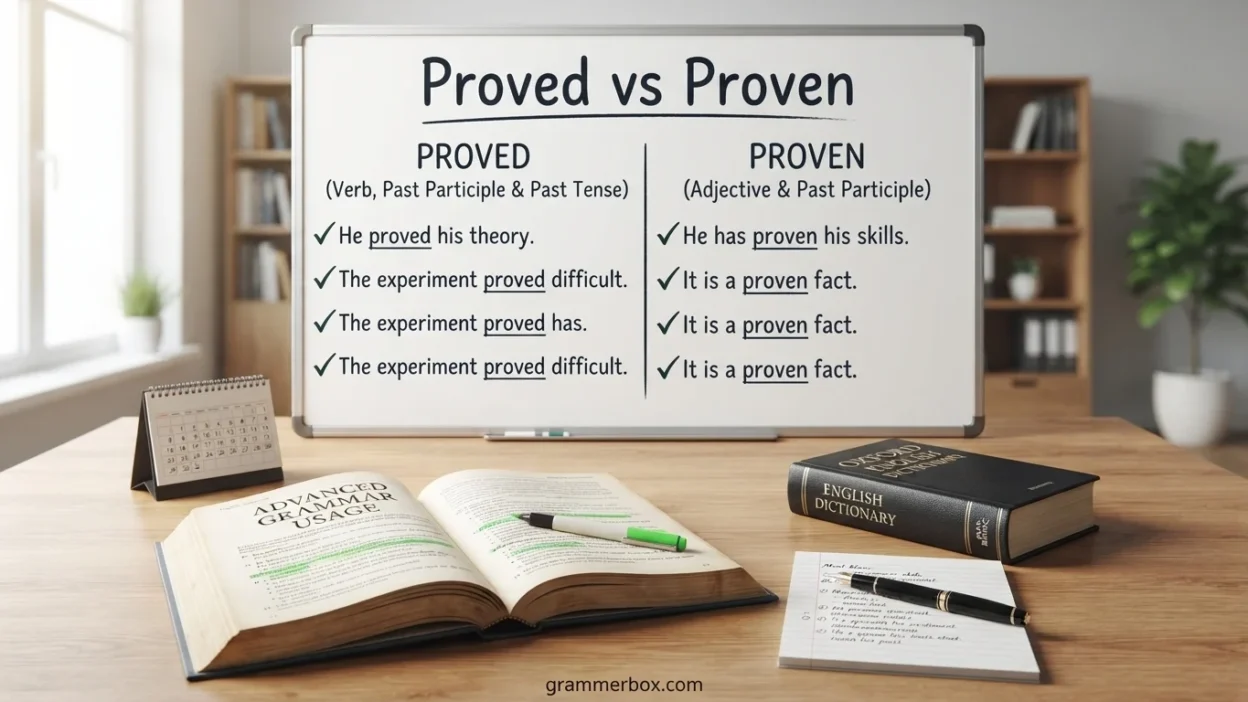
When you want to describe something that has been shown to be true, you may hesitate between proved and proven. Both words come from the verb prove, and both are accepted forms. The difference is mainly grammatical: proved can function as the simple past and past participle, while proven is commonly used as a past participle, especially before a noun or after forms of “have” and “be.” This makes the choice seem more complicated than it really is.
Understanding proved vs proven is useful for students, writers, professionals, and anyone trying to use precise English. Although the two forms often overlap, certain expressions sound much more natural with one than the other. In this guide, you’ll learn what each word means, how to use it correctly, the differences between American and British English, common mistakes to avoid, and practical examples that make the distinction easy to remember.
Quick Answer
Proved and proven are both correct forms of prove. Use proved for the simple past and past participle, while proven is especially common as a past participle and adjective. For example: “She proved her point” and “The method has proven effective” are both correct.
Why People Confuse It
People confuse proved and proven because they are both forms of the same irregular verb, prove.
The basic forms are:
- Present: prove
- Simple past: proved
- Past participle: proved or proven
The complication comes from the fact that proven is widely used as a past participle, while proved can serve as both the simple past and past participle.
For example:
- She proved her argument.
- She has proved her argument.
- She has proven her argument.
All three can be grammatically acceptable, although style and regional preference can influence which version sounds more natural.
Proved
Proved is the simple past form of prove and is also an accepted past participle.
Use proved when describing something that happened and established something as true in the past.
Examples
- The scientist proved the theory.
- Her evidence proved that he was right.
- The experiment proved successful.
- He proved his ability during the competition.
As a past participle, proved can also follow auxiliary verbs:
- The theory has been proved correct.
- Her claim was proved false.
- The method has proved useful over time.
Proved is especially common in straightforward past-tense statements.
Proven
Proven is traditionally a past participle of prove. It is particularly common in phrases where something has been demonstrated to work, succeed, or be true.
Examples include:
- a proven method
- a proven strategy
- a proven solution
- a proven technique
It is also common after auxiliary verbs:
- The strategy has proven effective.
- The treatment has proven successful.
- Her approach has proven valuable.
In modern English, proven is extremely common, particularly in American English and in professional, academic, and marketing contexts.
Proved vs Proven: Comparison Table
| Feature | Proved | Proven |
|---|---|---|
| Base verb | Prove | Prove |
| Simple past | Yes | No |
| Past participle | Yes | Yes |
| Meaning | Demonstrated as true | Demonstrated as true |
| Common use | Simple past and past participle | Past participle and adjective |
| Example | She proved her point. | She has proven her point. |
| Before a noun | Less common | Very common |
| Correct? | Yes | Yes |
The key point is that proved and proven are not competing words with completely different meanings. They are alternative forms of the verb prove, with different grammatical patterns and usage preferences.
When to Use Each
Use “proved” for the simple past
When talking about an action completed in the past, proved is the natural choice.
The evidence proved his innocence.
You would not normally say:
The evidence proven his innocence.
Use “proven” as an adjective
Before a noun, proven is especially natural:
- a proven method
- a proven expert
- a proven solution
- a proven technique
Use either after “has,” “have,” or “had”
Both forms can occur as past participles:
- The approach has proved effective.
- The approach has proven effective.
However, has proven is particularly common in contemporary English.
Examples of Proved vs Proven
Here are practical examples showing how the two forms work.
- The evidence proved that the witness was telling the truth.
- Her hard work proved worthwhile.
- The experiment proved the original hypothesis.
- He proved himself to be a capable leader.
- The new strategy has proven highly effective.
- This technique has proved useful in many situations.
- They developed a proven method for improving productivity.
- The software has proven reliable over several years.
- She proved her point with strong evidence.
- The training program has proven successful.
- His explanation was proved correct by later evidence.
- We need a proven solution rather than an untested idea.
Notice that proved is the natural choice when the sentence simply describes a completed past action. Proven becomes especially natural when it works as a participle or adjective describing something already demonstrated to be effective or true.
Common Mistakes
Mistake 1: Using “proven” as the simple past
Incorrect:
She proven her theory yesterday.
Correct:
She proved her theory yesterday.
Because the sentence uses the simple past, proved is required.
Mistake 2: Thinking “proved” is always better
Some writers assume proved is the only correct form because it is the regular-looking past form.
That is not true.
Correct:
The strategy has proven successful.
Also possible:
The strategy has proved successful.
Mistake 3: Avoiding “proven” before nouns
Proven is extremely natural as an adjective:
We used a proven technique.
Trying to replace it with “proved” can make the sentence sound less natural:
We used a proved technique.
Although “proved” can occur in some constructions, proven technique is the standard and familiar expression.
Mistake 4: Treating them as completely different words
They both come from prove and share the basic idea of demonstrating truth, validity, effectiveness, or ability.
The main difference is grammatical function and usage pattern.
Memory Trick
Think of it this way:
Proved = past action
Proven = established result
For example:
She proved her point.
She performed the action of proving.
Her method is proven effective.
The method has an established record of effectiveness.
A simple memory sentence is:
“I proved it; it is proven.”
This is not an absolute rule for every construction, but it is a useful shortcut for everyday writing.
American vs British English
Both proved and proven are used in American and British English.
However, proven is especially common in American English, particularly in expressions such as:
- proven effective
- proven successful
- proven technology
- proven method
British English also uses proven, but proved has traditionally been more common in some formal constructions.
For modern international English, neither form should automatically be considered wrong. The important thing is to use the form that fits the grammatical structure and maintain consistency with your preferred style.
Similar Words
If you’re learning the forms of prove, these related words can also cause confusion:
- Prove — present/base form
- Proved — simple past and past participle
- Proven — past participle and adjective
- Proof — noun meaning evidence that something is true
- Provable — capable of being proved
- Disprove — demonstrate that something is false
- Unproven — not yet demonstrated to be true or effective
- Demonstrate — show clearly through evidence or reasoning
- Verify — establish that something is accurate or true
- Establish — demonstrate or confirm something with evidence
For example:
Scientists need evidence to prove a claim.
The evidence proved the claim.
The theory has been proven through repeated experiments.
The researcher provided proof of the result.
FAQs
Is “proved” or “proven” correct?
Both are correct. Proved is the simple past form and can also be a past participle. Proven is also a past participle and is very common as an adjective.
Is “proven” grammatically correct?
Yes. Proven is a standard English form of prove, especially when used as a past participle or adjective.
Can I say “has proved” and “has proven”?
Yes. Both has proved and has proven are grammatically acceptable in modern English.
Is “proven” more common than “proved”?
It depends on the construction and variety of English. Proven is particularly common in phrases such as “proven effective” and “proven method,” while proved is standard for the simple past.
Which is correct: “proved effective” or “proven effective”?
Both can be correct. For example, “The treatment proved effective” and “The treatment has proven effective” are both natural, but they use different grammatical structures.
Is “proven” an adjective?
Yes. In phrases such as a proven method or a proven solution, proven functions as an adjective describing something that has demonstrated its effectiveness or reliability.
Can “proved” be a past participle?
Yes. Proved can function as both the simple past and past participle of prove.
Final Verdict
The choice between proved vs proven is mostly about grammar and usage rather than meaning. Proved is the simple past form and can also function as a past participle. Proven is another accepted past participle and is particularly common as an adjective and in constructions such as “has proven effective.”
When you’re writing, remember the basic pattern: use proved for a straightforward past action, and consider proven when describing an established quality, method, result, or achievement. Both forms are legitimate, so there is no need to treat one as universally correct and the other as incorrect.
Remember This
Proved = simple past and past participle
Proven = past participle and adjective
Examples:
- She proved her point.
- The method has proven effective.
- We chose a proven strategy.
- The experiment proved successful.
The easiest shortcut is: “I proved it; it is proven.”
Conclusion
The difference between proved and proven becomes much easier once you focus on their grammatical roles. Proved is the standard simple past form, while both proved and proven can serve as past participles. Proven is especially familiar when describing something that has already demonstrated its value, reliability, or effectiveness.
If you’re unsure which form to choose, look at the sentence structure rather than assuming one is always right. For a completed past action, proved is usually the clear choice. For an adjective such as “a proven method” or a participial phrase such as “has proven effective,” proven is often the most natural option.