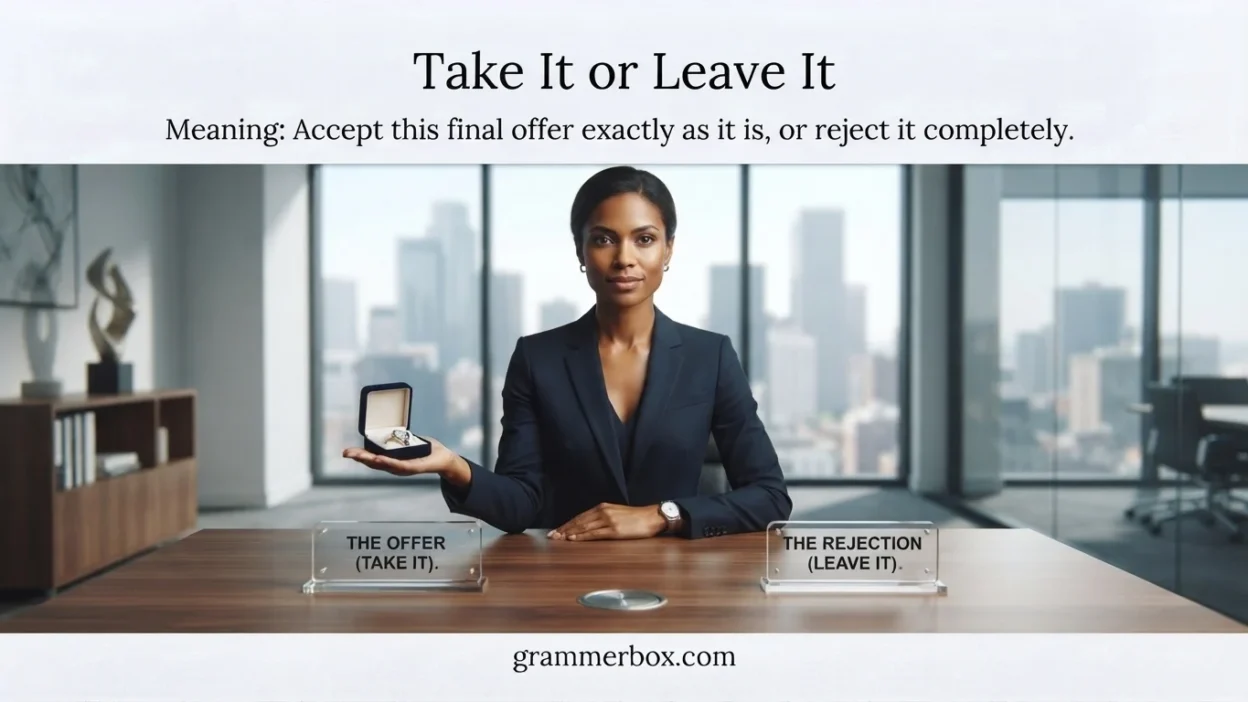
When someone says “take it or leave it,” they are usually presenting a choice with little or no room for negotiation. The phrase means that you can accept an offer, suggestion, or situation as it is, or refuse it. It can sound casual, confident, firm, or even slightly blunt depending on the context and tone.
You may hear “take it or leave it” in everyday conversations, business negotiations, sales, relationships, and informal discussions. For example, someone might say, “I’ll sell it to you for $50—take it or leave it.” Understanding this idiom helps you recognize when a speaker is offering a final choice rather than inviting further discussion. In this guide, we’ll explore its meaning, grammar, correct usage, examples, common mistakes, and how it compares with similar expressions.
Quick Answer
“Take it or leave it” means accept an offer or proposal as it is, or refuse it. It often suggests that the speaker is unwilling to negotiate or make changes. It can be used for prices, deals, suggestions, conditions, and other choices.
Why People Confuse It
People sometimes misunderstand “take it or leave it” because its literal meaning sounds incomplete. Taken word for word, it simply describes taking or leaving something. As an idiomatic expression, however, it communicates a much stronger idea.
The phrase usually implies:
- Accept the offer as presented.
- Reject it if you do not want it.
- Do not expect the speaker to change the terms.
For example:
“The job pays $20 an hour, take it or leave it.”
This does not simply mean “decide whether you want the job.” It suggests that $20 an hour is the final offer.
The tone matters, too. A friendly speaker may use the expression casually, while a frustrated or demanding speaker may make it sound like an ultimatum.
First Word: “Take”
Take is a verb meaning to accept, receive, choose, or obtain something.
In “take it or leave it,” “take it” means accept the offer or situation.
Examples
- “Here’s my offer. Take it.”
- “You can take the position if you want.”
- “I’m offering you $100. Take it or leave it.”
The word it refers to whatever has already been mentioned, such as an offer, deal, price, suggestion, or opportunity.
Second Word: “Leave”
Leave is the opposite choice in this expression. Here, it means reject, refuse, or walk away from the offer.
For example:
“The price is $500, and I won’t negotiate. Take it or leave it.”
The listener can either accept the $500 price or reject the deal.
The expression therefore creates a simple two-option structure:
Take it = accept it
Leave it = reject it
Comparison Table
| Expression | Meaning | Tone | Example |
|---|---|---|---|
| Take it or leave it | Accept or reject without changes | Firm | “That’s my final price—take it or leave it.” |
| Accept or decline | Choose whether to accept | Neutral/formal | “You can accept or decline the invitation.” |
| Your choice | The decision is yours | Neutral | “It’s your choice.” |
| Up to you | You decide | Casual | “It’s up to you whether you come.” |
| Final offer | No further negotiation | Firm/businesslike | “This is our final offer.” |
| Deal or no deal | Accept or reject a deal | Informal | “That’s the price. Deal or no deal?” |
When to Use Each
Use “take it or leave it” for firm offers
Use it when you want to make clear that the terms are not negotiable.
“I can do the work for $300. Take it or leave it.”
Use “up to you” for a neutral choice
If you genuinely want another person to decide freely, “up to you” sounds less forceful.
“We can eat at six or seven. It’s up to you.”
Use “final offer” in negotiations
“Final offer” is particularly useful in business or formal negotiations.
“This is our final offer, and we cannot increase the amount.”
Use “accept or decline” in formal writing
This expression works well for professional and administrative situations.
“You may accept or decline the invitation by Friday.”
Examples of “Take It or Leave It”
Here are natural examples showing how the idiom works in everyday English:
- “I’ll sell you the bike for $200—take it or leave it.”
- “This is the schedule we have, so take it or leave it.”
- “I can offer you $500 for the project. Take it or leave it.”
- “The apartment is available at that price, take it or leave it.”
- “That’s my best deal. Take it or leave it.”
- “I’m willing to help, but these are my conditions—take it or leave it.”
- “You can have the last slice, but you have to decide now. Take it or leave it.”
- “The seller says $1,000 is the final price. Take it or leave it.”
- “I’ll give you until Friday to decide. Take it or leave it.”
- “I can finish the work by Monday for $400. Take it or leave it.”
- “That’s the only room available, so take it or leave it.”
- “I’ve made my proposal. Take it or leave it.”
- “We can give you a 10% discount, but that’s it—take it or leave it.”
- “He offered me the position with no flexibility. It was basically take it or leave it.”
Common Mistakes
1. Changing the phrase unnecessarily
The standard expression is:
“Take it or leave it.”
Avoid awkward variations such as:
- “Take or leave it.”
- “Take it and leave it.”
“Take it or leave it” is the established idiomatic form.
2. Thinking it always sounds polite
The phrase can sound blunt or demanding, especially in sensitive conversations.
Instead of:
“Take it or leave it!”
you might say:
“That’s the best I can offer, but I understand if it doesn’t work for you.”
The second version is more diplomatic.
3. Using it when negotiation is expected
If you are genuinely open to changing your offer, “take it or leave it” may send the wrong message.
The idiom generally suggests that the terms are fixed.
4. Assuming “leave it” means physically walking away
In this idiom, “leave it” usually means reject or decline the offer, not necessarily leave a physical object somewhere.
Memory Trick
Think of “take” and “leave” as two doors:
- 🚪 Take it → Yes, I accept.
- 🚪 Leave it → No, I reject it.
The speaker is essentially saying:
“This is the offer. You can accept it as it stands or refuse it.”
A simple formula to remember is:
Take = accept
Leave = reject
American vs. British English
“Take it or leave it” is common and understandable in both American English and British English.
There is no major difference in its basic meaning or grammar between the two varieties.
The main difference is more likely to come from context and tone. In either variety, the expression can sound firm, especially when used during a negotiation.
For example:
“That’s my final price—take it or leave it.”
An American or British speaker would generally understand this as meaning that the price is not open to further negotiation.
Similar Words and Expressions
Several expressions have a similar meaning, but their tone can differ.
“Take it or leave it”
Means the offer is firm and usually non-negotiable.
“Up to you”
Means the other person can decide. It is generally softer.
“Your choice”
Emphasizes that the decision belongs to the other person.
“Final offer”
Clearly signals that no further changes are expected.
“Accept or decline”
A neutral and formal way to describe two choices.
“Deal or no deal”
An informal way of asking whether someone accepts a proposed deal.
“My way or the highway”
This is much stronger. It means someone must follow your terms or leave the situation.
FAQs:
1. What does “take it or leave it” mean?
It means accept an offer or proposal as it is, or reject it. The expression often indicates that the speaker is unwilling to negotiate further.
2. Is “take it or leave it” rude?
It can be. The phrase is not inherently rude, but it often sounds firm, blunt, or demanding. Tone and context determine how it is received.
3. Is “take it or leave it” an idiom?
Yes. “Take it or leave it” is an English idiom meaning that someone must accept an offer as presented or refuse it.
4. What is another way to say “take it or leave it”?
Depending on the situation, you can say “This is my final offer,” “accept or decline,” “that’s the best I can do,” or “the choice is yours.”
5. Does “take it or leave it” mean no negotiation?
Usually, yes. It strongly suggests that the terms are fixed and the speaker does not want to negotiate.
6. Can I use “take it or leave it” in formal writing?
You can, but it may sound too blunt in some professional contexts. A phrase such as “This is our final offer” may be more appropriate.
7. What does “leave it” mean in this phrase?
“Leave it” means reject or decline the offer. It does not usually mean physically leaving something behind.
Final Verdict
“Take it or leave it” is a common English idiom used when someone offers a choice with fixed terms. It means accept the offer as it stands or reject it.
The expression is especially common in negotiations, sales, offers, decisions, and everyday conversations. Remember that although it is grammatically simple, its tone can be quite firm.
Remember This
Take it or leave it = Accept it as offered or reject it.
Use it when you want to communicate that there is little or no room for negotiation. If you want to sound more polite, try “That’s the best I can offer” or “The choice is yours.”
Conclusion
Understanding “take it or leave it” is useful because the phrase carries more than its literal meaning. It tells the listener that an offer, proposal, or set of conditions is essentially fixed. Accepting means agreeing to the terms; leaving means declining them.
When using this idiom yourself, pay attention to tone. It works naturally in casual conversations and negotiations, but it can sound harsh when someone is expecting flexibility. Choosing a softer alternative can make your English sound more diplomatic while preserving the same basic message.