If you have ever described liquid, paint, mud, or blood hitting a surface, you may have wondered whether spatter or splatter is the better word. The two terms are closely related, and in many everyday sentences, either one can sound perfectly natural. However, there is a subtle difference in how they are commonly used and what they suggest about the pattern or amount of material involved.
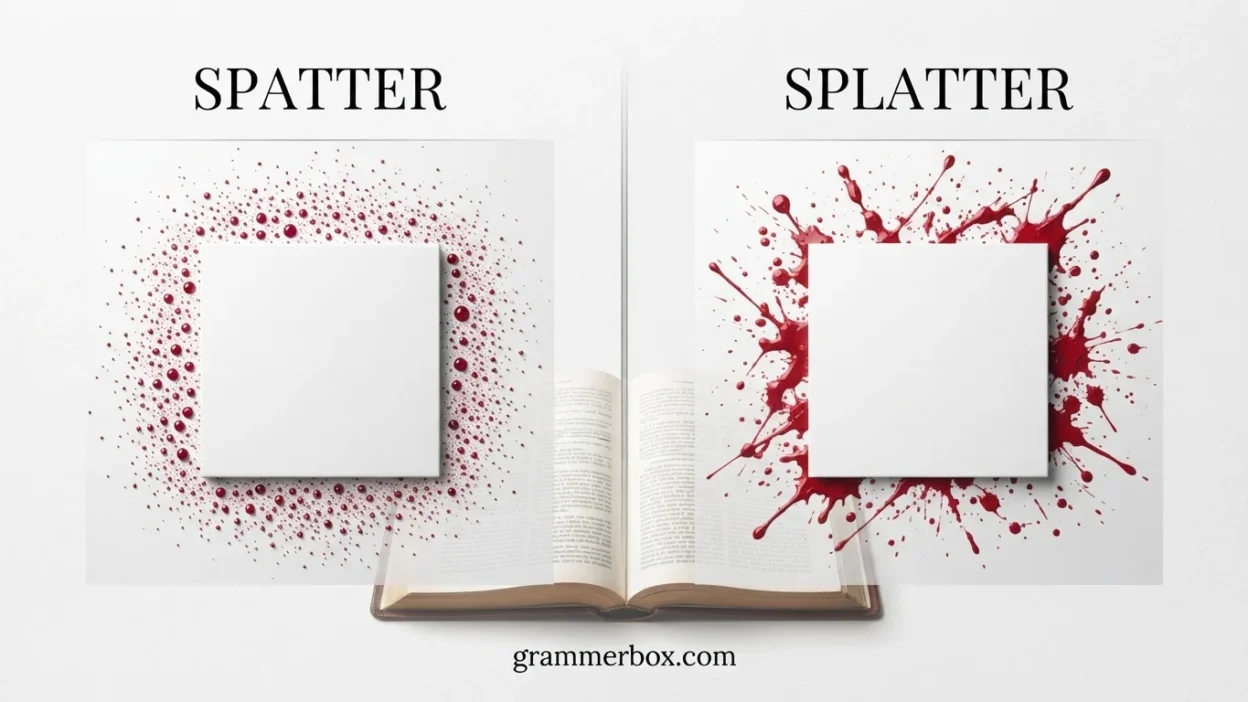
Spatter vs splatter is especially confusing because both words can function as verbs and nouns. Generally, spatter suggests small drops or scattered spots of liquid, while splatter often suggests larger, more noticeable, or messier drops scattered over an area. Understanding this distinction can help you choose the most precise word in writing, conversation, and descriptive contexts.
Quick Answer
Spatter usually means small drops scattered or sprinkled over a surface. Splatter often suggests larger, messier, or more forcefully scattered drops. Both can describe liquid, paint, mud, or other substances, and their meanings frequently overlap.
Why People Confuse It
The confusion comes from the fact that spatter and splatter share nearly the same basic meaning: something liquid or semi-liquid is scattered in drops.
For example:
- Paint can spatter a wall.
- Paint can splatter a wall.
- Mud can spatter your shoes.
- Mud can splatter your shoes.
Both are grammatically correct. The main difference is the impression created by the word.
Spatter tends to emphasize scattered small drops or spots.
Splatter tends to emphasize a messier, more dramatic, or heavier scattering of drops.
The distinction is not absolute, so context matters.
Spatter: Meaning and Usage
Spatter means to scatter small drops of liquid or another substance over a surface or nearby area.
As a verb, it describes the action:
- The rain spattered against the window.
- Mud spattered my trousers.
- The artist spattered paint across the canvas.
As a noun, spatter refers to the drops or marks themselves:
- There was spatter on the floor.
- The shirt was covered in paint spatter.
When to Use “Spatter”
Use spatter when you want to emphasize:
- Small scattered drops
- Specks or spots
- Light or incidental distribution
- A pattern of droplets
- Liquid landing on nearby surfaces
It can sound relatively neutral and is common in technical, scientific, artistic, and descriptive contexts.
Splatter: Meaning and Usage
Splatter also means to scatter drops of liquid or another substance, but it often creates a stronger image of something messy, forceful, or abundant.
As a verb:
- The car splattered mud onto the sidewalk.
- Sauce splattered across the stove.
- The children splattered paint everywhere.
As a noun:
- The kitchen floor was covered in splatter.
- There was tomato-sauce splatter on the counter.
When to Use “Splatter”
Use splatter when the situation suggests:
- A larger or messier spread
- Forceful movement
- Numerous visible drops
- A sudden burst of liquid
- A dramatic or untidy result
The word is particularly common when describing cooking messes, mud, paint, and other substances thrown or scattered with force.
Spatter vs Splatter: Comparison Table
| Feature | Spatter | Splatter |
|---|---|---|
| Basic meaning | Scatter small drops | Scatter drops messily or forcefully |
| Common image | Small spots or droplets | Larger, messier spread |
| Tone | More neutral | More vivid or dramatic |
| Verb | Yes | Yes |
| Noun | Yes | Yes |
| Common with | Rain, paint, mud, liquid | Paint, mud, sauce, liquid |
| Suggests force? | Not necessarily | Often |
| Always interchangeable? | Often, but not always | Often, but not always |
When to Use Each
A useful rule is to think about the size, force, and messiness of the drops.
Choose “spatter” when:
You are describing small droplets scattered across something.
The rain began to spatter the windshield.
The emphasis is on the individual drops.
Choose “splatter” when:
You are describing a messier or more forceful scattering.
The puddle splattered mud all over the car.
Here, splatter makes the action feel more dramatic and messy.
An important point
There is no strict scientific boundary between these words. Native speakers frequently use them interchangeably, especially in casual conversation.
Spatter vs Splatter Examples
Here are practical examples showing how each word works.
Examples with “Spatter”
- Tiny drops of rain spattered the glass.
- Mud spattered the bottom of his jeans.
- The painter spattered blue paint onto the canvas.
- Water spattered across the kitchen floor.
- The storm caused rain to spatter against the roof.
- There was a little paint spatter on the table.
- Oil spattered when it hit the hot pan.
- The puddle left spatter marks on my shoes.
- Waves spattered the passengers with seawater.
- The artist added white spatter to the background.
Examples with “Splatter”
- The car splattered mud across my coat.
- Hot oil splattered onto the countertop.
- Tomato sauce splattered all over the stove.
- The children splattered paint across the floor.
- The truck drove through a puddle and splattered water everywhere.
- The muddy tires splattered the side of the vehicle.
- Paint splatter covered the artist’s apron.
- The pan sent grease splattering across the kitchen.
- The machine splattered liquid onto the wall.
- A wave splattered seawater over the deck.
Common Mistakes
Mistake 1: Assuming only one word is correct
Both spatter and splatter are standard English words.
Incorrect idea:
“Splatter” is wrong because “spatter” is the real word.
Better understanding:
Both words are legitimate; they simply carry slightly different associations.
Mistake 2: Treating the difference as absolute
You should not assume that spatter always means tiny drops and splatter always means huge drops.
The distinction is mainly about connotation and emphasis, not a fixed measurement.
Mistake 3: Using “splatter” when a neutral description is better
If you are writing a technical or scientific description, spatter may sound more neutral.
For example:
The surface contained small droplets of water spatter.
Mistake 4: Thinking “spatter” cannot describe messy situations
Spatter can absolutely describe something messy.
Mud spattered the windshield.
The word simply does not necessarily emphasize the dramatic messiness as strongly as splatter can.
Memory Trick
Here is an easy way to remember the difference:
Spatter = small spots.
Splatter = bigger, messier spread.
Think of the extra “l” in splatter as giving the word a little more “loud” action.
- Spatter → scattered drops
- Splatter → scattered, messy drops
This is only a memory aid, not a strict grammatical rule.
American vs British English
There is no major American-versus-British distinction that makes one word correct and the other incorrect.
Both spatter and splatter are used in American and British English.
The difference is primarily one of meaning, emphasis, and context, rather than geography.
You may encounter spatter in more technical or descriptive contexts, while splatter can feel more vivid and informal. However, usage varies considerably depending on the subject and speaker.
Similar Words
Several English words are related to spatter and splatter.
Sprinkle
Sprinkle usually means distributing small amounts of something over an area.
She sprinkled water on the plants.
Splash
Splash often involves a larger amount of liquid moving or striking a surface.
Water splashed onto the floor.
Spray
Spray describes liquid being distributed in very small droplets, often through pressure or a nozzle.
The bottle sprayed water onto the leaves.
Scatter
Scatter is a broad term meaning to distribute things over an area.
The wind scattered leaves across the yard.
Spritz
Spritz generally means to spray a small amount of liquid.
She spritzed perfume onto her wrist.
Smear
Smear involves spreading a substance across a surface rather than scattering it into droplets.
He smeared paint across the paper.
FAQs:
Is “spatter” the same as “splatter”?
They are very similar and are often interchangeable. Spatter commonly suggests scattered small drops, while splatter can suggest a messier or more forceful spread.
Is it “paint spatter” or “paint splatter”?
Both are correct. Paint spatter can sound more neutral and focused on scattered droplets, while paint splatter often emphasizes a messy or energetic distribution.
Is “blood spatter” or “blood splatter” correct?
Both expressions occur in English. Blood spatter is especially common in forensic and technical contexts, where the focus is on droplets and their patterns.
What is the difference between spatter and splash?
A splash generally involves a larger quantity of liquid moving or striking a surface. Spatter emphasizes smaller drops scattered around an area.
Can “spatter” be a noun?
Yes. For example:
There was paint spatter on the floor.
Can “splatter” be a noun?
Yes. For example:
The wall was covered with paint splatter.
Which word should I use in formal writing?
Both can be correct. If you are describing small droplets or using technical language, spatter is often the more neutral choice. Use splatter when the messy or forceful quality is important.
Final Verdict
Spatter and splatter are both correct English words with overlapping meanings. The key difference is the feeling they create. Spatter commonly refers to small drops or scattered spots, while splatter often suggests a more forceful, abundant, or messy distribution.
When you’re unsure, look at the context rather than searching for a rigid rule. If you are describing small droplets or a neutral pattern, spatter is a natural choice. If you want to emphasize a dramatic mess, splatter may be more expressive.
Remember This
- Spatter = small, scattered drops or spots.
- Splatter = drops scattered in a messier or more forceful way.
- Both can be nouns and verbs.
- Both are used in American and British English.
- The distinction is about usage and emphasis, not a strict grammatical rule.
- In many everyday sentences, either word can work.
Conclusion
Understanding spatter vs splatter does not require memorizing a complicated rule. Both words describe substances being scattered in drops, but spatter often gives a more neutral impression of small droplets, while splatter tends to highlight messiness, force, or a more dramatic spread.
If you’re writing about rain, paint, mud, sauce, or another liquid, consider what you want the reader to picture. Choose spatter for scattered droplets and splatter when you want a stronger sense of action or mess. When the context allows both, either choice can be perfectly natural.