
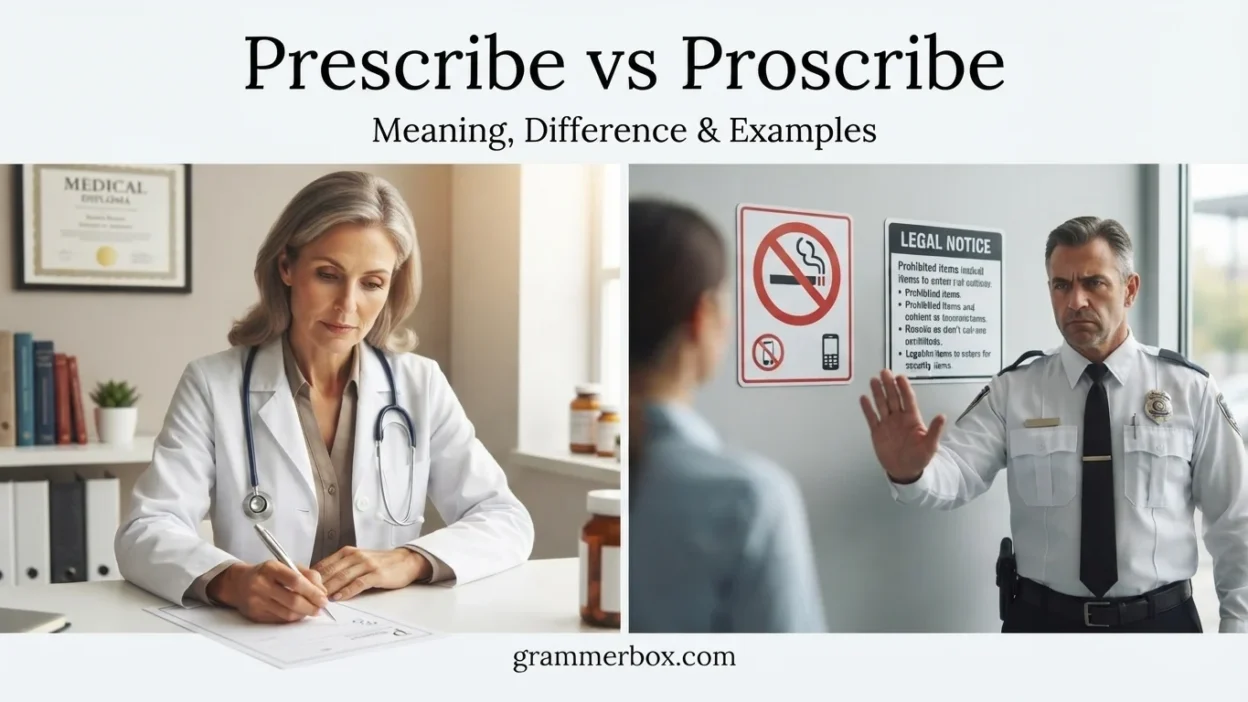
If you have ever confused prescribe vs proscribe, you are not alone. These two words look and sound remarkably similar, but their meanings point in completely different directions. One is commonly associated with doctors, rules, and recommendations, while the other means to officially forbid or prohibit something. A single letter can completely change the meaning of a sentence.
Understanding the difference between prescribe and proscribe is especially important in formal writing, academic English, medicine, law, and professional communication. In this guide, you will learn what each word means, how to use it correctly, and how to avoid common mistakes. You will also find clear examples, a comparison table, memory tricks, and answers to frequently asked questions so you can confidently choose the right word whenever you encounter this easily confused pair.
Quick Answer
Prescribe means to recommend, order, or officially establish something, especially medicine or rules. Proscribe means to officially forbid or ban something. Remember: doctors prescribe medicine, while authorities may proscribe certain activities.
Why People Confuse It
The confusion comes mainly from the nearly identical spelling and pronunciation of these words.
Both words contain scribe, which comes from a Latin root related to writing. Their prefixes, however, give them different meanings:
- Pre- = before → prescribe = lay down or order in advance.
- Pro- in proscribe developed into the sense of publicly declaring something forbidden.
- Both are formal words, so you may encounter them in similar contexts involving rules, instructions, policies, or authority.
The biggest mistake is assuming that proscribe is simply a less common spelling of prescribe. It is not.
Prescribe: Meaning and Usage
Prescribe is a verb meaning to officially recommend, order, or establish something.
The word is most familiar in medical contexts. A doctor can prescribe medication, treatment, exercise, or a particular course of action.
Common meanings of prescribe
- To order medicine for a patient
- To recommend a treatment
- To specify what should be done
- To officially establish a rule or requirement
Examples
- The doctor prescribed antibiotics for the infection.
- She was prescribed a lower dose of the medication.
- The therapist prescribed several exercises.
- The law prescribes strict safety standards.
- The instructions prescribe a specific procedure.
In simple terms, prescribe generally tells you what should be done.
Proscribe: Meaning and Usage
Proscribe means to officially forbid, ban, or prohibit something.
It is much less common in everyday conversation than prescribe, but it appears frequently in formal, legal, political, and academic writing.
Common meanings of proscribe
- To prohibit something officially
- To ban an activity or practice
- To declare something unacceptable or forbidden
Examples
- The organization proscribed the use of unauthorized equipment.
- The government proscribed certain activities.
- The rules proscribe discrimination in the workplace.
- The policy proscribes the disclosure of confidential information.
- The school has proscribed bullying and harassment.
In simple terms, proscribe tells you what must not be done.
Prescribe vs Proscribe: Comparison Table
| Feature | Prescribe | Proscribe |
|---|---|---|
| Meaning | Recommend, order, or establish | Forbid, ban, or prohibit |
| Typical context | Medicine, instructions, rules | Laws, policies, regulations |
| Basic idea | Say what should happen | Say what must not happen |
| Example | The doctor prescribed medication. | The law proscribes discrimination. |
| Opposite idea | Permit/recommend | Allow/permit |
| Part of speech | Verb | Verb |
| Commonness | Very common | Less common, more formal |
The easiest distinction
This distinction is not perfect for every context, but it works well as a quick guide.
When to Use Each
Use “prescribe” when:
Use prescribe when someone with authority recommends, orders, or establishes something.
Common collocations include:
- prescribe medication
- prescribe treatment
- prescribe antibiotics
- prescribe exercise
- prescribe a course of action
- prescribe standards
- prescribe requirements
- prescribe procedures
Example:
The doctor prescribed two weeks of rest.
Use “proscribe” when:
Use proscribe when an authority officially prohibits something.
Common collocations include:
- proscribe an activity
- proscribe discrimination
- proscribe behavior
- proscribe a practice
- proscribe certain conduct
- proscribe the use of something
Example:
The regulations proscribe the unauthorized use of company data.
Prescribe vs Proscribe: 12 Clear Examples
- The doctor prescribed medication for her condition.
- The law proscribes discrimination based on certain characteristics.
- The physician prescribed a daily exercise routine.
- The school rules proscribe violent behavior.
- The doctor prescribed a different treatment.
- The regulations proscribe the unauthorized release of information.
- The veterinarian prescribed medicine for the dog.
- The policy proscribes the use of personal devices in restricted areas.
- The doctor prescribed three days of rest.
- The organization proscribed conduct that violated its code of ethics.
- The instructions prescribe the steps workers should follow.
- The regulations proscribe activities that could endanger employees.
Notice the central difference: prescribe establishes or recommends something to be followed, while proscribe establishes something that must not be followed or permitted.
Common Mistakes
Mistake 1: Using “proscribe” when you mean “prescribe”
❌ The doctor proscribed antibiotics.
✅ The doctor prescribed antibiotics.
A doctor normally prescribes medicine rather than proscribing it.
Mistake 2: Thinking “proscribe” means recommend
❌ The doctor proscribed a treatment plan.
✅ The doctor prescribed a treatment plan.
Proscribe means to prohibit, not recommend.
Mistake 3: Assuming “prescribe” always refers to medicine
Although medical usage is extremely common, prescribe can also mean to establish rules or requirements.
Example:
The regulations prescribe minimum safety standards.
Mistake 4: Confusing “proscribe” with “prescribe” because of pronunciation
The words are similar enough that listening alone may not always make the distinction obvious. Consider the context carefully.
Memory Trick: Prescribe vs Proscribe
Try this simple trick:
PREscribe = PREpare a plan
Think of a doctor preparing a treatment plan and prescribing medicine.
PROscribe = PROhibit
Both proscribe and prohibit begin with pro-, making this a useful memory association.
Remember:
Prescribe → provide/order something.
Proscribe → prohibit something.
Another quick example:
A doctor prescribes a pill.
A law proscribes an activity.
American vs British English
There is no major difference in meaning between American and British English for prescribe and proscribe.
Both varieties use:
- prescribe for ordering or recommending treatment and for establishing requirements.
- proscribe for officially forbidding or banning something.
The main difference is frequency and context rather than meaning. Prescribe is common in everyday medical English in both varieties, while proscribe tends to appear in formal, legal, academic, or institutional writing.
Similar Words
Knowing related words can make the distinction easier.
Words similar to “prescribe”
- recommend
- order
- advise
- direct
- specify
- stipulate
- require
- establish
Words similar to “proscribe”
- prohibit
- ban
- forbid
- outlaw
- disallow
- restrict
- prevent
- prohibit
Be careful with prescribe and proscribe because their synonyms reveal their opposite directions:
Prescribe → recommend/order
Proscribe → prohibit/ban
FAQs:
Is “proscribe” the opposite of “prescribe”?
Not exactly in every context, but they have contrasting meanings. Prescribe means to recommend, order, or establish something, whereas proscribe means to officially prohibit something.
Does a doctor prescribe or proscribe medicine?
A doctor prescribes medicine. For example, “The doctor prescribed antibiotics.”
What does proscribe mean in simple English?
Proscribe means to officially ban or forbid something.
Can “prescribe” be used outside medicine?
Yes. It can mean to officially establish a rule, requirement, procedure, or standard.
Example: The regulations prescribe specific safety measures.
Is “proscribe” a common English word?
It is a legitimate English word, but it is considerably less common than prescribe. You are more likely to see it in formal, legal, academic, or policy-related writing.
What is an easy way to remember prescribe vs proscribe?
Think prescribe = recommend/order and proscribe = prohibit. A doctor prescribes medicine; a rule may proscribe certain behavior.
Are prescribe and proscribe pronounced the same?
No. Their pronunciations are similar but not identical. In both cases, paying attention to the spelling and context helps prevent confusion.
Final Verdict
The difference between prescribe vs proscribe becomes simple once you focus on their actions. Prescribe means to recommend, order, or establish something. It is especially common when talking about medical treatment, but it can also describe rules and requirements.
Proscribe, on the other hand, means to officially prohibit or ban something. If you remember “prescribe = recommend/order” and “proscribe = prohibit,” you will have a reliable way to distinguish them in everyday and formal English.
Remember This
Prescribe = recommend, order, or establish.
Proscribe = prohibit, ban, or forbid.
Doctor → prescribes medicine.
Authority → proscribes prohibited behavior.
Conclusion
Although prescribe and proscribe look almost identical, they communicate very different ideas. Prescribe is about telling someone what should be done or establishing what is required, while proscribe is about officially saying what is not allowed. Recognizing that difference will help you avoid an especially tricky vocabulary mistake.
When choosing between the two, ask yourself one simple question: Am I talking about something being recommended or required, or something being forbidden? If it is recommended or ordered, choose prescribe. If it is prohibited or banned, choose proscribe.