
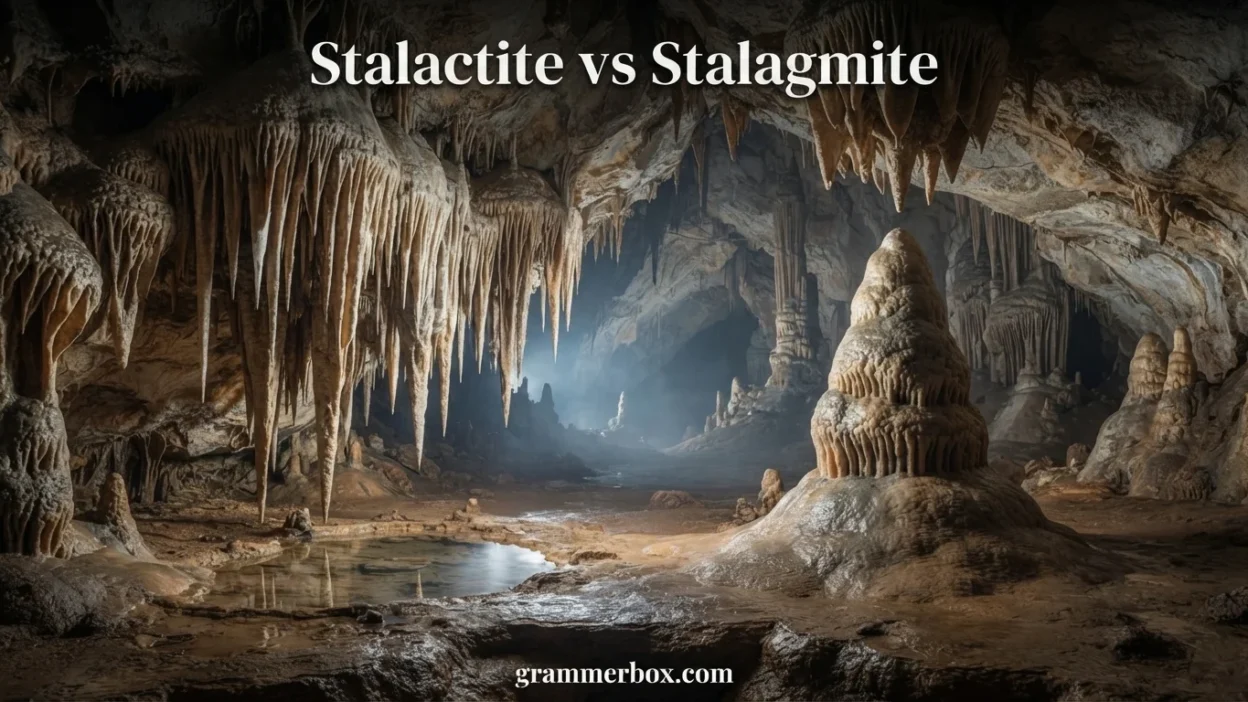
When I have visited caves, I have noticed that Stalactites vs Stalagmites can cause confusion, especially when people see these natural speleothems. These structures develop inside a cave, and their position helps explain the main difference. Stalactites arise from the ceiling, while stalagmites grow from the floor. Looking at photos can make these vertical shapes easier to recognize, particularly when comparing ceiling structures with floor structures.
The formation of these types of speleothems depends on how they form over time. A stalactite hangs downward from the ceiling, while a stalagmite rises upward from the floor. Their vertical growth provides a simple way to remember the difference between stalactites and stalagmites. When explaining stalactites vs stalagmites, I focus on their location first because it removes much of the doubt surrounding these cave structures.
There are many interesting curiosities about these natural types of formations, but the basic idea remains simple. Stalactites connect with the ceiling, while stalagmites connect with the floor. Once you understand this distinction, the form and formation of each become easier to recognize, whether you see them inside real caves or in photos.
Quick Answer
A stalactite is a mineral formation that hangs from the ceiling of a cave, while a stalagmite rises from the cave floor. Both usually form when mineral-rich water deposits minerals over long periods.
Why People Confuse It
People often confuse stalactite vs stalagmite because the words are nearly identical in spelling and pronunciation. Both begin with “stalac-” and describe mineral formations found in caves.
The biggest difference is their direction of growth:
- Stalactite → grows down from the ceiling
- Stalagmite → grows up from the floor
Another reason for confusion is that both formations can appear together. A stalactite may eventually meet a stalagmite as they continue growing, creating a column or pillar.
First Word: Stalactite
A stalactite is a mineral deposit that hangs downward from the roof or ceiling of a cave.
It commonly forms when groundwater moves through cracks in limestone. As the water reaches the cave ceiling and drips downward, it can leave behind small amounts of minerals such as calcium carbonate. Over a very long period, these deposits accumulate and create a hanging formation.
Examples of Stalactite
- The cave ceiling was covered with beautiful stalactites.
- Water slowly dripped from the stalactite above us.
- The guide warned us not to touch the delicate stalactites.
- A large stalactite hung above the underground passage.
- The photograph showed dozens of thin stalactites.
A stalactite can look like an icicle hanging from the ceiling, although it is made from minerals rather than frozen water.
Second Word: Stalagmite
A stalagmite is a mineral formation that rises upward from the floor of a cave.
When mineral-rich water drips from the ceiling, it may land on the cave floor. Over time, the minerals left behind can accumulate into a mound or column that grows upward. This formation is called a stalagmite.
Examples of Stalagmite
- A tall stalagmite stood in the middle of the cave.
- The children admired the unusual shape of the stalagmites.
- The guide pointed to a newly forming stalagmite.
- The cave floor contained several large stalagmites.
- Scientists measured the growth of a stalagmite over several years.
Stalagmites generally grow from the ground upward, making them the floor-based counterpart of stalactites.
Comparison Table
| Feature | Stalactite | Stalagmite |
| Location | Cave ceiling | Cave floor |
| Direction | Grows downward | Grows upward |
| Formation | Mineral deposits from dripping water | Mineral deposits accumulating on the floor |
| Appearance | Often resembles an upside-down icicle | Often resembles a mound or upward-growing column |
| Memory clue | Ceiling | Ground |
| Can they connect? | Yes | Yes |
| Common setting | Caves and underground chambers | Caves and underground chambers |
When to Use Each
Use stalactite when you are talking about a formation hanging from the ceiling of a cave.
The stalactite hung from the cave roof.
Use stalagmite when you are describing a formation growing upward from the floor.
The stalagmite rose from the cave floor.
A useful way to think about the distinction is to focus on where the formation starts:
- Ceiling → stalactite
- Ground → stalagmite
Examples of Stalactite vs Stalagmite
- The cave ceiling was filled with long stalactites.
- Several stalagmites rose from the damp cave floor.
- The guide showed us a huge stalactite hanging above the path.
- A pointed stalagmite stood directly beneath a small stalactite.
- The underground chamber contained both stalactites and stalagmites.
- Visitors were asked not to touch the fragile stalactites.
- The scientists studied how quickly the stalagmite was growing.
- Water dripped from the stalactite onto the cave floor.
- The large stalagmite had developed over thousands of years.
- The two formations eventually joined and created a natural column.
- The photographer captured the dramatic stalactites above the cavern.
- The cave floor was covered with unusual stalagmites.
Common Mistakes
1. Thinking both words mean the same thing
They are related terms, but they refer to formations in different locations.
Incorrect: “The stalactite was growing from the cave floor.”
Correct: “The stalagmite was growing from the cave floor.”
2. Mixing up ceiling and floor
This is the most common mistake. Remember that stalactites hang down, while stalagmites grow up.
3. Assuming every cave formation is a stalactite
Caves can contain many different mineral formations. A formation growing upward from the floor is a stalagmite, not a stalactite.
4. Forgetting that both can form from dripping water
The formation process involves mineral-rich water in both cases, but the resulting deposits develop in different places.
5. Spelling the words incorrectly
Because the terms are so similar, common misspellings can occur. Pay attention to the -tite and -mite endings.
Memory Trick
The easiest memory trick is:
Stalactites hold tight to the ceiling.
Think of the “C” in ceiling and remember that a stalactite hangs from above.
For stalagmites, think:
Stalagmites might grow up from the ground.
Another popular memory aid is:
Stalactites hang tight. Stalagmites might reach the ceiling.
So:
- Stalactite = ceiling
- Stalagmite = ground
If you remember only one thing, remember that stalactites come down and stalagmites go up.
American vs British English
There is no major difference between American and British English in the meanings of stalactite and stalagmite.
Both varieties of English use stalactite for a cave formation hanging from the ceiling and stalagmite for one growing upward from the floor.
The spelling and basic pronunciation are also essentially the same in American and British English. The distinction is therefore about meaning and location, not regional vocabulary.
Similar Words
Several terms are associated with cave formations and can sometimes appear alongside stalactite and stalagmite.
- Cave formation — a general term for a natural formation found inside a cave.
- Speleothem — a mineral deposit formed in a cave, including stalactites and stalagmites.
- Column — a cave formation created when a stalactite and stalagmite eventually join.
- Flowstone — a sheet-like mineral deposit formed when mineral-rich water flows over a cave surface.
- Dripstone — a general term for mineral deposits formed from dripping water.
- Cave crystal — a less specific description for crystalline mineral formations found in caves.
The word speleothem is especially useful when discussing cave geology because it includes many types of secondary mineral deposits.
FAQs:
What is the difference between a stalactite and a stalagmite?
A stalactite hangs downward from the ceiling of a cave, while a stalagmite grows upward from the cave floor.
Which one grows from the ceiling?
A stalactite grows from and hangs down from the cave ceiling.
Which one grows from the ground?
A stalagmite grows upward from the cave floor.
How do stalactites and stalagmites form?
They generally form when mineral-rich water enters a cave, drips or flows onto surfaces, and leaves behind minerals that gradually accumulate over long periods.
Can a stalactite and stalagmite join together?
Yes. If formations growing from the ceiling and floor continue to grow toward each other, they can eventually meet and form a column.
Which is stalactite and which is stalagmite?
Stalactite = ceiling. Stalagmite = floor. This simple distinction is the easiest way to tell them apart.
Is a stalactite an icicle?
No. Although a stalactite may look like an icicle, it is a mineral formation created by deposits left behind by water inside a cave.
Remember This
Stalactite = ceiling = hangs down.
Stalagmite = ground = grows up.
If you see a cave formation hanging above you, it is a stalactite. If it rises from the floor beneath you, it is a stalagmite.
Conclusion
Understanding stalactite vs stalagmite does not require memorizing complicated geological definitions. The most important difference is their position: stalactites form on cave ceilings and grow downward, while stalagmites form on cave floors and grow upward. Both develop gradually as minerals are deposited by water.
The next time you read about a spectacular cave, use the ceiling-and-floor rule to identify its formations. Stalactites hang tight, while stalagmites might rise toward them a simple memory trick that makes the difference easy to remember.