
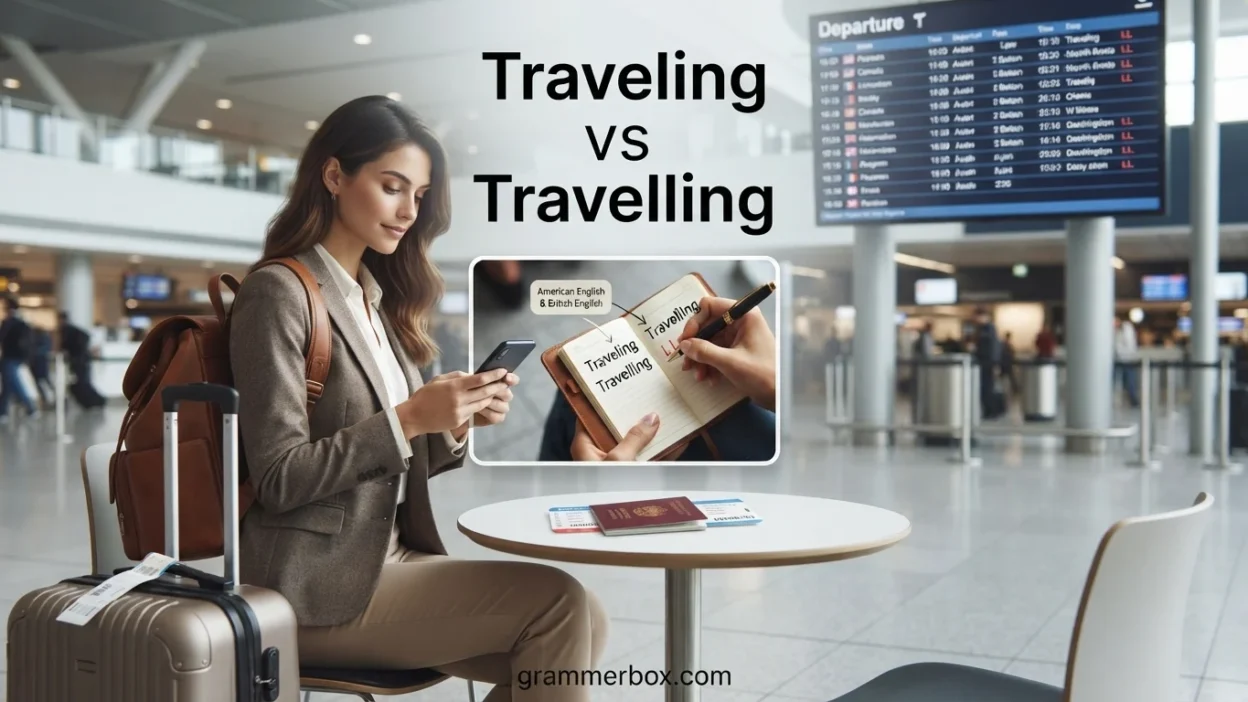
Traveling vs Travelling can look confusing, but the choice mainly depends on regional spelling and the audience you are writing for in English. In American English, traveling with one L is the preferred form, while British English uses travelling with two Ls as the standard spelling. The United States commonly uses the first form, while the United Kingdom, Canada, and Australia generally use the second. These countries show how regional preferences can affect everyday writing, and knowing your readers’ location helps you use the right form.
The difference may cause confusion because related terms such as traveler and traveled can also follow regional patterns. As an English educator, I often see learners wonder whether one spelling is incorrect, but both forms are accepted according to the audience. Travel itself is a wonderful experience, whether it means meeting new people, exploring new places, or immersing yourself in different cultures. Still, spelling these words can be tricky, so learning how to spell them correctly makes their differing forms easier to clarify when choosing the right version for your readers, whether you are describing a new journey or discussing places you have traveled to.
Quick Answer
Traveling and travelling are both correct spellings. Traveling is preferred in American English, while travelling is preferred in British English and several other English varieties. The meaning and pronunciation are essentially the same.
Why People Confuse It
The confusion happens because English has different spelling conventions depending on the region.
The verb travel becomes traveling in American English but travelling in British English. The extra l in the British spelling follows a broader spelling pattern in which the final consonant is doubled before certain suffixes.
For example:
- American English: traveling
- British English: travelling
- American English: traveled
- British English: travelled
The important point is that neither spelling is a typo when it follows the appropriate regional convention.
First Word: Traveling
Traveling is the standard American English spelling of the present participle or gerund form of travel.
It can describe the activity of going from one place to another or function as part of a continuous verb construction.
Examples of Traveling
- I enjoy traveling during the summer.
- She is traveling to Chicago tomorrow.
- Traveling teaches you about different cultures.
- He spends a lot of time traveling for work.
- We were traveling across the country when we heard the news.
The spelling traveling is especially appropriate when following U.S. English spelling conventions.
Second Word: Travelling
Travelling is the standard British English spelling of the same word.
It has exactly the same meaning as traveling. The additional l is simply part of the spelling convention used in British English.
Examples of Travelling
- I enjoy travelling during the summer.
- She is travelling to London tomorrow.
- Travelling can broaden your perspective.
- He spends a lot of time travelling for work.
- They are travelling around Europe this year.
You will commonly see travelling in British publications, British schools, and writing from countries that generally follow British spelling conventions.
Comparison Table
| Feature | Traveling | Travelling |
| Meaning | Going from one place to another | Going from one place to another |
| Standard variety | American English | British English |
| Number of Ls | One | Two |
| Pronunciation | Same | Same |
| Part of speech | Verb form / gerund | Verb form / gerund |
| Example | She is traveling abroad. | She is travelling abroad. |
| Common spelling | U.S. English | U.K. English |
When to Use Each
The best spelling depends on your intended audience and the English variety you are following.
Use “Traveling” When:
- You are writing in American English.
- Your audience is primarily in the United States.
- You are following an American style guide.
- Your organization consistently uses U.S. spelling.
- You are writing for a U.S.-focused publication.
Example:
She is traveling to New York next week.
Use “Travelling” When:
- You are writing in British English.
- Your audience is primarily in the United Kingdom.
- Your publication follows British spelling.
- You are using a British English style guide.
- Consistency with other British spellings is important.
Example:
She is travelling to Manchester next week.
The key is consistency. Avoid switching between American and British spelling conventions within the same piece of writing without a specific reason.
Examples of Traveling vs Travelling
Here are examples showing how both spellings work in sentences:
- American: I love traveling to new places.
British: I love travelling to new places. - American: She is traveling with her family.
British: She is travelling with her family. - American: Traveling alone can be an exciting experience.
British: Travelling alone can be an exciting experience. - American: They are traveling through Europe.
British: They are travelling through Europe. - American: He enjoys traveling by train.
British: He enjoys travelling by train. - American: We were traveling when the storm began.
British: We were travelling when the storm began. - American: She spends much of her year traveling for business.
British: She spends much of her year travelling for business. - American: Traveling can help people understand other cultures.
British: Travelling can help people understand other cultures. - American: They are traveling across the country.
British: They are travelling across the country. - American: I have always enjoyed traveling abroad.
British: I have always enjoyed travelling abroad. - American: He is traveling with only a backpack.
British: He is travelling with only a backpack. - American: We spent the summer traveling around California.
British: We spent the summer travelling around California.
Common Mistakes
1. Assuming one spelling is always wrong
Neither spelling is universally wrong. The correct choice depends on the English variety.
2. Mixing spelling styles
A common problem is using traveling in one paragraph and travelling in another when the entire article is supposed to follow one regional standard.
3. Thinking the extra “l” changes the meaning
It does not. Traveling and travelling mean the same thing.
4. Confusing spelling with pronunciation
The additional l does not create a meaningful pronunciation difference.
5. Changing the spelling unnecessarily
If you are writing in British English, use travelling consistently. If you are writing in American English, use traveling consistently.
Memory Trick
A simple way to remember the difference is:
American = one L → traveling
British = two Ls → travelling
You can also remember the British form by thinking of British spelling as giving travel an extra L before -ing.
U.S. → traveling
U.K. → travelling
This quick association can help you choose the right spelling when writing for a particular audience.
American vs British English
The difference between traveling and travelling is part of a larger pattern of spelling differences between American and British English.
For example:
| American English | British English |
| traveling | travelling |
| traveled | travelled |
| canceled | cancelled |
| labeling | labelling |
| modeled | modelled |
However, spelling differences are not always identical across every word. Different words follow different historical and grammatical patterns, so it is better to learn common forms rather than assume that every word will behave exactly the same way.
When writing professionally, choose one regional standard and apply it consistently.
Similar Words
Several related forms can also cause spelling questions:
- Travel — to go from one place to another.
- Traveler — a person who travels.
- Travelling — British spelling of the activity or continuous form.
- Traveling — American spelling of the activity or continuous form.
- Traveled — American past-tense and past-participle spelling.
- Travelled — British past-tense and past-participle spelling.
- Travels — third-person singular present form.
- Traveling abroad — going to another country.
- Travel plans — arrangements for a journey.
- Travel experience — knowledge or experience gained through traveling.
FAQs:
Is traveling or travelling correct?
Both are correct. Traveling is the standard American English spelling, while travelling is the standard British English spelling.
Is traveling American or British English?
Traveling is the standard spelling in American English.
Is travelling British English?
Yes. Travelling is the standard British English spelling.
Do traveling and travelling have the same meaning?
Yes. They have the same meaning and pronunciation. The difference is primarily a regional spelling convention.
Why does British English have two Ls in travelling?
British English commonly doubles the final consonant in forms such as travelling when adding the suffix -ing. American English generally uses traveling.
Which spelling should I use in an essay?
Use the spelling that matches the English variety required by your school, institution, publisher, or intended audience. Most importantly, use the same convention consistently.
Is “traveling” with one L a spelling mistake?
No. Traveling is the standard American English spelling and is completely correct in that variety of English.
Conclusion
The difference between traveling vs travelling is simple once you know the regional rule. Traveling is used in American English, while travelling is used in British English. Both refer to the same activity and function in the same grammatical way.
When choosing between them, think about your audience rather than trying to decide which spelling is universally correct. If you write “I am traveling” or “I am travelling,” your meaning remains unchanged. The best writing choice is the one that matches your chosen English variety and stays consistent from beginning to end.
Remember This
Traveling = American English 🇺🇸
Travelling = British English 🇬🇧
Both are correct; just choose the spelling that matches your audience and keep your writing consistent.