Learning verbs that start with B is an easy way to expand your English vocabulary and improve your writing, speaking, and reading skills. Verbs are action words, and adding more of them to your vocabulary helps you express ideas more naturally in conversations, essays, emails, and creative writing.
Whether you’re a student, an ESL learner, a teacher, or simply someone who enjoys learning English, this guide introduces common and useful B verbs with simple meanings and practical examples. You’ll also discover how to use them correctly, avoid common mistakes, and remember them with easy learning tips.
Quick Answer
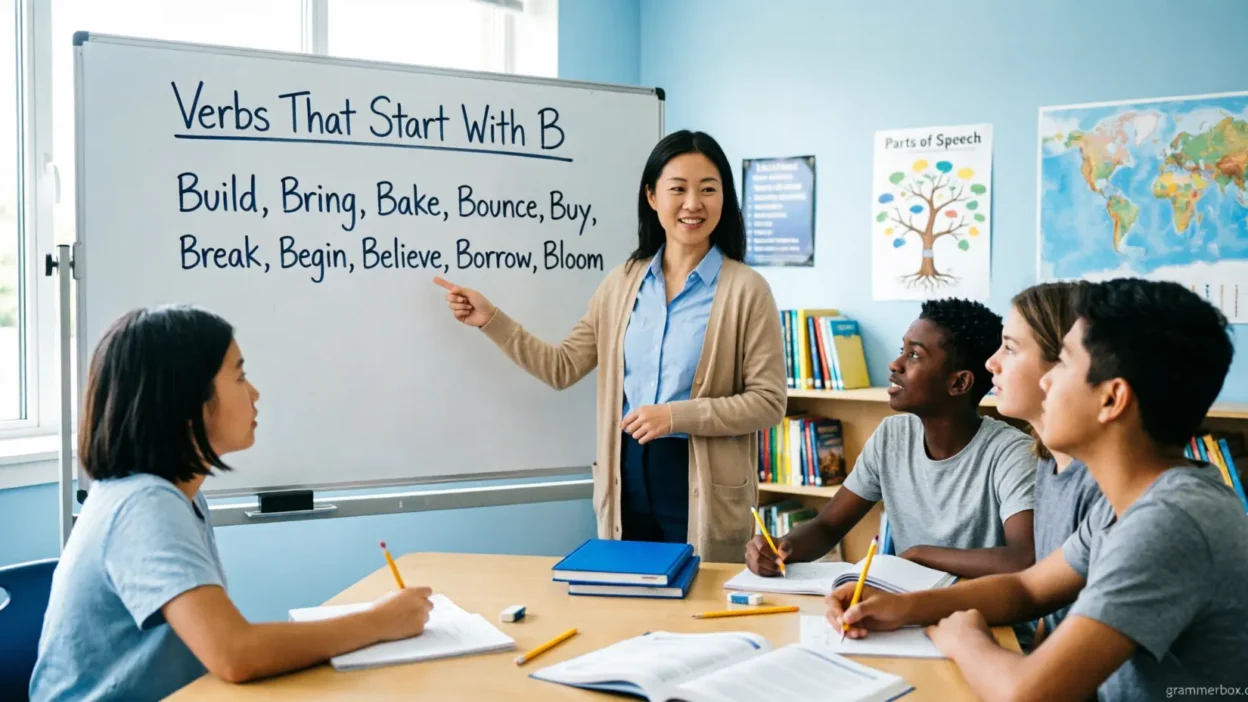
Verbs that start with B are action words beginning with the letter B, such as build, bring, bake, believe, borrow, bend, blink, bounce, bloom, and breathe. These verbs describe actions, thoughts, or changes and are commonly used in everyday English communication.
Why People Confuse Verbs That Start With B
Many English learners assume all verbs beginning with B have similar meanings because they share the same first letter. In reality, every verb has its own purpose.
For example:
- Bring means to carry something toward someone.
- Borrow means to take something temporarily.
- Build means to construct something.
- Believe means to accept something as true.
Understanding each verb in context is the key to using it correctly.
First Word: Build
Meaning: To construct or create something.
Examples
- They plan to build a new bridge.
- Good habits build confidence.
- We will build a stronger team.
Second Word: Bring
Meaning: To carry or take something toward a person or place.
Examples
- Please bring your notebook.
- She always brings snacks to class.
- Can you bring me a glass of water?
Comparison Table
| Verb | Meaning | Example |
|---|---|---|
| Build | Construct something | They built a house. |
| Bring | Carry toward someone | Bring your bag. |
| Borrow | Take temporarily | I borrowed a book. |
| Buy | Purchase something | She bought flowers. |
| Bake | Cook using an oven | We baked cookies. |
| Believe | Accept as true | I believe you. |
| Bend | Curve something | Bend your knees. |
| Bounce | Rebound after hitting a surface | The ball bounced high. |
| Bloom | Produce flowers | Roses bloom in spring. |
| Breathe | Take air into the lungs | Remember to breathe deeply. |
When to Use Each
Choose the correct verb based on the action you want to describe.
- Use build for creating or constructing.
- Use bring when moving something toward someone.
- Use borrow for taking something temporarily.
- Use buy when purchasing.
- Use bake when cooking in an oven.
- Use believe for trust or opinion.
- Use bend for making something curve.
- Use bounce for something that rebounds.
- Use bloom for flowers opening.
- Use breathe for taking in air.
Examples (10+)
Here are more commonly used verbs that start with B.
| Verb | Meaning | Example Sentence |
|---|---|---|
| Bake | Cook in an oven | My grandmother bakes bread every Sunday. |
| Balance | Keep steady | Balance the box carefully. |
| Bark | Make a dog’s sound | The dog barked loudly. |
| Bathe | Wash yourself | Children bathe before bedtime. |
| Beam | Smile brightly | She beamed with pride. |
| Beat | Win or strike | Our team beat the champions. |
| Become | Grow into | He became a doctor. |
| Begin | Start | Let’s begin the lesson. |
| Behave | Act properly | Please behave politely. |
| Belong | Be owned by | This notebook belongs to Sarah. |
| Bless | Give good wishes | They blessed the newly married couple. |
| Blink | Close and open eyes | She blinked twice. |
| Boil | Heat until bubbling | Boil the water first. |
| Boost | Increase | Exercise boosts energy. |
| Bow | Bend the body | The actor bowed to the audience. |
Common Mistakes
Avoid these common errors when using B verbs.
- Confusing bring with take.
- Mixing up borrow and lend.
- Saying “I am believe” instead of “I believe.”
- Using build when create fits better.
- Forgetting irregular forms like buy → bought.
Memory Trick
Think of the letter B as standing for “Beginning Big Actions.”
Remember this phrase:
Bake, Build, Bring, Believe, Borrow, Bloom, Breathe.
Repeating these verbs together helps strengthen your vocabulary.
American vs British English
Most verbs that start with B have the same meanings in American and British English.
Some spelling differences appear in related nouns or adjectives, but the verbs themselves are generally identical.
Examples:
- Bake — same in both.
- Borrow — same in both.
- Build — same in both.
- Believe — same in both.
Usage differences are minimal, making these verbs easy to learn regardless of the English variety.
Similar Words
These verbs are often related in meaning:
- Build → Construct, Create, Assemble
- Bring → Carry, Deliver, Fetch
- Buy → Purchase, Acquire
- Believe → Trust, Accept
- Begin → Start, Commence
- Boost → Improve, Increase
- Bend → Curve, Flex
- Bloom → Blossom, Flower
- Bounce → Rebound, Spring
- Breathe → Inhale, Exhale
Final Verdict
Learning verbs that start with B strengthens your vocabulary and improves everyday communication. Many of these verbs are among the most frequently used words in English, making them valuable for speaking, writing, and understanding conversations.
Focus on learning the meaning, pronunciation, and correct usage of each verb. Practice them in real-life sentences, and you’ll quickly become more confident in your English skills.
Frequently Asked Questions
1. What are verbs that start with B?
They are action or state words beginning with the letter B, such as build, bring, buy, believe, and breathe.
2. Which B verbs are most common?
Some of the most common include begin, build, bring, become, buy, borrow, believe, and behave.
3. Are all B words verbs?
No. Many B words are nouns, adjectives, or adverbs. Only words that express an action, occurrence, or state are verbs.
4. Why should I learn verbs alphabetically?
Learning verbs by letter makes vocabulary easier to organize, remember, and review.
5. How can I remember new B verbs?
Practice writing sentences, read English regularly, and group similar verbs together for better recall.
6. Are these verbs suitable for beginners?
Yes. Most of the verbs listed here are commonly taught in beginner and intermediate English courses.
7. What’s the difference between “bring” and “take”?
Bring means moving something toward the speaker or destination, while take means moving something away from the speaker.
Remember This
The easiest way to master verbs that start with B is to use them every day. Learn a few new verbs each week, write your own example sentences, and try using them in conversations. Regular practice is far more effective than memorizing long lists.
Conclusion
Verbs beginning with B cover a wide range of actions, from everyday activities like buy, bring, and bake to abstract actions such as believe and become. Because these words appear frequently in spoken and written English, learning them will immediately improve your communication skills.
Keep expanding your vocabulary by practicing these verbs in real-life situations. The more often you read, write, and speak using them, the more naturally they’ll become part of your English. Consistent practice is the fastest path to confidence and fluency.