Many English learners find At the House vs In the House confusing because context affects how we use these phrases in daily conversations. The difference becomes easier when we focus on meaning instead of strict rules of grammar.
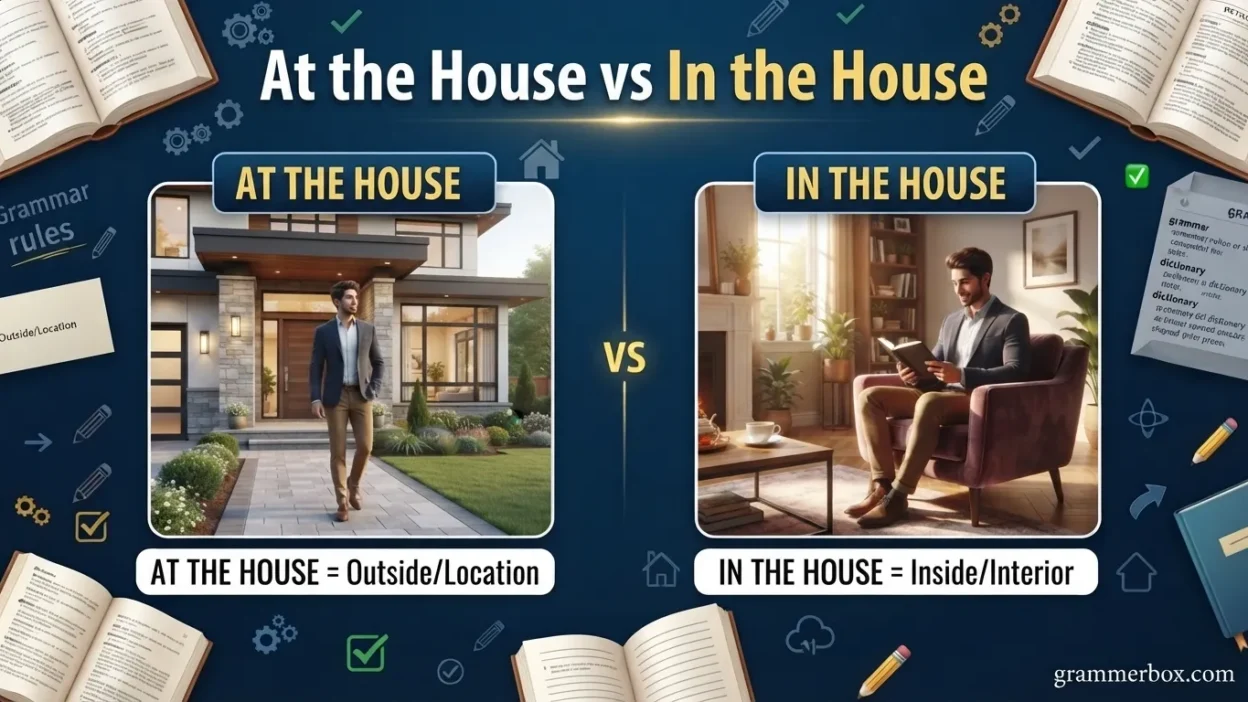
From my experience, learning these expressions may feel like navigating a nightmarish maze, but real examples make the idea clearer. At the house refers to a general location or social visit, such as being outside, approaching a home, or planning to meet someone there later.
On the other hand, in the house means being inside, physically surrounded by walls and rooms within a private environment. A common misunderstanding happens when people use both phrases the same way. The difference may seem Kafkaesque, like the bureaucratic systems of Czech writer Franz Kafka, where rules appear illogical and overwhelming. Real-life examples from books, movies, and everyday life help explain the true essence of this distinction.
The concept is simple when we break it down. “At the house” captures a wider idea of location, while “in the house” focuses on being within the space itself. Using correctly these phrases helps avoid confusion, powerlessness, and helplessness in social environments and professional environments.
Quick Answer
At the house means you are at a specific home location, but you may be inside or outside. In the house means you are physically inside the home. Use at for a general place or location and in for an enclosed space.
Why People Confuse It
Many learners confuse at the house or in the house because both expressions refer to a home. However, English prepositions describe different relationships between a person and a place.
The main difference is focus:
- At focuses on a location or point.
- In focuses on being inside a space.
For example:
- I am at the house waiting for you.
This sentence only tells the listener your location. You could be in the garden, driveway, garage, or inside the home.
- I am in the house waiting for you.
This sentence clearly means you are inside the building.
These small differences are important because English prepositions do not always translate directly from other languages. Many ESL learners make common preposition mistakes by choosing words based on translation instead of meaning.
A simple way to remember:
At = Where something is located
In = Where something is inside
At the House Meaning
The phrase “at the house” means being at a particular home location. It is used when the speaker wants to mention a place but does not need to explain the exact position.
The focus is the location, not the interior.
Think of it like pointing to a place on a map:
📍 At the house = at this location
Examples:
- I am at the house right now.
- Sarah is at the house waiting for her brother.
- The workers are at the house repairing the roof.
- We will meet at the house after lunch.
- My friends are at the house for the party.
In these examples, the person’s exact position does not matter.
They could be:
- Inside the home
- Outside the home
- In the yard
- Near the entrance
- In the driveway
The phrase only tells us the general location.
When to Use “At the House”
Use “at the house” when you are talking about:
1. A Specific Location
Example:
- The delivery driver is at the house.
Meaning:
The driver has arrived at that location.
2. A Meeting Place
Example:
- Let’s meet at the house before going to the restaurant.
Meaning:
The house is the meeting point.
3. Someone’s Location
Example:
- My brother is at the house today.
Meaning:
His current location is that house.
Common Sentence Patterns With “At the House”
Pattern 1:
Subject + be + at the house
Examples:
- She is at the house.
- They are at the house.
Pattern 2:
Subject + action + at the house
Examples:
- We had dinner at the house.
- They played games at the house.
Second Word: In the House
In the House Meaning
The phrase “in the house” means someone or something is physically inside a home or building.
The focus is the interior area.
Think about being surrounded by walls:
🏠 In the house = inside the building
Examples:
- My children are in the house watching TV.
- The keys are in the house.
- Someone is in the house.
- My parents are in the house having coffee.
- The dog is in the house sleeping.
Here, the listener understands that the person or object is indoors.
When to Use “In the House”
Use “in the house” when you want to describe:
1. An Indoor Location
Example:
- My phone is in the house.
Meaning:
The phone is somewhere inside the home.
2. An Activity Happening Indoors
Example:
- The children are playing in the house.
Meaning:
They are inside the building while playing.
3. Someone Being Inside
Example:
- Everyone is in the house for dinner.
Meaning:
Everyone has entered the home.
Common Sentence Patterns With “In the House”
Pattern 1:
Subject + be + in the house
Examples:
- He is in the house.
- The cat is in the house.
Pattern 2:
Subject + activity + in the house
Examples:
- She is cooking in the house.
- They are relaxing in the house.
At the House vs In the House Comparison Table
| Phrase | Meaning | Main Focus | Example |
|---|---|---|---|
| At the house | At a specific home location | Place/location | I am at the house. |
| In the house | Inside the home | Interior space | I am in the house. |
| At my house | At my home location | Residence/location | Come to my house; I am at my house. |
| In my house | Inside my home | Physical position | My dog is in my house. |
| At home | At your own residence | General home location | I am at home today. |
At Home vs In the House
Many learners also confuse at home vs in the house.
At Home
“At home” means you are at your residence. It does not necessarily focus on whether you are inside a particular room.
Examples:
- I am at home today.
- She works at home.
In the House
“In the house” specifically means inside the building.
Examples:
- I left my wallet in the house.
- The children are in the house.
Compare:
- “I am at home.” → I am at my residence.
- “I am in the house.” → I am inside the building.
When to Use Each
Knowing when to use at the house and in the house depends on whether you want to talk about a general location or a specific inside area.
Use “At the House” for Location
Use “at the house” when the house is a place, destination, or meeting point.
Examples:
- I will be at the house after work.
- The electrician is at the house today.
- We are waiting for you at the house.
- Everyone arrived at the house before sunset.
In these sentences, the important information is the location.
The speaker is not explaining where inside the house someone is.
Use “In the House” for Inside Position
Use “in the house” when you want to show that someone or something is inside the building.
Examples:
- My laptop is in the house.
- The kids are in the house playing games.
- She is in the house making dinner.
- There is a new painting in the house.
Here, the focus is the interior space.
Examples of At the House vs In the House
Understanding examples is one of the best ways to learn the correct use of at and in.
Examples Using “At the House”
- I am at the house if you need me.
- My friends are at the house for the weekend.
- The repair team is at the house fixing the roof.
- We met at the house before the event.
- The children are at the house with their grandparents.
- The delivery person is at the house now.
- She waited at the house until her parents arrived.
- They stayed at the house all evening.
Examples Using “In the House”
- My keys are in the house somewhere.
- The baby is sleeping in the house.
- Everyone is in the house because it is raining.
- There is a strange noise in the house.
- My brother is in the house studying.
- The furniture is in the house already.
- The dog is hiding in the house.
- She left her jacket in the house.
Real-Life Conversation Examples
Native speakers often use these phrases naturally in conversations.
Conversation 1
Person A: Where are you?
Person B: I’m at the house. Come over if you want.
Meaning:
The person is at that location.
Conversation 2
Person A: Where are your shoes?
Person B: They are in the house near the door.
Meaning:
The shoes are inside.
Conversation 3
Person A: Is John available?
Person B: Yes, he is in the house.
Meaning:
John is inside the home.
Conversation 4
Person A: Where should we meet?
Person B: Meet me at the house.
Meaning:
The house is the meeting location.
Common Mistakes
Mistake 1: Using “In the House” for Every Situation
Some learners use “in the house” whenever they talk about a home.
Incorrect:
- Let’s meet in the house at 5 PM. (if the focus is the meeting location)
Better:
- Let’s meet at the house at 5 PM.
Why?
The house is the meeting place, not necessarily the inside area.
Mistake 2: Using “At the House” When Talking About an Object Inside
Incorrect:
- My phone is at the house.
Better:
- My phone is in the house.
Why?
The phone is physically inside the building.
Mistake 3: Confusing “At Home” and “At the House”
These expressions are related but not identical.
At home means you are at your own residence.
Example:
- I am at home today.
At the house usually refers to a specific house.
Example:
- I am at my friend’s house.
Mistake 4: Thinking “At” Always Means Outside
This is incorrect.
Someone can be:
- At the house
- Inside the house
Example:
- I am at the house and waiting in the kitchen.
The phrase focuses on location, not physical position.
Memory Trick
Use this simple rule:
AT = A Location
Think of a map pin.
📍 At the house = the house is your location.
Example:
- I am at the house.
IN = Inside
Think of entering through the door.
🏠 In the house = inside the building.
Example:
- I am in the house.
A quick memory sentence:
“At tells me where. In tells me inside.”
American vs British English
Both American and British English use “at the house” and “in the house.”
The grammar rule is the same, but everyday expressions can differ.
American English
Americans commonly say:
- I’m at the house.
- I’m at home.
- The kids are in the house.
Example:
“I’ll call you when I get at the house.”
(Informal speech may sometimes include regional variations.)
British English
British speakers also use these phrases but often prefer:
- I’m at home.
- I’m in the house.
Example:
“I left my phone in the house.”
The meaning difference between at and in prepositions remains the same in both varieties.
Similar Words and Related Expressions
At Home
Meaning:
At your own residence.
Example:
- I am at home today.
Inside the House
Meaning:
A stronger way to say “in the house.”
Example:
- Everyone is inside the house.
Outside the House
Meaning:
Not inside the building.
Example:
- The children are playing outside the house.
Around the House
Meaning:
In the area near the home.
Example:
- He is working around the house.
At My House
Meaning:
At my residence location.
Example:
- We are having dinner at my house.
In My House
Meaning:
Inside my home.
Example:
- My dog sleeps in my house.
FAQs:
1. What is the difference between at the house and in the house?
“At the house” refers to a location, while “in the house” means someone or something is physically inside the home.
2. Is “I am at the house” correct English?
Yes. “I am at the house” is grammatically correct and means you are at that location.
3. Is “I am in the house” grammatically correct?
Yes. It means you are inside the building.
4. Should I say at home or in the house?
Use at home when talking about your residence. Use in the house when you want to emphasize being inside the building.
5. Are “at the house” and “at home” the same?
Not always.
“At home” usually means your own residence.
“At the house” can refer to any specific house location.
6. Can someone be at the house and in the house at the same time?
Yes.
Example:
- Sarah is at the house and in the house.
“At the house” describes her location, while “in the house” describes her position.
7. Which preposition is used with house?
Both at and in can be used with “house,” but they have different meanings.
- At the house = location
- In the house = inside
Final Verdict
The difference between at the house vs in the house is simple: “at” describes a place, while “in” describes being inside a place.
Use “at the house” when you are talking about a location, destination, or meeting point. Use “in the house” when you want to show that someone or something is physically inside the home.
Learning these small differences in English prepositions of place can make your conversations clearer and more natural. Once you remember that at = location and in = inside, choosing the correct phrase becomes much easier.
Remember This
At the house = a location 📍
Example: I am at the house.
In the house = inside the home 🏠
Example: I am in the house.
At home = your residence
Example: I am at home.
Conclusion
Understanding at the house vs in the house helps English learners avoid common grammar mistakes and communicate more naturally. Although these phrases seem similar, they describe different ideas. “
At the house” gives information about where someone is located, while “in the house” explains that someone or something is inside the building.
The best way to master these expressions is through practice and real-life examples. Pay attention to the meaning you want to express rather than translating word-for-word. With regular use, choosing between these prepositions will become automatic.