If you’ve ever wondered whether to write sell or sale, you’re not alone. Many English learners, students, and even native speakers occasionally confuse these two words because they are closely related. Although both refer to buying and selling, they serve different purposes in English grammar. Understanding the difference between sell and sale will help you write and speak more accurately in everyday conversations, business communication, and academic writing.
In this complete guide, you’ll learn the sell vs sale meaning, their definitions, grammar rules, pronunciation, and real-life examples. We’ll explain how to use sell and sale correctly, highlight common mistakes, and provide practical tips to remember the difference. Whether you’re learning sell vs sale in English for school, work, or daily life, this article gives you everything you need in one place.
Quick Answer
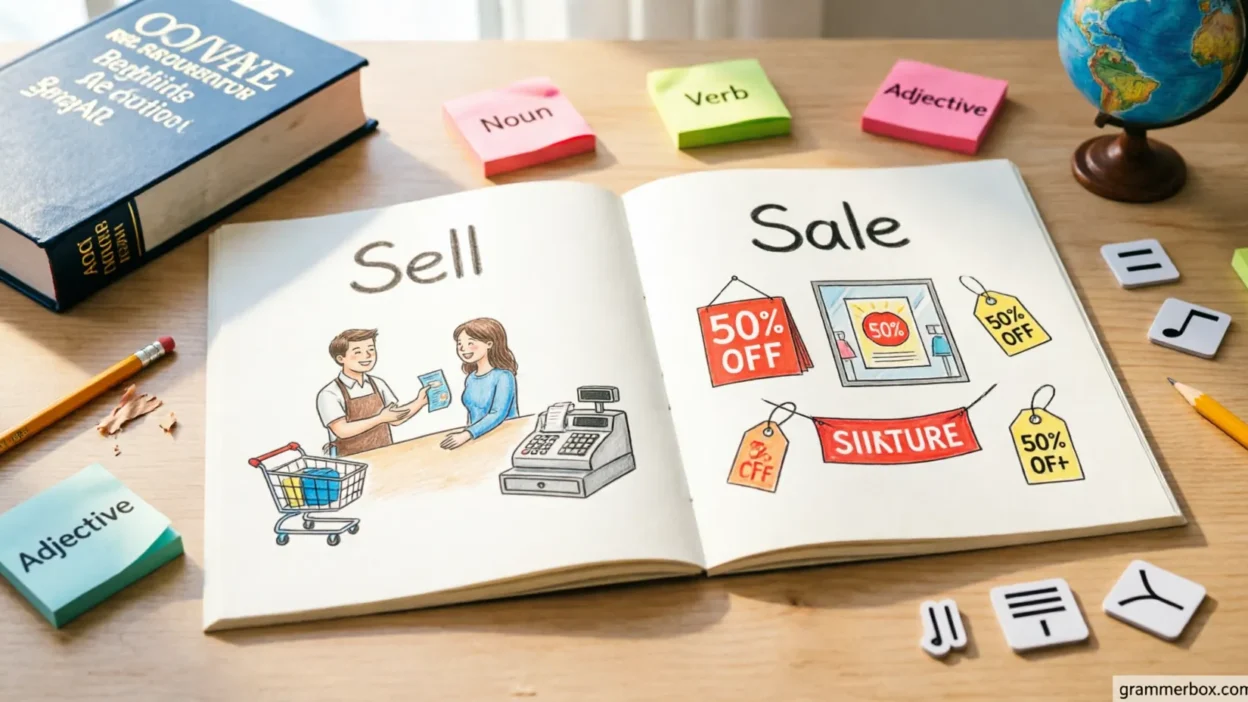
The sell vs sale difference is simple: sell is a verb that means to exchange something for money, while sale is a noun that refers to the act of selling, a completed transaction, or a promotional event where items are offered at discounted prices. In short, you sell a product, but a product is on sale or for sale.
Why People Confuse Sell and Sale
The confusion between sell vs sale is extremely common because both words come from the same idea of exchanging goods or services for money. They are frequently used together in advertisements, online shopping, retail stores, and business conversations. As a result, many learners mistakenly believe they can replace one another.
Another reason is that English contains many words that look and sound similar but belong to different parts of speech. Since sell is a verb and sale is a noun, using the wrong one creates grammatical errors.
Here are the most common reasons people mix them up:
- Both relate to buying and selling.
- Their spellings are very similar.
- They often appear in the same sentence.
- Many advertisements use both words together.
- ESL learners often confuse verbs and nouns.
- Some languages use a single word for both meanings.
Learning the sell and sale difference is mostly about understanding their grammatical role.
What Does “Sell” Mean?
Sell Definition
The sell meaning is to give or exchange something for money. It describes an action, which is why sell is a verb.
Whenever someone transfers ownership of a product or service in exchange for payment, they sell it.
Grammar
- Part of Speech: Verb
- Base Form: Sell
- Past Tense: Sold
- Past Participle: Sold
- Present Participle: Selling
Because sell is an action word, it changes its form depending on the tense.
Examples of Sell
- I want to sell my old bicycle.
- They sell fresh vegetables every morning.
- She sold her laptop yesterday.
- We are selling handmade furniture online.
- The company sells software around the world.
- He hopes to sell his house before winter.
- Small businesses sell products through online marketplaces.
- Many artists sell digital artwork on the internet.
- Farmers sell crops directly to local markets.
- The shop sells imported chocolates.
Common Expressions with Sell
These expressions are widely used in business English, shopping vocabulary, and everyday conversation.
- Sell a car
- Sell a house
- Sell online
- Sell products
- Sell services
- Sell tickets
- Sell quickly
- Sell directly
- Sell successfully
- Sell at a profit
Sell in Business English
In business, sell refers to the process of offering goods or services to customers. Companies focus on increasing sales by improving marketing, pricing, customer service, and product quality.
Examples:
- The company sells electronics worldwide.
- We sell software subscriptions to businesses.
- Online retailers sell millions of products every year.
- Small businesses often sell through social media platforms.
Understanding the sell definition is important because it represents the action that creates a sales transaction.
What Does “Sale” Mean?
Sale Definition
The sale meaning is the act of selling, a completed transaction, or a special event where products are offered at discounted prices.
Unlike sell, sale is not an action. It is something you can count or describe.
Grammar
- Part of Speech: Noun
- Singular: Sale
- Plural: Sales
The plural sales usually refers to the number or value of products sold.
Examples:
- Monthly sales increased by 20%.
- Car sales reached a record high.
- Online sales continue to grow.
Examples of Sale
- The shoes are on sale today.
- Everything is for sale.
- The store announced a holiday sale.
- Their biggest sale starts this weekend.
- House sales increased this year.
- The final sale begins Friday morning.
- Black Friday sales attract millions of shoppers.
- The apartment is for sale.
- Ticket sales exceeded expectations.
- Our annual clearance sale starts tomorrow.
Common Types of Sales
Retail stores organize different kinds of sales throughout the year.
Some common examples include:
- Clearance sale
- Flash sale
- Summer sale
- Winter sale
- Holiday sale
- Final sale
- End-of-season sale
- Warehouse sale
- Promotional sale
- Online sale
These terms are commonly used in retail sales, commerce, and shopping vocabulary.
Sell vs Sale Comparison Table
The easiest way to understand the sell vs sale comparison is to look at their grammatical roles side by side.
| Feature | Sell | Sale |
|---|---|---|
| Part of Speech | Verb | Noun |
| Meaning | To exchange something for money | The act of selling or a discounted event |
| Function | Describes an action | Names an event, thing, or result |
| Grammar | Action word | Naming word |
| Example | I sell books online. | The books are on sale today. |
| Common Phrases | Sell products, sell tickets | On sale, for sale, clearance sale |
| Question It Answers | What do you do? | What happened or what event is it? |
Quick Tip: If the word describes an action, choose sell. If it names an event, transaction, or discount, choose sale.
Which Word Should You Use?
Many users searching for sell or sale correct usage simply want to know which word fits their sentence. Here’s an easy way to decide.
Use sell if you’re talking about doing something.
Examples:
- I want to sell my bicycle.
- They sell handmade furniture.
- She sells homemade cakes.
Use sale if you’re naming an event, promotion, or completed transaction.
Examples:
- The bicycle is for sale.
- Everything is on sale this weekend.
- Ticket sales increased dramatically.
Ask Yourself One Question
Before writing the sentence, ask yourself:
Am I describing an action?
If the answer is yes, use sell.
If you’re naming an event or thing, use sale.
This simple question helps learners master how to use sell and sale correctly in almost every situation.
When to Use “Sell”
Use sell whenever you describe someone exchanging goods or services for money. Since it is a verb, it always expresses an action.
Common situations include:
- Selling products
- Selling services
- Selling property
- Selling tickets
- Selling online
- Selling ideas
Real-Life Examples
- We sell fresh fruit every day.
- She sells handmade jewelry on Etsy.
- The company sells smartphones worldwide.
- Farmers sell vegetables at the local market.
- They plan to sell their apartment next year.
- He sells insurance policies.
- Local artists sell paintings during festivals.
- The bakery sells fresh bread every morning.
- Our website sells digital courses.
- Many entrepreneurs sell products through e-commerce platforms.
When to Use “Sale”
Use sale whenever you’re referring to a noun rather than an action.
This includes:
- A discount event
- A completed transaction
- The total number of products sold
- Property available for purchase
Examples
- Everything is on sale today.
- The winter sale begins Monday.
- Ticket sales have doubled this month.
- The house is for sale.
- Our biggest sale happens every December.
- The company reported strong quarterly sales.
- Holiday sales increased customer traffic.
- The clearance sale attracted hundreds of shoppers.
- Final sale items cannot be returned.
- Property sales are rising this year.
Sell vs Sale in Business English
Understanding sell vs sale in Business English is especially important if you work in marketing, retail, finance, or customer service.
Businesses use sell to describe the process of offering products or services to customers.
Examples:
- We sell office equipment to schools.
- The company sells its products in over 40 countries.
Businesses use sale to discuss revenue, promotions, or completed transactions.
Examples:
- Last month’s sales exceeded expectations.
- The annual sale increased customer traffic.
- The marketing team planned a discount sale for the holiday season.
This distinction is common in reports, presentations, invoices, advertising, and business meetings.
Sell vs Sale in Everyday English
Outside the business world, you’ll hear these words almost every day.
Examples of sell:
- I’m going to sell my old phone.
- He sells homemade cookies.
- They sell coffee near my office.
Examples of sale:
- Those shoes are on sale.
- The bicycle is for sale.
- The store’s weekend sale starts tomorrow.
Whether you’re shopping, browsing online marketplaces, or talking with friends, choosing the correct word makes your English sound more natural and accurate.
Common Expressions with Sell and Sale
English has several fixed expressions that use these words. Learning them will improve both your vocabulary and fluency.
Expressions with Sell
- Sell out
- Sell online
- Sell directly
- Sell at a profit
- Sell fast
- Sell well
- Sell products
- Sell services
Expressions with Sale
- On sale
- For sale
- Final sale
- Flash sale
- Clearance sale
- Holiday sale
- Summer sale
- Retail sale
- Sales promotion
- Sales report
Knowing these expressions will help you understand advertisements, business English, and everyday conversations more easily.
Sell vs Sale Examples (20+ Real-Life Sentences)
Learning from examples is one of the easiest ways to understand the difference between sell and sale. The following sell vs sale example sentences show how each word is used naturally in different situations.
Examples with Sell
- I want to sell my old laptop before buying a new one.
- They sell fresh vegetables at the local market.
- She sells handmade candles through her online store.
- We sell office furniture across the country.
- My parents sold their house last year.
- The company plans to sell its new software globally.
- Farmers sell fruit directly to customers.
- He sells used cars for a living.
- Our website sells digital courses.
- Small businesses often sell products through social media.
Examples with Sale
- The laptop is for sale.
- Everything is on sale this weekend.
- The store announced its annual summer sale.
- House sales increased this year.
- The Black Friday sale attracted thousands of shoppers.
- Ticket sales broke previous records.
- The apartment is for sale.
- Final sale items cannot be exchanged.
- Their holiday sale begins tomorrow.
- Online sales continue to grow every year.
Correct vs Incorrect Usage
Many learners search for sell or sale correct usage because they accidentally replace one word with the other.
The table below shows the most common mistakes.
| Incorrect | Correct |
|---|---|
| I want sale my bike. | I want to sell my bike. |
| They sale clothes online. | They sell clothes online. |
| This phone is sell. | This phone is for sale. |
| The shoes are sell today. | The shoes are on sale today. |
| She sale handmade bags. | She sells handmade bags. |
| We have a big sell tomorrow. | We have a big sale tomorrow. |
| The company sale software. | The company sells software. |
| My house is sell. | My house is for sale. |
Common Mistakes
Understanding sell vs sale grammar helps you avoid errors in writing and speaking.
Mistake 1: Using “Sale” as a Verb
❌ I will sale my car tomorrow.
✅ I will sell my car tomorrow.
Mistake 2: Using “Sell” as a Noun
❌ Our biggest sell starts Friday.
✅ Our biggest sale starts Friday.
Mistake 3: Forgetting Common Expressions
❌ The jacket is sell.
✅ The jacket is for sale.
❌ Everything is sell.
✅ Everything is on sale.
Mistake 4: Confusing “Sales” and “Sell”
❌ The company sales computers.
✅ The company sells computers.
Remember that sales is the plural noun, while sells is the third-person singular form of the verb sell.
Memory Trick
Here’s an easy trick to remember the sell and sale difference forever.
- Sell = Verb = Action
- Sale = Noun = Thing or Event
Think of these two simple sentences:
- You SELL something.
- Something is ON SALE.
If the sentence describes an action, choose sell.
If it names an event, promotion, or transaction, choose sale.
This memory trick works for beginners, students, and ESL learners.
American vs British English
Many learners wonder whether sell vs sale in English changes between American and British English.
The answer is no.
Both American and British English use these words in exactly the same way.
American English
- The house is for sale.
- They sell electronics online.
British English
- The house is for sale.
- They sell electronics online.
The only difference you may notice is vocabulary around shopping.
For example:
| American English | British English |
|---|---|
| Store | Shop |
| Shopping Cart | Shopping Trolley |
| Vacation Sale | Holiday Sale (sometimes) |
The grammar of sell and sale never changes.
Similar Words
If you’re improving your English vocabulary, you may also find these related words useful.
Words Related to Sell
- Market
- Trade
- Offer
- Promote
- Advertise
- Exchange
- Resell
- Distribute
- Retail
- Wholesale
Words Related to Sale
- Discount
- Promotion
- Bargain
- Clearance
- Transaction
- Purchase
- Deal
- Offer
- Marketplace
- Commerce
These words often appear in business English, shopping vocabulary, and retail sales.
Mini Quiz
Test your understanding.
Fill in the blanks.
- I want to _____ my bicycle.
- The bicycle is _____ sale.
- They _____ handmade furniture.
- Our biggest _____ starts Friday.
- Ticket _____ increased this month.
- She wants to _____ her old phone.
- Everything is _____ sale today.
- The company _____ software worldwide.
Answers
- sell
- for
- sell
- sale
- sales
- sell
- on
- sells
If you answered all eight correctly, you’ve mastered the sell vs sale difference.
Final Verdict
The sell vs sale difference becomes simple once you understand their grammatical roles.
Use sell whenever you’re describing an action. It is a verb that means to exchange goods or services for money.
Use sale whenever you’re referring to a noun, such as a discount event, completed transaction, or the total amount of products sold.
Whether you’re writing an email, preparing a business report, shopping online, or speaking in everyday English, choosing the correct word will make your communication clearer and more professional.
FAQs:
What is the difference between sell and sale?
Sell is a verb that means to exchange something for money, while sale is a noun referring to a transaction or promotional event.
Is “sell” a noun?
No. Sell is a verb.
Is “sale” a verb?
No. Sale is a noun.
Which is correct: “sell my car” or “sale my car”?
The correct phrase is sell my car.
What does “on sale” mean?
It means an item is available at a discounted price.
What does “for sale” mean?
It means something is available to be purchased.
Why do people confuse sell and sale?
Because both words relate to buying and selling and have similar spellings, but they belong to different parts of speech.
Is there any difference between American and British English?
No. Both varieties use sell and sale in the same way.
Conclusion
Understanding sell vs sale is essential for anyone learning English or improving their writing skills. Although the two words are closely connected, they perform different grammatical functions.
Sell is the action of exchanging goods or services for money, while sale refers to the event, transaction, or promotional offer. Remembering this simple distinction will help you avoid many common grammar mistakes.
The next time you write or speak, ask yourself one question: Am I describing an action or naming a thing? If it’s an action, use sell. If it’s a noun describing an event, transaction, or discount, use sale. With regular practice and the examples in this guide, using these commonly confused words correctly will soon become second nature.
Remember This
- Sell = Verb = Action
- Sale = Noun = Event or Transaction
- You sell a product.
- A product is for sale.
- A product can also be on sale.