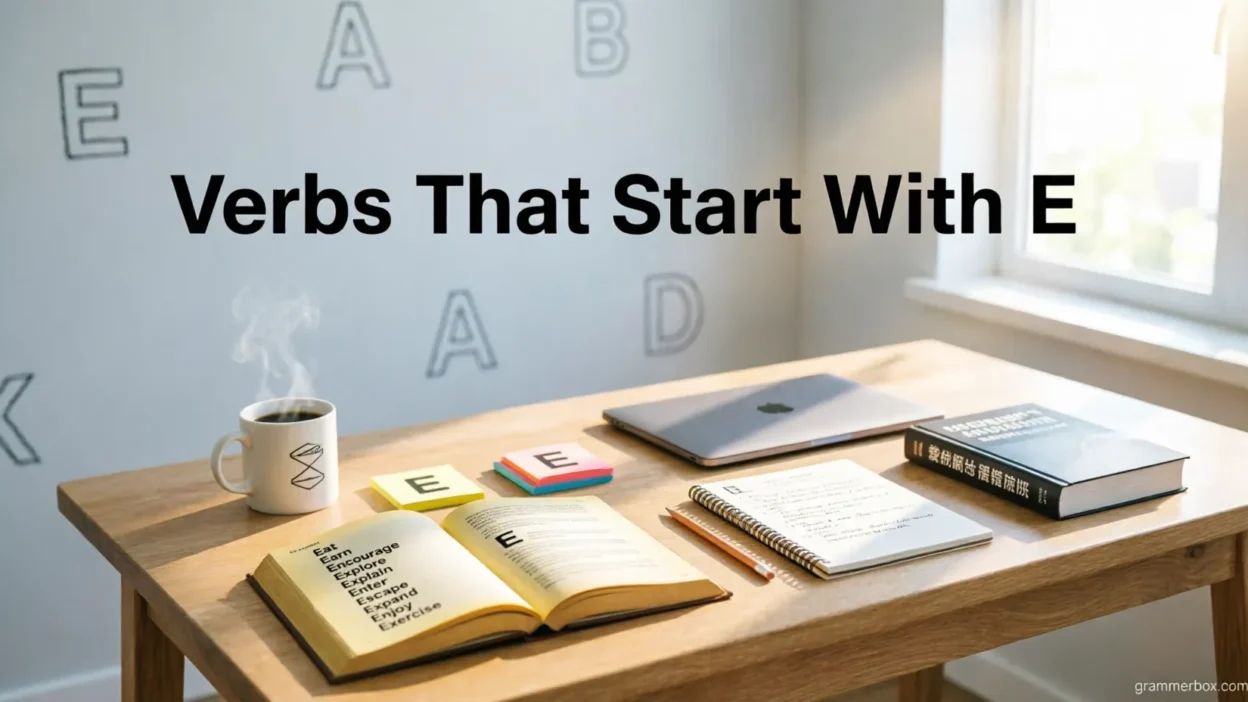
Verbs are action words that bring sentences to life, and learning new ones can instantly improve your speaking and writing skills. If you’re searching for verbs that start with E, you’ve come to the right place. If you’re a student, English learner, teacher, or writer, expanding your vocabulary helps you communicate more clearly and confidently.
In this guide, you’ll discover common and advanced E verbs, their meanings, practical examples, and tips for using them correctly. We’ll also cover common mistakes, memory tricks, related words, and frequently asked questions to make learning simple and enjoyable.
Quick Answer
Verbs that start with E are action or state-of-being words beginning with the letter E, such as eat, enjoy, explain, encourage, explore, enter, escape, and earn. They describe actions, emotions, or processes and are useful in everyday conversations, academic writing, and professional communication.
Why People Confuse Verbs That Start With E
Many English learners confuse E verbs because several have similar meanings or are used in different contexts. For example:
- Explain vs. Express
- Enter vs. Enroll
- Escape vs. Evade
- Expand vs. Extend
Understanding the meaning and context of each verb makes choosing the right one much easier.
First Word: What Are Verbs?
A verb is a word that shows an action, occurrence, or state of being. Every complete sentence needs a verb.
Examples:
- She eats breakfast every morning.
- They enjoy reading books.
- The flowers exist naturally in this region.
Without verbs, sentences would not express complete ideas.
Second Word: List of Verbs That Start With E
Here are some of the most useful verbs that start with E.
| Verb | Meaning |
|---|---|
| Eat | Consume food |
| Earn | Receive through work |
| Ease | Make less difficult |
| Educate | Teach or train |
| Edit | Revise written material |
| Eliminate | Remove completely |
| Embark | Begin a journey |
| Embrace | Accept willingly or hug |
| Employ | Hire or use |
| Empower | Give strength or authority |
| Enable | Make possible |
| Encourage | Give confidence |
| End | Finish something |
| Endure | Suffer patiently |
| Enforce | Make people obey |
| Engage | Participate or involve |
| Enhance | Improve quality |
| Enjoy | Take pleasure in |
| Enlarge | Make bigger |
| Enrich | Improve or add value |
| Enroll | Register officially |
| Ensure | Make certain |
| Enter | Go into |
| Entertain | Amuse others |
| Escape | Get away |
| Establish | Set up |
| Estimate | Calculate approximately |
| Evaluate | Judge quality |
| Evaporate | Turn into vapor |
| Evoke | Bring to mind |
| Evolve | Develop gradually |
| Examine | Inspect carefully |
| Exchange | Trade one thing for another |
| Excite | Cause enthusiasm |
| Exclude | Leave out |
| Excuse | Forgive or pardon |
| Execute | Carry out |
| Exercise | Perform physical activity |
| Exhibit | Display publicly |
| Exist | Continue to live or be |
| Expand | Increase in size |
| Expect | Believe something will happen |
| Explain | Make clear |
| Explore | Investigate or travel |
| Export | Send goods abroad |
| Express | Communicate thoughts |
| Extend | Lengthen |
| Extract | Remove from something |
| Erase | Remove writing |
| Exaggerate | Overstate something |
Comparison Table
| Verb | Best Used For | Example |
|---|---|---|
| Explain | Giving information | Please explain the lesson. |
| Express | Sharing feelings | She expressed her opinion. |
| Expand | Making larger | The company expanded quickly. |
| Extend | Lengthening time or distance | We extended the deadline. |
| Escape | Getting away | The prisoner escaped. |
| Evade | Avoiding intentionally | He evaded the question. |
When to Use Each
Choose the correct verb depending on your purpose.
- Use eat for consuming food.
- Use earn for receiving money or rewards.
- Use encourage to inspire confidence.
- Use enhance to improve quality.
- Use evaluate when judging performance.
- Use explore when discovering new places or ideas.
- Use express for sharing thoughts or emotions.
- Use ensure when making something certain.
- Use edit when revising writing.
- Use educate when teaching others.
Examples (10+)
Here are practical examples of verbs that start with E.
- I eat healthy meals every day.
- She earned a scholarship.
- Teachers educate future leaders.
- Please edit this article.
- They eliminated unnecessary expenses.
- We encourage students to ask questions.
- The manager evaluated our performance.
- Scientists explore space constantly.
- He explained the answer clearly.
- They expanded their business overseas.
- We enjoyed the concert.
- The company exported goods worldwide.
- She expressed her gratitude sincerely.
- The museum exhibited ancient artifacts.
- Plants exist in many environments.
Common Mistakes
Avoid these common errors.
- Using explain instead of express feelings.
- Confusing ensure with insure.
- Mixing expand and extend.
- Using escape when evade is more appropriate.
- Choosing edit when you actually mean rewrite.
Memory Trick
Remember this phrase:
“Every Excellent Explorer Enjoys Exciting Experiences.”
The repeated E sound helps you remember several common E verbs:
- Explore
- Enjoy
- Excite
- Experience
- Expand
American vs British English
Most verbs that start with E are spelled and used the same in American and British English.
Examples include:
- Explain
- Enjoy
- Enter
- Evaluate
- Explore
- Establish
The only noticeable differences usually appear in noun spellings related to these verbs rather than the verbs themselves.
Similar Words
These related action words are useful alongside E verbs.
- Act
- Build
- Create
- Develop
- Discover
- Learn
- Improve
- Produce
- Perform
- Achieve
- Complete
- Organize
Final Verdict
Learning verbs that start with E strengthens your English vocabulary and improves both spoken and written communication. Start with everyday verbs like eat, enjoy, enter, explain, and earn, then gradually add advanced verbs such as evaluate, enhance, evoke, and establish to your vocabulary.
FAQs:
What are verbs that start with E?
They are action or state-of-being words beginning with the letter E, such as eat, enjoy, explain, explore, and earn.
What is the most common E verb?
Eat is one of the most frequently used verbs beginning with E.
Why should I learn E verbs?
They improve vocabulary, writing, speaking, reading comprehension, and communication skills.
Are E verbs useful in academic writing?
Yes. Words like evaluate, explain, establish, examine, and express are commonly used in essays and research papers.
What’s the difference between “expand” and “extend”?
Expand means to become larger, while extend means to make something longer in time, length, or duration.
How can I remember more E verbs?
Practice reading, writing example sentences, using flashcards, and grouping similar verbs together.
Conclusion
Learning verbs that start with E is an easy way to strengthen your English vocabulary and become a more confident communicator. These verbs appear in everyday conversations, academic writing, business communication, and creative storytelling, making them valuable for learners of every level.
The best way to remember new verbs is to use them regularly. Create your own sentences, read English articles, and practice speaking whenever possible. Over time, verbs like encourage, evaluate, explore, establish, and express will become a natural part of your vocabulary.
Remember This
Verbs that start with E help you describe actions, emotions, ideas, and processes. Learn a few each day, use them in real sentences, and your English fluency will grow naturally.