
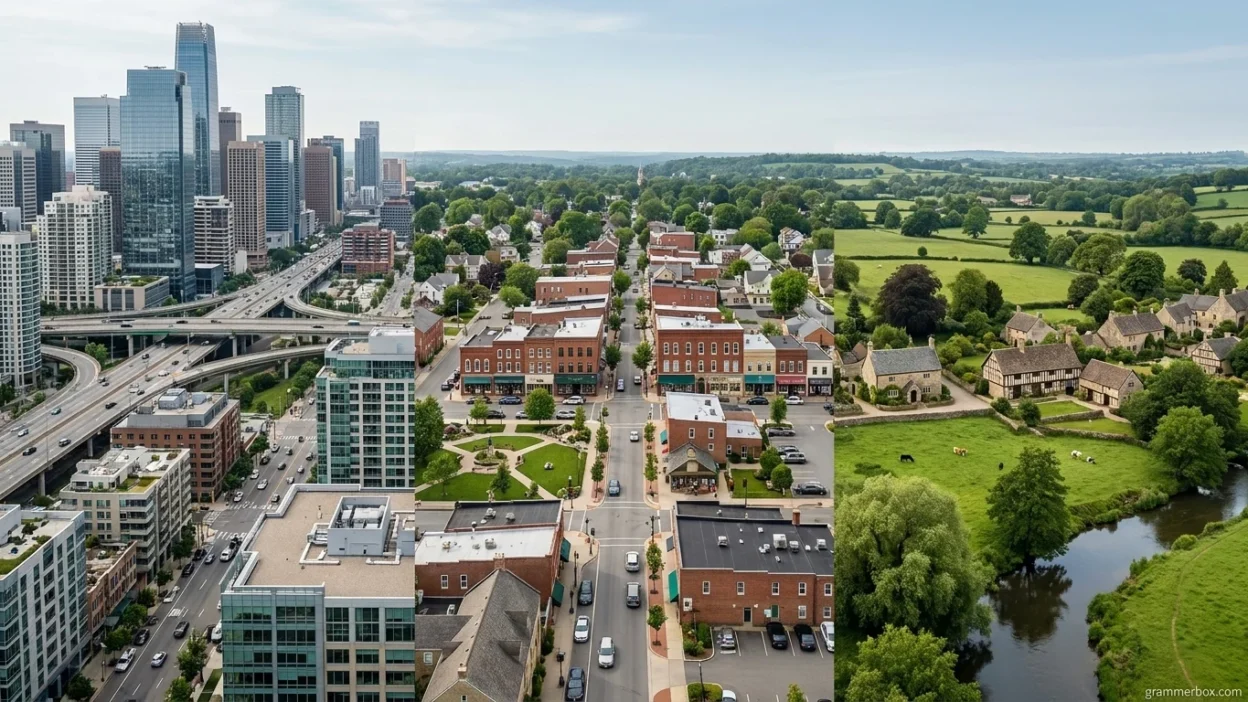
When talking about places where people live, city vs town vs village can be confusing because all three words describe settlements or communities. However, they are not always interchangeable. The main differences usually involve population size, development, services, infrastructure, and how the settlement is officially classified. There is no single worldwide population rule that perfectly separates a city, town, and village.
Understanding these terms can make your English more precise, especially when describing where someone lives, writing about geography, or discussing communities. In this guide, we’ll explain city, town, and village in simple language, compare their typical characteristics, and provide practical examples. You’ll also learn how American and British English may use these words differently, along with common mistakes and an easy memory trick to help you remember the distinction.
Quick Answer
A city is generally a large, highly developed settlement with extensive services and infrastructure. A town is usually smaller than a city but larger than a village. A village is typically a smaller community with fewer residents and services. Exact definitions vary by country.
Why People Confuse City, Town, and Village
People often confuse these words because there is no universal population threshold that applies everywhere.
A place may be called a city because of its legal or historical status rather than simply because it has a large population. Similarly, a town can sometimes be surprisingly large, while a village can have different meanings depending on the country.
The words generally suggest this progression:
Village → Town → City
But this is a useful generalization, not a strict worldwide rule.
City
A city is generally a large and developed urban settlement. Cities usually have a high population, extensive transportation networks, businesses, government institutions, schools, hospitals, and other public services.
Examples of a city
- New York City
- London
- Tokyo
- Paris
- Lahore
- Toronto
City in a sentence
- She moved to the city to find a better job.
- The city has a large public transportation system.
- New businesses are opening throughout the city.
The adjective urban is commonly associated with cities.
Town
A town is generally smaller than a city but larger or more developed than a typical village.
Towns often have local shops, schools, restaurants, healthcare facilities, offices, and community services. However, the exact meaning of town varies considerably between countries.
Examples of a town
- We stayed in a small town during our vacation.
- The town has a population of about 20,000 people.
- Everyone in the town knows the local baker.
The adjective town can also describe things associated with a particular town, such as town center or town hall.
Village
A village is generally a small settlement or community. Villages often have fewer residents and fewer services than towns or cities.
Villages may be located in rural areas, although the exact classification differs by country.
Examples of a village
- My grandparents live in a quiet village.
- The village has a small grocery store.
- We walked through the village after breakfast.
The word rural is often associated with villages, but a village is not necessarily completely rural.
City vs Town vs Village: Comparison Table
| Feature | City | Town | Village |
|---|---|---|---|
| Typical size | Large | Medium | Small |
| Population | Generally high | Generally moderate | Generally low |
| Infrastructure | Extensive | Moderate | Limited |
| Public services | Many | Several | Fewer |
| Businesses | Numerous | Moderate | Usually fewer |
| Transportation | Extensive | Moderate | Limited |
| Environment | Mostly urban | Urban or semi-urban | Often rural |
| General impression | Large urban community | Smaller community | Small local community |
Important: These are general patterns, not universal legal definitions.
When to Use Each
Use “city” when:
Use city when referring to a large urban settlement or a place officially recognized as a city.
- I live in the city.
- The city has several major universities.
- She works in the financial district of the city.
Use “town” when:
Use town for a smaller community that is commonly described as a town.
- He grew up in a small town.
- The town has a beautiful historic center.
- We stopped in a nearby town for lunch.
Use “village” when:
Use village for a small settlement or community, particularly when emphasizing its small-scale or rural character.
- They live in a peaceful village.
- The village is surrounded by farmland.
- A small village lies at the foot of the mountain.
City vs Town vs Village: 10+ Examples
- London is a major city with millions of residents.
- They moved from the city to a quieter town.
- My uncle owns a shop in a small village.
- The town is about an hour from the nearest city.
- The village has only a few hundred residents.
- Many people commute from the town to the city for work.
- The city offers more public transportation options.
- The village is known for its traditional houses.
- We visited a historic town during our trip.
- She prefers village life because it is quieter.
- The city has several international airports nearby.
- A small town grew rapidly after new businesses arrived.
Common Mistakes
1. Assuming population alone defines a city
A common mistake is believing that every place above a certain population must be a city.
Better: Remember that legal and historical classifications can matter.
2. Treating the words as exact synonyms
Although all three describe settlements, they do not always communicate the same scale or character.
City usually suggests a larger urban environment, while village suggests a smaller community.
3. Assuming every village is rural
Villages are often associated with rural areas, but the term does not universally require a rural location.
4. Thinking “town” always has the same definition
The meaning and official status of town vary between countries.
5. Using “city” simply because a place is popular
A famous tourist destination is not automatically a city. Its official classification and common usage matter.
Memory Trick
Use this simple scale:
Village = small
Town = middle
City = large
Think of it as:
V → T → C
Village → Town → City
If you are describing the general size of a settlement, this progression will usually help you choose the appropriate word.
American vs British English
The use of city, town, and village differs somewhat between American and British English.
American English
In the United States, city often refers to an incorporated municipality with a particular legal status. Town can also have a specific governmental meaning that varies from state to state.
The word village is used for some communities, but its legal meaning also varies by location.
British English
In the United Kingdom, city status is a formal designation that does not simply depend on population size.
Town and village are commonly used in everyday descriptions, but their classifications can also depend on history, local government, and established usage.
So, avoid assuming that a population number automatically determines whether a place is a city, town, or village.
Similar Words
Several related terms can describe settlements:
- Hamlet — usually a very small settlement, often smaller than a village.
- Community — a broad term for people living in a particular area or sharing a common connection.
- Settlement — a general geographical term for a place where people live.
- Municipality — an officially organized local government area.
- Suburb — a residential area located within or around a larger city or town.
- Metropolis — a very large and important city or urban area.
- Urban area — a developed area associated with towns or cities.
- Rural area — an area generally associated with the countryside rather than dense urban development.
FAQs:
Is a town bigger than a village?
Generally, yes. A town is commonly understood to be larger or more developed than a village, but the exact distinction depends on local definitions.
Is a city bigger than a town?
Usually, yes. Cities generally have larger populations and more extensive infrastructure and services, although official classifications do not always follow population size.
What is the difference between a city and a village?
A city is generally a large urban settlement with extensive infrastructure and services, while a village is usually a much smaller community with fewer facilities.
Can a village become a town?
Yes. A settlement can grow and may eventually be recognized or commonly described as a town, depending on local laws and traditions.
Can a town become a city?
Yes, in places where city status is formally granted. The requirements vary by country and jurisdiction.
Is a village always in the countryside?
No. Villages are often associated with rural areas, but the word does not have one universal geographical definition.
Which is bigger: village, town, or city?
The usual general order is:
Village → Town → City
However, actual population sizes and official classifications vary from place to place.
Final Verdict
The simplest way to understand city vs town vs village is to think about general scale. A city is typically a large urban settlement, a town is generally smaller and less extensive, and a village is usually a small community. These distinctions are useful for everyday English, even though legal definitions differ around the world.
When you need to describe a specific place, check how that place is officially classified or commonly described rather than relying only on its population. This is especially important in geography, travel writing, academic work, and formal documents.
Remember This
City = generally large and urban
Town = generally medium-sized
Village = generally small
Village → Town → City
The key point is that these are general descriptions, not universal population categories.
Conclusion
Understanding city vs town vs village becomes easier when you focus on the typical size, services, infrastructure, and character of each settlement. Cities usually offer the widest range of facilities, towns occupy a middle position, and villages tend to be smaller and more closely connected communities.
Still, English usage depends heavily on location. A place called a town in one country may have characteristics similar to a city somewhere else. For accurate writing, always consider the local or official classification as well as the everyday meaning of the word.