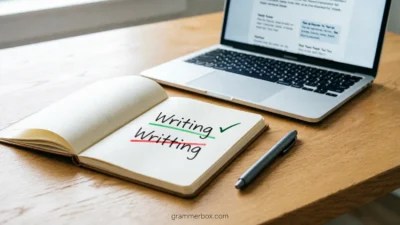

When you want to say that something is obvious, expected, or readily accepted, should you write “of course” or “ofcourse”? This small spelling question causes confusion because the two words are often pronounced together in everyday speech. However, English spelling does not always follow pronunciation, and this is one of those cases where spacing matters. Knowing the correct form can help you write more confidently in emails, essays, social media posts, and professional communication.
The correct spelling is “of course”, written as two separate words. “Ofcourse” is not considered standard English and should be avoided in formal and informal writing. In this guide, we will explain why people confuse these forms, show how “of course” works in sentences, compare it with similar expressions, and provide practical examples. By the end, you will have a simple trick for remembering the correct spelling every time.
Quick Answer
“Of course” is the correct spelling. It is always written as two words in standard English. “Ofcourse” is an incorrect spelling. Use “of course” when expressing agreement, certainty, or something that is obvious or expected.
Why People Confuse It
The confusion between of course and ofcourse mainly comes from pronunciation and fast speech.
When people say “of course” naturally, the two words can sound like one connected unit. This can make writers assume that they should also be combined in writing.
Another reason is that English contains many compound words that are written as one word. For example:
- however
- altogether
- already
- sometimes
- therefore
Because of these examples, it is understandable that someone might wonder whether ofcourse is also a closed compound.
It is not.
The phrase remains two separate words: of + course.
A useful point to remember is that of course is an established phrase, not a single compound word. Standard dictionaries and conventional English usage treat it as two words.
First Word: Of Course
Of course is the correct form.
It is an English phrase commonly used as an adverbial expression. Depending on the context, it can communicate:
- certainty
- agreement
- obviousness
- willingness
- politeness
- expected information
For example:
Of course, I remember your name.
Here, “of course” shows that remembering the person’s name is not surprising.
It can also express agreement:
“Can I borrow your notes?”
“Of course!”
In this sentence, “of course” means something like certainly or yes, certainly.
The phrase can appear at the beginning, middle, or end of a sentence depending on the intended emphasis.
Examples of “Of Course”
- Of course, I will help you.
- She knew of course that the plan might change.
- You can come with us, of course.
- Of course, that makes sense.
- He was nervous, of course, but he continued.
Second Word: Ofcourse
Ofcourse is incorrect in standard English.
Although you may occasionally see it online, in text messages, comments, or informal posts, writing ofcourse as one word is generally considered a spelling mistake.
For example:
❌ Ofcourse I can help you.
The corrected version is:
✅ Of course I can help you.
The same rule applies whether you are writing casually or formally. If you want your English to follow standard spelling conventions, keep the words separate.
Comparison Table
| Form | Correct? | Meaning | Example |
|---|---|---|---|
| of course | ✅ Yes | Certainly; naturally; obviously | Of course, I agree. |
| ofcourse | ❌ No | Intended to mean “of course” | Ofcourse, I agree. |
| of-course | ❌ No | Not the standard spelling | Of-course, I agree. |
The key takeaway is simple: use “of course” as two words.
When to Use Each
When to Use “Of Course”
Use of course whenever you want to express certainty, agreement, or something that is expected or obvious.
It works in both casual and formal English.
In conversation:
“Are you coming with us?”
“Of course!”
In an email:
Of course, I would be happy to assist you.
In academic writing:
The results were, of course, influenced by several external factors.
In everyday writing:
Of course, you can use my laptop.
There is no situation in standard English where you need to replace of course with ofcourse.
When to Use “Ofcourse”
You generally should not use ofcourse.
If you see it in a text, comment, or online post, it is usually simply a misspelling of of course.
Examples of “Of Course”
Here are more than ten examples showing how to use the correct spelling naturally:
- Of course, you can ask me for help.
- She will of course attend the meeting.
- “Do you want some coffee?” “Of course!”
- Of course, I understand what you mean.
- We can change the schedule, of course.
- He was disappointed, of course, but he remained positive.
- Of course, everyone deserves a fair chance.
- You should of course check the instructions first.
- “Can I sit here?” “Of course.”
- It was difficult, of course, but we learned a lot.
- Of course, they knew the answer.
- I would of course recommend checking your work.
- Of course, mistakes can happen.
- She agreed to help, of course.
- “Are you sure?” “Of course I’m sure!”
Notice that the spelling stays the same in every example: of course.
Common Mistakes
1. Writing “Ofcourse”
The most common mistake is combining the two words.
❌ Ofcourse, I understand.
✅ Of course, I understand.
2. Adding a Hyphen
Another unnecessary variation is:
❌ Of-course, I understand.
✅ Of course, I understand.
There is normally no hyphen in this expression.
3. Treating It Like One Word
Because “of course” is frequently pronounced quickly, some writers assume it functions like a single word.
Pronunciation does not determine whether English words should be joined in writing.
4. Using Unnecessary Capitalization
Unless it begins a sentence, of course does not need to be capitalized.
❌ I Of Course agree.
✅ I of course agree.
5. Forgetting Punctuation
When “of course” introduces a sentence or acts as an introductory expression, a comma is often appropriate.
Of course, I will be there.
However, punctuation can vary depending on sentence structure and emphasis.
Memory Trick
Here is an easy way to remember the spelling:
Think of “of course” as “of” + “course.”
The phrase contains two ordinary words, and they stay separate.
You can also remember this sentence:
The meaning of the phrase is not directly connected to this literal idea, but the visual reminder can help you remember the spacing.
Another quick trick:
Of Course = 2 Words
Ofcourse = 0 Standard Uses
Whenever you are unsure, choose of course.
American vs British English
There is no meaningful spelling difference between American and British English for this expression.
Both varieties use:
American English:
Of course, I can help you.
British English:
Of course, I can help you.
The spelling ofcourse is not a standard alternative in either variety.
This is different from words that genuinely have American and British spelling variations, such as color/colour, center/centre, or organize/organise. With of course, the standard form remains the same on both sides of the Atlantic.
Similar Words
Several expressions have a meaning similar to of course, although they are not always interchangeable.
Certainly
Certainly means definitely or without doubt.
Certainly, I can help you.
This can often replace “of course” in polite or formal contexts.
Naturally
Naturally can mean that something is expected or understandable.
Naturally, she was nervous before the interview.
Obviously
Obviously refers to something that is clear or easy to understand.
Obviously, we need more time.
Be careful with “obviously,” because it can sometimes sound blunt or condescending.
Surely
Surely is often used when something seems certain or highly likely.
Surely, you don’t expect me to believe that.
Its tone can differ from “of course.”
Definitely
Definitely expresses strong certainty.
I will definitely attend the meeting.
Indeed
Indeed can emphasize agreement or confirm a statement.
Indeed, that was an important decision.
Absolutely
Absolutely is commonly used to show strong agreement.
“Do you agree?”
“Absolutely!”
These alternatives can be useful for avoiding repetition, but they do not change the spelling rule: of course remains two words.
Is “Of Course” One Word or Two?
Of course is two words.
The phrase consists of the preposition of and the noun course, and together they form a common expression meaning certainly, naturally, or as expected.
For example:
Of course, you can join us.
Writing ofcourse as one word is not standard English.
Is “Of Course” Grammatically Correct?
Yes. Of course is grammatically correct and extremely common in English.
It can function as an adverbial phrase that modifies the statement or expresses the speaker’s attitude toward it.
For example:
Of course, she knew the answer.
It can also stand alone as a response:
“Will you help me?”
“Of course!”
Its exact function depends on the sentence, but its spelling remains unchanged.
Can “Of Course” Be Used in Formal Writing?
Yes, but its suitability depends on context.
In professional and academic writing, of course can be perfectly acceptable when used naturally. However, writers should avoid overusing it because it can sometimes imply that information is obvious when it may not be.
For example:
The policy was, of course, reviewed by the committee.
This is grammatically correct, but depending on the context, of course may be unnecessary.
A more direct version could be:
The policy was reviewed by the committee.
Good writing is not only about correctness; it is also about choosing words that add useful meaning.
Is “Ofcourse” Ever Correct?
In standard English, ofcourse is not the accepted spelling of the phrase.
You may encounter it in usernames, informal internet writing, brand names, social media posts, or spelling mistakes. These occurrences do not make it a standard English word.
For normal writing, use:
not:
FAQs:
1. Is it “of course” or “ofcourse”?
The correct form is of course, written as two separate words. Ofcourse is a misspelling in standard English.
2. Is “of course” hyphenated?
No. The standard expression is of course, without a hyphen.
3. What does “of course” mean?
“Of course” can mean certainly, naturally, obviously, or as expected, depending on the context.
4. Can “of course” begin a sentence?
Yes. For example:
Of course, I will help you.
When used at the beginning as an introductory expression, it is commonly followed by a comma.
5. Is “of course” formal or informal?
It can be used in both formal and informal English. Its tone depends on the sentence and context.
6. Do Americans and British people spell “of course” differently?
No. Both American and British English use of course as two words.
7. Can I write “ofcourse” in texting?
People may understand it, but ofcourse is still nonstandard spelling. If you want correct English, write of course.
Final Verdict
The answer is straightforward:
✅ Of course — correct
❌ Ofcourse — incorrect
Whenever you want to express certainty, agreement, or something that seems natural or expected, use of course as two separate words.
The pronunciation may make the phrase sound like one unit, but standard English spelling keeps of and course separate. This rule applies across American and British English, in casual conversations as well as professional and academic writing.
Remember This
Think:
OF + COURSE = OF COURSE
If you remember only one thing from this guide, remember that “ofcourse” is not the standard spelling. Whether you are writing an email, school assignment, blog post, message, or social media caption, choose of course.
Conclusion
Choosing between of course and ofcourse is easy once you know the standard spelling. Of course is the correct two-word expression, while ofcourse is a common spelling mistake caused partly by the way the phrase sounds when spoken quickly. The correct form works naturally in everyday conversations, professional communication, and formal writing.
When proofreading your writing, look for the phrase and make sure there is a space between of and course. You do not need a hyphen or any special spelling variation. Remember the simple rule—of course has two words—and you will avoid this common English spelling error with confidence.