English learners often wonder whether have fun and enjoy mean the same thing. While both expressions relate to pleasure and happiness, they are not always interchangeable. Choosing the right one depends on the situation, sentence structure, and the message you want to convey.
Understanding the difference between have fun vs enjoy will help you sound more natural in conversations, emails, and writing. In this guide, you’ll learn what each expression means, when to use it, common mistakes to avoid, and plenty of real-life examples to build your confidence.
Quick Answer
Have fun is an expression used to wish someone an enjoyable experience or describe enjoying an activity. Enjoy is a verb that means to take pleasure in something. Use have fun for experiences and activities, while enjoy is followed by an object, activity, or event that someone likes or appreciates.
Why People Confuse It
Many learners think have fun and enjoy are identical because both relate to happiness and pleasure.
The confusion happens because:
- Both express positive feelings.
- Both are common in spoken English.
- They often appear in similar situations.
- Some languages translate them with the same word.
However, their grammar and usage are different.
What Does “Have Fun” Mean?
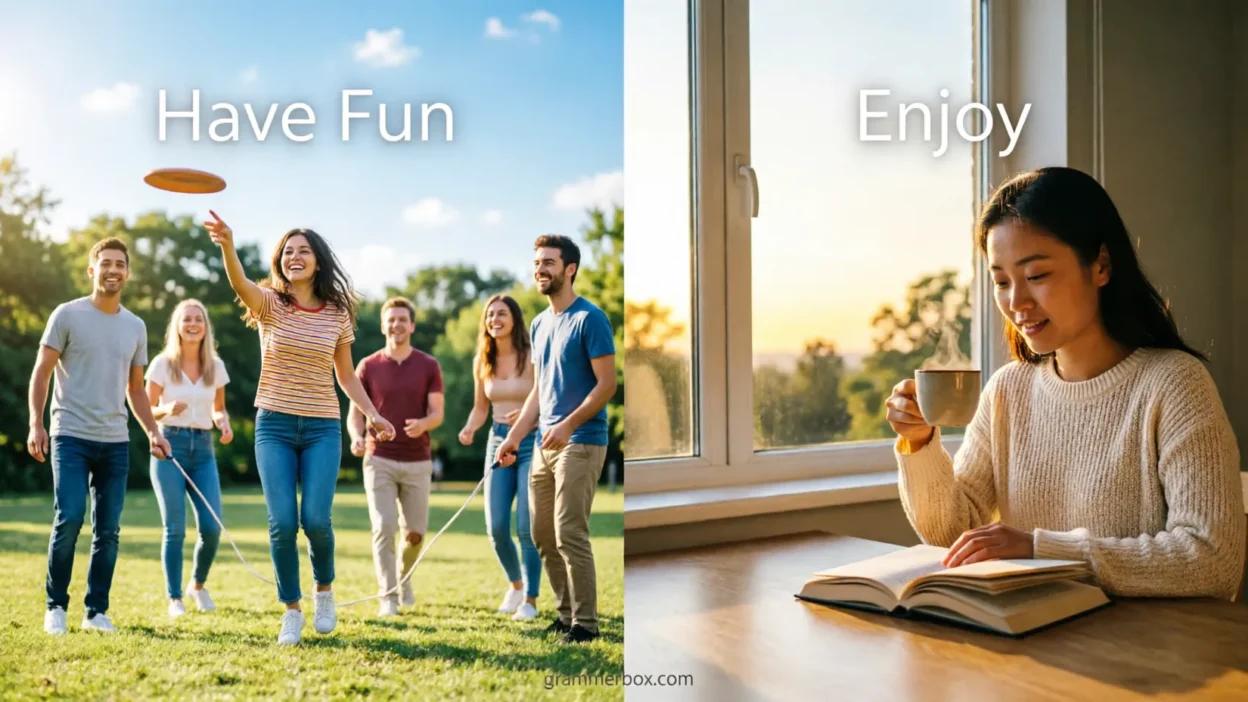
Have fun is an expression meaning to experience enjoyment while doing something.
It is commonly used:
- To encourage someone.
- To wish someone a good time.
- To describe an enjoyable experience.
Examples
- Have fun at the concert!
- We had fun at the beach.
- The children are having fun outside.
- Have fun on your vacation.
- I hope you have fun tonight.
Key Point
Have fun focuses on the experience itself.
What Does “Enjoy” Mean?
Enjoy is a verb that means to take pleasure in someone or something.
Unlike have fun, it usually needs an object.
Examples
- I enjoy reading novels.
- She enjoys Italian food.
- They enjoyed the movie.
- We enjoyed our vacation.
- He enjoys learning English.
Key Point
Enjoy focuses on what gives pleasure.
Have Fun vs Enjoy Comparison Table
| Feature | Have Fun | Enjoy |
|---|---|---|
| Part of speech | Expression | Verb |
| Main meaning | Experience pleasure | Take pleasure in something |
| Needs an object? | No | Usually yes |
| Common use | Wishes, activities, experiences | Activities, hobbies, food, events |
| Formality | Informal to neutral | Neutral to formal |
| Example | Have fun at the party! | Enjoy the party! |
When to Use Each
Use Have Fun When:
- Wishing someone a good time.
- Talking about enjoyable experiences.
- Referring to entertainment or activities.
- Speaking casually.
Examples:
- Have fun at school!
- We’re having fun together.
- Go and have fun.
- They had fun camping.
- Have fun on your trip.
Use Enjoy When:
- Talking about things you like.
- Mentioning hobbies.
- Referring to food, books, movies, or music.
- Writing formally or casually.
Examples:
- I enjoy swimming.
- She enjoys classical music.
- We enjoyed dinner.
- They enjoy traveling.
- He enjoys helping others.
Examples (10+)
Here are more examples showing the difference.
- Have fun at the wedding!
- I hope you have fun this weekend.
- The kids are having fun in the park.
- We had fun playing cards.
- Did you have fun yesterday?
- I enjoy reading before bed.
- She enjoys painting landscapes.
- They enjoyed the concert.
- We enjoy spending time together.
- He enjoys watching documentaries.
- Enjoy your meal!
- I really enjoyed the presentation.
Common Mistakes
Many learners make these errors:
❌ I enjoyed at the party.
✅ I enjoyed the party.
❌ Have enjoy your trip.
✅ Enjoy your trip.
✅ Have fun on your trip.
❌ I have fun reading books every day.
✅ I enjoy reading books every day.
❌ Enjoy at the beach.
✅ Enjoy the beach.
Memory Trick
Here’s an easy way to remember:
- Have fun = Good experience
- Enjoy = Like something
Think of it this way:
Fun happens. Enjoy needs something.
If you’re wishing someone well, choose have fun or enjoy depending on the sentence.
- Have fun at the festival!
- Enjoy the festival!
Both are correct, but enjoy directly refers to the festival, while have fun refers to the overall experience.
American vs British English
Both have fun and enjoy are widely used in American and British English.
There is no major difference in meaning between the two varieties.
Americans may say:
- Have fun!
- Enjoy!
British speakers use these expressions just as naturally.
Neither is considered incorrect or unusual in either dialect.
Similar Words
If you want alternatives, consider these expressions:
- Have a good time
- Take pleasure in
- Appreciate
- Like
- Love
- Delight in
- Relish
- Savor
- Be entertained
- Make the most of
- Celebrate
- Experience joy
Each has slightly different shades of meaning depending on context.
Final Verdict
Both expressions are correct, but they serve different purposes.
Choose have fun when talking about enjoyable experiences or wishing someone a good time.
Choose enjoy when referring to a specific activity, object, event, or experience that gives pleasure.
Learning this small difference makes your English sound much more fluent and natural.
Frequently Asked Questions
Is “have fun” the same as “enjoy”?
Not exactly. Have fun refers to experiencing enjoyment, while enjoy means taking pleasure in something specific.
Can I say “Enjoy your trip”?
Yes. It is completely correct and very common.
Can I say “Have fun on your trip”?
Yes. This is also correct and sounds friendly and natural.
Which is more formal?
Enjoy is slightly more formal because it functions as a standard verb in both speech and writing.
Does “enjoy” always need an object?
Usually yes. You enjoy something, such as a meal, movie, or hobby.
Can I use both in the same sentence?
Yes.
Example:
Have fun, and enjoy your vacation!
Is “have fun” only for children?
No. Adults use it just as often in everyday English.
Conclusion
Although have fun and enjoy both express positive feelings, they are used differently. Have fun focuses on the overall experience and is often used as a friendly wish before someone begins an activity. Enjoy, on the other hand, is a verb that highlights the specific thing a person takes pleasure in, such as a meal, hobby, event, or vacation.
Once you understand this distinction, choosing the right expression becomes much easier. Practice using both in daily conversations and writing, and you’ll sound more fluent and natural. Paying attention to sentence structure is the key to using these common English expressions correctly.
Remember This
Have fun = Enjoy the experience.
Enjoy = Take pleasure in a specific thing.
If you can name what someone likes, use enjoy. If you’re wishing someone a great experience, say have fun.