
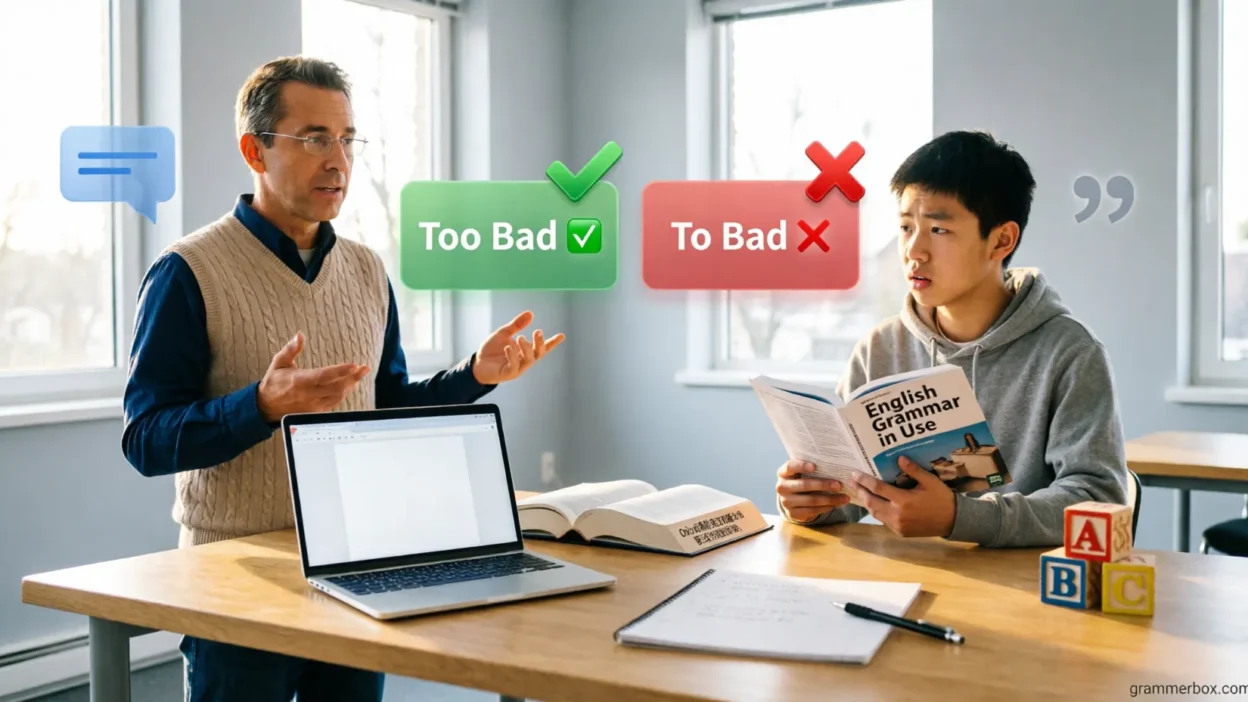
English has many word pairs that look almost identical but have completely different meanings. One common mistake is writing “to bad” instead of “too bad.” Since both words are familiar, it’s easy to type the wrong one without realizing it.
If you’ve ever wondered whether too bad vs to bad is correct, you’re not alone. This guide explains the difference in simple language, provides real-life examples, highlights common mistakes, and shares an easy trick to help you remember the correct form every time.
Quick Answer
“Too bad” is the correct expression when you want to say something is unfortunate, disappointing, or unlucky. “To bad” is almost always incorrect because to is a preposition and does not naturally pair with bad in this expression. In everyday English, you should use too bad whenever expressing sympathy or disappointment.
Why People Confuse “Too Bad” and “To Bad”
The confusion happens because to and too sound exactly alike. They are homophones, meaning they have the same pronunciation but different meanings and spellings.
People often type quickly and accidentally replace too with to, especially in text messages, emails, or social media posts. Spellcheck may not always catch the mistake because to is a correctly spelled word.
What Does “Too Bad” Mean?
Too bad is a common English expression that means:
- Unfortunate
- Disappointing
- Regrettable
- A pity
- Sadly
It can express sympathy, disappointment, or even mild sarcasm depending on the situation.
Examples
- That’s too bad you missed the concert.
- It’s too bad the weather changed.
- Too bad we couldn’t meet yesterday.
- That’s too bad, but maybe next time.
- It’s too bad the store was closed.
What Does “To Bad” Mean?
To bad is not a standard English expression.
The word to is a preposition or part of an infinitive verb. It does not combine with bad to express disappointment.
Although you might occasionally see to bad as part of a larger sentence, such as:
- We went to Bad Ischl in Austria.
Here, Bad is part of a proper place name, not the adjective bad.
Outside of special names, writing “to bad” instead of “too bad” is considered a grammatical mistake.
Too Bad vs To Bad: Comparison Table
| Feature | Too Bad | To Bad |
|---|---|---|
| Correct phrase | ✅ Yes | ❌ No (usually) |
| Meaning | Unfortunate, disappointing | No standard meaning |
| Part of speech | Adverb + adjective | Preposition + adjective |
| Common in conversation | Yes | No |
| Used in formal writing | Yes | No |
| Example | That’s too bad. | That’s to bad. ❌ |
When to Use Each
Use Too Bad when:
- Expressing disappointment
- Showing sympathy
- Saying something is unfortunate
- Reacting to bad news
Examples:
- That’s too bad.
- It’s too bad you couldn’t come.
- Too bad the game was canceled.
- It’s too bad they left early.
Use To Bad
Generally, don’t use it.
Only use to before Bad if Bad is part of a proper noun or place name.
Examples (10+)
Here are more examples showing the correct usage.
- It’s too bad you missed the train.
- That’s too bad for everyone involved.
- I feel it’s too bad the project ended.
- It’s too bad we didn’t have enough time.
- Too bad the restaurant was full.
- That’s too bad, but we’ll try again.
- It’s too bad she couldn’t attend.
- Too bad the movie wasn’t better.
- It’s too bad the flight was delayed.
- That’s too bad you lost your phone.
- It’s too bad the team didn’t win.
- Too bad we have to leave already.
Common Mistakes
Many English learners make these errors:
❌ That’s to bad.
✅ That’s too bad.
❌ It was to bad we arrived late.
✅ It was too bad we arrived late.
❌ I’m sorry, to bad.
✅ I’m sorry. Too bad.
Memory Trick
Here’s an easy way to remember it:
- Too means also or more than enough, and it’s often used for emphasis.
- Too bad emphasizes that something is unfortunate.
Think:
Too = Extra
If you’re emphasizing disappointment, use too.
American vs British English
Both American English and British English use too bad in exactly the same way.
There is no spelling difference between the two varieties of English.
Examples:
- US: That’s too bad you missed class.
- UK: That’s too bad the match was canceled.
The expression is standard and widely accepted in both.
Similar Words and Expressions
If you want alternatives to too bad, try:
- Unfortunately
- What a shame
- That’s unfortunate
- That’s a pity
- Sadly
- Regrettably
- How disappointing
- That’s a shame
- Unluckily
- What a pity
Final Verdict
When comparing too bad vs to bad, the winner is clear.
Too bad is the correct expression for describing something unfortunate or disappointing.
To bad is almost always a spelling mistake unless Bad is part of a proper noun or place name. Whenever you want to express sympathy or disappointment, choose too bad.
FAQs:
Is “to bad” ever correct?
Only in rare situations where Bad is part of a proper noun, such as a place name. Otherwise, it’s incorrect.
Is “too bad” informal?
No. It works in both casual conversations and formal writing, depending on the context.
Why do people write “to bad”?
Because to and too sound the same, making them easy to confuse.
Can I say “that’s too bad”?
Yes. It’s one of the most common ways to express sympathy or disappointment.
Does “too bad” mean impossible?
No. It simply means something is unfortunate or disappointing.
Is “too bad” rude?
Usually not. However, tone matters. It can sound sarcastic if spoken dismissively.
Conclusion
The difference between too bad and to bad is simple once you understand the role of too. Whenever you’re talking about something unfortunate, disappointing, or regrettable, too bad is the correct choice.
Although to bad may appear because of typing mistakes or confusion between homophones, it is not considered correct English in normal writing. Learning this distinction will make your writing clearer, more professional, and grammatically accurate.
Remember This
Use “too bad” whenever you mean unfortunate, disappointing, or a pity.
Never write “to bad” unless Bad is part of a proper noun or place name.