When talking about shopping, errands, or everyday activities, you may wonder whether to say “in the store” or “at the store.” Both expressions are correct, and English speakers use them regularly. However, they emphasize slightly different ideas. Understanding this small difference can help you sound more natural in conversations, emails, and written English. Although the phrases sometimes describe the same situation, the context determines which one fits best.
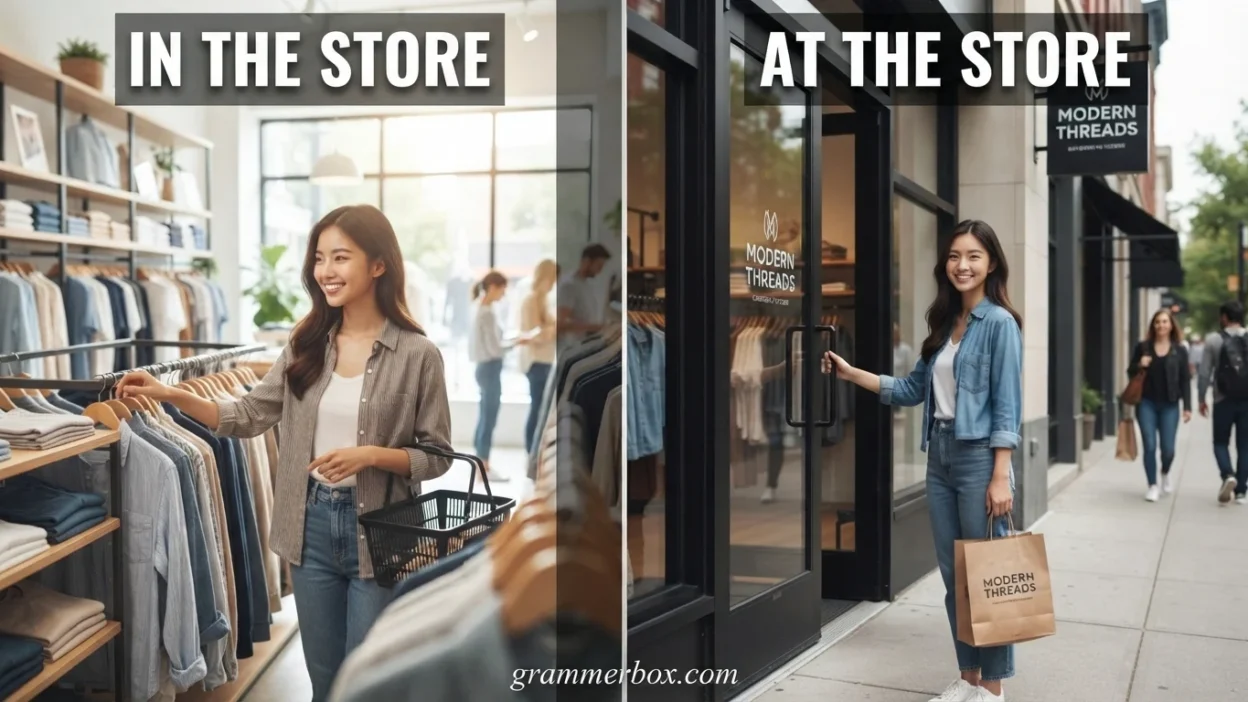
The main difference is that “in the store” usually emphasizes being inside the building, while “at the store” identifies the store as a location or destination. For example, you might say, “I am in the store looking for a jacket,” to highlight what you are doing inside. Alternatively, “I am at the store picking up groceries” simply tells someone where you are. Learning when to use each expression makes it easier to describe your location accurately. In this guide, you will discover their meanings, grammatical differences, practical examples, common mistakes, and useful memory tricks.
Quick Answer
“In the store” emphasizes being inside a store’s building, while “at the store” focuses on the store as a location. Both expressions are grammatically correct and often interchangeable. Use “in” when the interior matters and “at” when simply identifying where someone is or what destination they have reached.
Why People Confuse It
People often confuse “in the store” and “at the store” because both phrases describe someone’s presence at a shopping location. In many everyday situations, they communicate nearly the same information.
For example:
- “She is in the store.”
- “She is at the store.”
Both sentences tell us where she is. However, the first highlights her presence inside the building, while the second identifies the store as her current location.
The confusion also comes from the different meanings of the prepositions “in” and “at.”
- In generally emphasizes being inside an enclosed space.
- At generally identifies a particular place or point on a map.
The difference becomes clearer when you consider the speaker’s intention. If someone asks whether you are inside the building, “in the store” may be more precise. If someone asks where you are, “at the store” is a natural answer.
First Word: In the Store
The expression “in the store” means inside a shop or retail building. It emphasizes the interior space rather than simply naming the location.
Use this phrase when you want to explain that someone is physically inside a store, browsing products, buying something, or working there.
Examples of In the Store
- I am in the store looking for a new pair of shoes.
- The employees are in the store preparing for the morning rush.
- She left her umbrella in the store.
- There are several customers in the store right now.
- We spent an hour in the store comparing prices.
When Is “In the Store” Most Appropriate?
Choose “in the store” when the interior is important to your message.
For example, if your friend asks, “Where did you leave your shopping bag?” you could answer, “I left it in the store near the checkout counter.”
The preposition “in” makes it clear that the bag is inside the building.
You can also use this phrase to describe activities taking place inside a shop, such as browsing shelves, speaking to an employee, or waiting in a checkout line.
Second Word: At the Store
The expression “at the store” means at a particular shopping location. It emphasizes the place itself rather than whether someone is physically inside the building.
This phrase is especially common when explaining where you are, where someone has gone, or where an activity takes place.
Examples of At the Store
- I am at the store buying groceries.
- Dad is at the store, so he cannot answer the phone.
- We met our neighbors at the store yesterday.
- She works at the store near our house.
- I will stop at the store on my way home.
When Is “At the Store” Most Appropriate?
Use “at the store” when the exact interior location does not matter.
For instance, if someone asks, “Where is your brother?” you can simply say, “He is at the store.”
You do not need to explain whether he is walking through the aisles, standing at the checkout, or speaking to a cashier.
The phrase also works naturally when discussing shopping trips, errands, workplaces, and meeting points.
Comparison Table
| Feature | In the Store | At the Store |
|---|---|---|
| Main meaning | Inside the building | At the store location |
| Main emphasis | Interior space | General location |
| Common use | Browsing or finding something inside | Running errands or reporting where you are |
| Example | The keys are in the store. | I am at the store. |
| Focus | Where inside or within the building | Which place or destination |
| Grammatical status | Correct | Correct |
Important: The distinction is about emphasis, not an absolute rule. Someone who is “in the store” is normally also “at the store.” The appropriate phrase depends on what the speaker wants to communicate.
When to Use Each
Choosing the right expression becomes easier when you focus on the meaning of your sentence.
Use “In the Store” When:
- You want to emphasize being inside the building.
- You are describing something located within the shop.
- You are talking about an activity happening inside.
- You need to distinguish the interior from the outside.
Examples:
- The children are playing quietly in the store.
- I found a great discount in the store.
- There is a long line in the store.
- My wallet might be in the store, near the entrance.
Use “At the Store” When:
- You are telling someone your current location.
- You are discussing a shopping trip or errand.
- You are describing a workplace or meeting place.
- You are identifying the store as a destination.
Examples:
- I am at the store right now.
- We will meet at the store after work.
- My sister works at the store on weekends.
- Please stop at the store and buy some milk.
Can You Use Both Phrases in the Same Situation?
Yes. Consider these sentences:
- “I am in the store looking for bread.”
- “I am at the store buying bread.”
Both are natural. The first emphasizes being inside the shop, while the second emphasizes the shopping location.
In everyday conversation, the difference is often subtle. Native English speakers frequently use either expression when the context makes their meaning clear.
Examples: In the Store vs. At the Store
The following examples show how both phrases work in everyday English.
- In the store: I saw a beautiful dress in the store.
At the store: I saw my teacher at the store. - In the store: The air conditioning is not working in the store.
At the store: The manager is at the store today. - In the store: I could not find the product in the store.
At the store: I bought the product at the store. - In the store: There are too many people in the store.
At the store: There were many people at the store during the sale. - In the store: My son is waiting in the store near the toy section.
At the store: My son is at the store with his father. - In the store: The music playing in the store was too loud.
At the store: We heard about the discount at the store. - In the store: I accidentally dropped my phone in the store.
At the store: I accidentally met an old friend at the store. - In the store: Workers are arranging the shelves in the store.
At the store: Workers are arriving at the store early. - In the store: She found her missing receipt in the store.
At the store: She returned the item at the store. - In the store: The children were running around in the store.
At the store: We stopped at the store before dinner. - In the store: I left my shopping basket in the store.
At the store: I left my shopping basket at the store. - In the store: A customer is asking for help in the store.
At the store: A customer is waiting for help at the store.
Notice that some pairs describe almost identical situations. The preposition changes the emphasis, but the overall meaning often remains understandable.
Common Mistakes
Even though both expressions are simple, learners sometimes use them incorrectly or assume they always mean different things.
Mistake 1: Thinking “At the Store” Is Incorrect
Incorrect assumption: “I am at the store” is grammatically wrong.
Correct: “I am at the store.”
This expression is completely natural English when identifying your location.
Mistake 2: Thinking “In the Store” Always Means Shopping
Incorrect assumption: “In the store” can only describe someone shopping.
Correct: “My phone is in the store.”
The phrase can describe people, objects, events, and activities inside the building.
Mistake 3: Using “In” When the Location Is Only a General Meeting Point
Suppose you are arranging to meet a friend outside a supermarket.
Less appropriate if you mean outside: “I will meet you in the store.”
More appropriate: “I will meet you at the store.”
Use “at” when the meeting point is the general location and you do not mean inside the building.
Mistake 4: Assuming “At” Means Outside
Incorrect assumption: “If I am at the store, I must be outside.”
Correct: You can be inside the building and still say, “I am at the store.”
“At” does not automatically mean outside. It simply places you at that location without emphasizing the interior.
Mistake 5: Forgetting That Context Matters
Both phrases can be correct in similar situations. Instead of memorizing rigid rules, consider whether your sentence emphasizes the inside space or the general location.
Memory Trick
Here is an easy way to remember the difference:
IN = Inside. AT = Address or Area.
- In the store: Picture yourself walking between the shelves.
- At the store: Picture the store marked on a map.
Remember these examples:
- “The milk is in the store.” You are emphasizing where the milk is located.
- “I am at the store.” You are telling someone your location.
This simple trick works for many other places, too.
- In the office: Emphasizes being inside the office.
- At the office: Identifies the office as your location.
- In the restaurant: Emphasizes the interior.
- At the restaurant: Identifies the restaurant as the location.
These are useful guidelines rather than absolute rules, because context can affect which preposition sounds most natural.
American vs. British English
Both “in the store” and “at the store” are standard expressions in American and British English. The basic distinction between interior space and general location remains the same.
However, British English often uses the word “shop” where American English commonly uses “store.”
| American English | British English |
|---|---|
| I am at the store. | I am at the shop. |
| I am in the store. | I am in the shop. |
| I stopped at the store. | I stopped at the shop. |
| She is in the grocery store. | She is in the supermarket. |
These are common equivalents, not strict regional rules. British speakers also use “store,” particularly for certain types of retail establishments, and American speakers use “shop” in expressions such as “coffee shop.”
The choice of “in” or “at” generally depends on the intended meaning, not whether the speaker uses American or British English.
Similar Words and Expressions
Understanding related prepositional phrases can help you describe locations more accurately.
1. In the Shop vs. At the Shop
These expressions follow the same basic pattern as “in the store” and “at the store.” The first emphasizes the interior; the second identifies the shop as a location.
2. In the Mall vs. At the Mall
“In the mall” emphasizes being inside the shopping center. “At the mall” identifies the mall as your destination or general location.
Example: “I am at the mall, and I am shopping in the mall’s clothing stores.”
3. In the Supermarket vs. At the Supermarket
“In the supermarket” focuses on the interior. “At the supermarket” identifies the supermarket as the place where you are or are going.
4. In the Office vs. At the Office
“In the office” emphasizes the interior space. “At the office” identifies the workplace as your location.
5. In the Restaurant vs. At the Restaurant
“In the restaurant” emphasizes being inside the dining establishment. “At the restaurant” identifies the restaurant as the location of a meal, meeting, or event.
6. In the Building vs. At the Building
“In the building” means inside the structure. “At the building” identifies the building as the location, possibly without specifying whether someone is inside or outside.
FAQs:
1. Is it “in the store” or “at the store”?
Both are correct. Use “in the store” to emphasize being inside the building and “at the store” to identify the store as your location or destination.
2. Does “at the store” mean you are outside?
No. “At the store” does not specify whether you are inside or outside. It identifies your location generally, and you can use it while shopping inside the building.
3. Is “I am in the store” grammatically correct?
Yes. It is a grammatically correct sentence that usually means you are physically inside a shop or retail building.
4. Can I say “I am at the store shopping”?
Yes. This is natural English. The phrase identifies your location, while “shopping” explains what you are doing there.
5. Which phrase is better for everyday conversation?
Both are common. “I am at the store” is a natural way to report your location, while “I am in the store” is useful when being inside matters.
6. Should I use “in” or “at” when meeting someone?
Use “at the store” when the store is the general meeting point. Use “in the store” when you specifically mean that the meeting should happen inside.
7. Are “in the store” and “at the store” used differently in British English?
The same basic distinction applies in British English. British speakers often say “shop” instead of “store,” but both prepositions work in the same general way.
8. Is “I bought it at the store” correct?
Yes. “At the store” naturally identifies where the purchase happened. You can also say “I bought it in the store” when emphasizing the shopping activity inside the building.
Final Verdict
The difference between “in the store” and “at the store” is mainly about emphasis. “In the store” focuses on the inside of the building, whereas “at the store” identifies the store as a general location. Both expressions are grammatically correct, widely used, and appropriate in everyday English.
When choosing between them, think about the information you want to communicate. If you are describing something happening inside the shop, “in the store” may be the clearer option. If you are telling someone where you are, arranging a meeting, or talking about an errand, “at the store” is often the more natural choice. You do not need to treat the two phrases as completely separate because their meanings frequently overlap.
Remember This
- In the store = Emphasizes the interior of the building.
- At the store = Emphasizes the general location or destination.
- Both expressions are correct in American and British English.
- Context determines which phrase communicates your meaning most clearly.
Quick tip: If you are thinking about the inside, choose “in.” If you are identifying the place, choose “at.”