
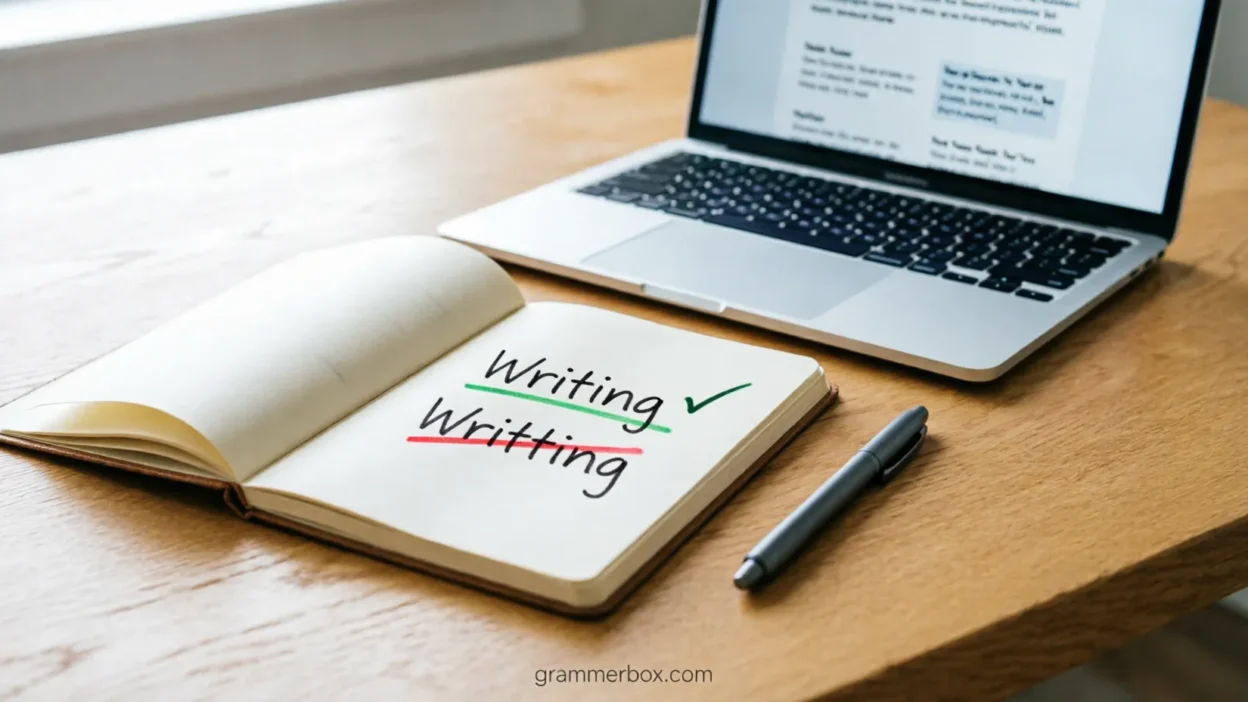
If you have ever paused while typing the word writing, you may have wondered whether writing or writting is correct. The confusion is understandable because English spelling rules sometimes require a consonant to be doubled when a suffix is added. However, the word writing follows a different pattern, making the extra t incorrect.
The correct spelling is writing, with only one t. It is the present participle and gerund form of the verb write. You will see it in sentences about creating text, composing stories, taking notes, or communicating through words.
Writting is a common spelling mistake and is not accepted as the standard English spelling. In this guide, we will explain why the error happens, compare both forms, provide practical examples, and give you an easy memory trick so you can spell writing correctly every time.
Quick Answer
Writing is the correct spelling. Writting is incorrect in standard English. The word writing comes from write and drops the final e before adding -ing, resulting in writing, not writting.
Why People Confuse It
The confusion usually comes from English doubling rules.
When adding -ing, some words double their final consonant:
- run → running
- sit → sitting
- swim → swimming
Because these familiar examples contain a doubled consonant, people sometimes assume that write should become writting.
However, write follows a different spelling pattern. The final e is removed before -ing is added:
write → writing
There is no need to double the t.
First Word: Writing
Writing is the correct and standard English spelling.
It is formed from the verb write:
write + -ing → writing
The word can function as a gerund or present participle.
As a gerund
A gerund acts like a noun:
- Writing takes patience.
- Writing is one of my favorite hobbies.
- Good writing requires practice.
As a present participle
It can also form part of a continuous verb phrase:
- She is writing an email.
- They are writing a new book.
- He was writing in his notebook.
Meaning of Writing
Writing generally refers to the act or process of producing words, sentences, stories, articles, messages, or other forms of written communication.
Second Word: Writting
Writting is an incorrect spelling in standard English.
Although you may encounter it in informal online writing, social media posts, comments, or messages, it should not be used in formal or professional English.
For example:
- ❌ I am writting an article.
- ✅ I am writing an article.
The mistake happens because the writer incorrectly doubles the t in write.
Remember:
write → writing
Not:
write → writting
Comparison Table
| Word | Correct? | Meaning | Example |
|---|---|---|---|
| Writing | ✅ Yes | The act of producing written words | She enjoys writing stories. |
| Writting | ❌ No | Incorrect spelling of writing | I am writting a letter. |
The key difference is simple: writing has one “t,” while writting incorrectly has two.
When to Use Each
Use “Writing”
Use writing whenever you mean the act of producing written language.
Examples include:
- writing a letter
- writing an essay
- writing a novel
- writing notes
- writing an email
- writing a report
You can also use it when discussing writing as a skill:
Her writing has improved significantly.
Do Not Use “Writting”
Avoid writting in academic assignments, resumes, business communication, articles, emails, and other forms of standard English.
If you see yourself typing two t’s, stop and remember the correct form:
Writing = W-R-I-T-I-N-G
Examples of Writing in Sentences
Here are several examples showing how writing is correctly used:
- I am writing a letter to my friend.
- She enjoys writing short stories.
- He is writing an important report.
- Writing every day can improve your vocabulary.
- They are writing their final exams.
- My teacher praised my writing skills.
- She spent the evening writing in her journal.
- He is writing an article about grammar.
- Writing clearly makes communication easier.
- I started writing my assignment after dinner.
- Good writing requires careful editing.
- The author is writing a new novel.
Notice that writing always contains only one t.
Common Mistakes
Here are some frequent mistakes involving writing:
1. Adding an extra “t”
❌ She is writting a story.
✅ She is writing a story.
2. Forgetting the “i”
❌ He is witing a report.
✅ He is writing a report.
3. Keeping the final “e”
❌ She is writeing a letter.
✅ She is writing a letter.
The spelling changes from write to writing, not writeing or writting.
4. Confusing “writing” with “written”
These are different forms:
- writing — She is writing a book.
- written — She has written a book.
Memory Trick
Use this simple trick:
“Write loses its E before ING, but it does not double T.”
Think of the spelling this way:
WRITE − E + ING = WRITING
You can also remember:
This quick rule can help you avoid the common writting spelling error.
American vs. British English
There is no difference between American and British English when it comes to the spelling of this word.
Both varieties use:
writing
Examples:
- American English: She is writing an article.
- British English: She is writing an article.
So, whether you are writing for an American audience or a British audience, writing is the correct spelling.
Similar Words
Understanding related forms can make the spelling easier to remember.
- Write — to produce words using written symbols.
- Writing — the act of producing written words.
- Writes — third-person singular form of write.
- Wrote — simple past tense of write.
- Written — past participle of write.
- Writer — a person who writes.
- Rewrite — to write something again or differently.
- Handwriting — writing produced by hand.
- Typewriting — writing produced using a typewriter.
- Writing style — the particular way someone expresses ideas in written form.
FAQs:
Is “writing” or “writting” correct?
Writing is correct. Writting is a misspelling and should be avoided in standard English.
Why is writing spelled with one T?
The word write drops its final e before adding -ing. The result is writing, with one t.
Is “writting” ever correct?
No. Writting is not the standard spelling of the word in English.
What is the verb form of writing?
Writing comes from the verb write. It can function as a gerund or present participle.
Is “writeing” correct?
No. The correct form is writing. The final e in write is removed before adding -ing.
What is the past tense of write?
The simple past tense is wrote.
Example: She wrote a letter yesterday.
What is the past participle of write?
The past participle is written.
Example: He has written three articles.
Final Verdict
The correct spelling is writing, not writting. The extra t is a common spelling mistake caused by confusion about when English doubles final consonants before adding -ing.
Remember that write becomes writing by dropping the final e and adding -ing. There is no consonant doubling involved. Whether you are writing an essay, email, story, report, or social media post, writing is the form you should use.
Remember This
Writing = Correct ✅
Writting = Incorrect ❌
The easiest formula is:
WRITE − E + ING = WRITING
So whenever you are unsure, remember: one T in “writing.”
Conclusion
Choosing writing instead of writting is a small spelling decision, but getting it right helps your English look polished and professional. The correct form follows a straightforward pattern: remove the final e from write and add *-ing.
Once you remember that write becomes writing without doubling the t, this common spelling confusion becomes much easier to avoid. Keep the simple rule in mind, and you will consistently use the correct spelling in academic, professional, and everyday English.