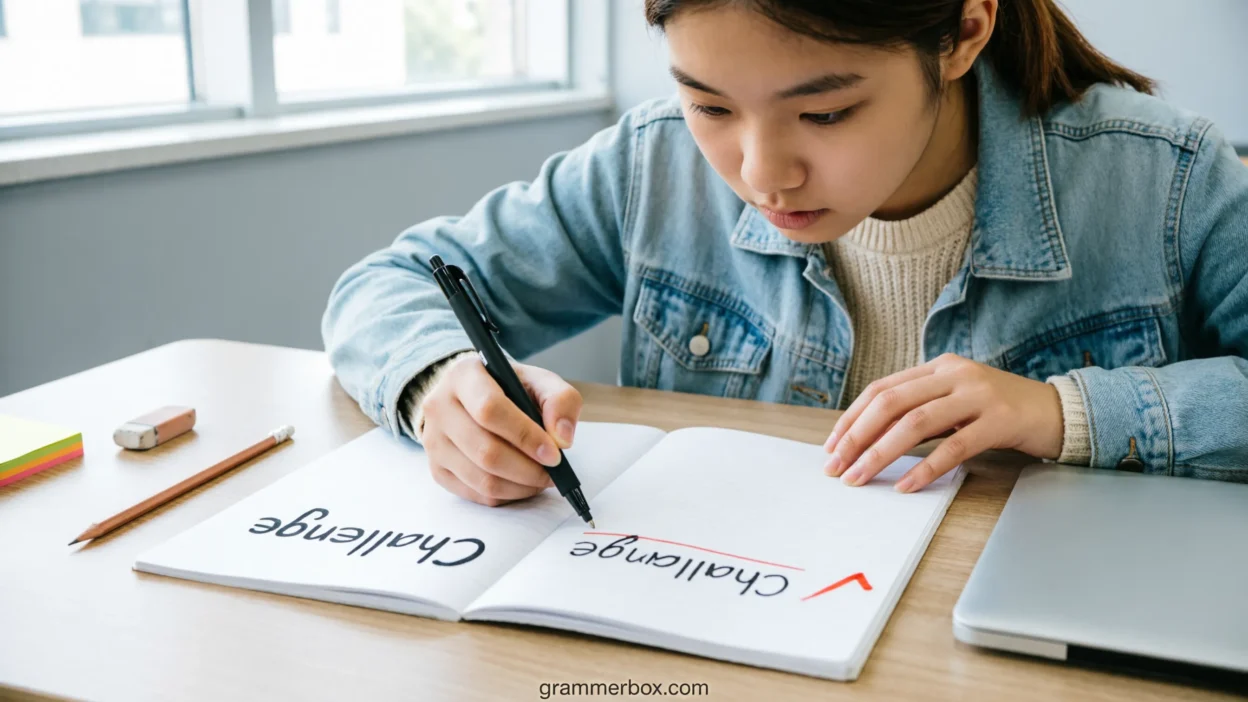
If you have ever hesitated between Challenge or Challange, you are not alone. The two spellings look almost identical, so it is easy to type the extra “a” without noticing. However, only one of them is the standard spelling in English. Knowing the correct form can help you write more confidently in emails, school assignments, professional documents, and everyday conversations.
The confusion usually comes from the way challenge is pronounced. When we say the word quickly, the vowel sounds can make the spelling difficult to remember. In this guide, you will learn the correct spelling, understand why challange is incorrect, and see how to use challenge naturally in different sentences.
We will also cover common mistakes, similar words, American and British English usage, and a simple memory trick that makes the correct spelling easier to remember.
Quick Answer
Challenge is the correct spelling. Challange is a common misspelling and is not considered standard English. Use challenge when referring to a difficult task, a demanding situation, an invitation to compete, or the act of questioning something.
Why People Confuse It
The main reason people confuse challenge and challange is pronunciation.
When spoken quickly, the middle vowel sound in challenge may not be very noticeable. This can make writers incorrectly assume that the word contains “a” after the “ll.”
Another reason is that English spelling does not always perfectly match pronunciation. Words can sound similar while being spelled differently, so relying only on pronunciation can lead to mistakes.
For example:
- Correct: This project is a real challenge.
- Incorrect: This project is a real challange.
The extra a in challange does not belong there.
First Word: Challenge
Challenge is the correct and standard English spelling.
It can function as both a noun and a verb.
As a noun
A challenge is something difficult that requires effort, skill, or determination.
- Learning a new language can be a challenge.
- Completing the marathon was a major challenge.
- The exam presented a difficult challenge.
As a verb
To challenge someone can mean to question, confront, compete with, or encourage someone to prove something.
- I challenge you to finish the puzzle.
- The lawyer challenged the evidence.
- She challenged the decision.
Second Word: Challange
Challange is incorrect in standard English.
It is simply a misspelling of challenge. Although you may see it in informal writing, social media posts, comments, or user-generated content, it should not be used in formal or professional writing.
For example:
- ❌ The assignment was a difficult challange.
- ✅ The assignment was a difficult challenge.
If you are writing an essay, resume, email, article, report, or academic paper, always use challenge.
Comparison Table
| Word | Correct? | Meaning | Example |
|---|---|---|---|
| Challenge | ✅ Yes | A difficult task or situation; to question or compete | The project was a challenge. |
| Challange | ❌ No | Misspelling of challenge | Avoid this spelling. |
The key point is simple: challenge is correct, while challange is incorrect.
When to Use Each
Use “Challenge” When Talking About Difficulty
Use challenge for something that requires effort or skill.
Starting a business is a significant challenge.
Use “Challenge” for Competition
You can also use it when someone invites another person to compete.
I challenge you to a game of chess.
Use “Challenge” for Questioning Something
The verb challenge can mean to question or dispute something.
The researchers challenged the earlier conclusion.
Do Not Use “Challange”
There is no standard English situation where challange should replace challenge.
If you are unsure, remember that the correct spelling contains -enge, not -ange.
Examples of Challenge in Sentences
Here are more examples showing how challenge works in everyday English:
- Learning to drive was a big challenge for me.
- The students accepted the challenge enthusiastically.
- Climbing the mountain will be a serious challenge.
- She decided to challenge herself by running a marathon.
- The team faced a new challenge this season.
- He challenged his friend to a tennis match.
- The manager challenged the accuracy of the report.
- Finding a solution was the biggest challenge.
- Every new skill comes with its own challenge.
- They successfully overcame the challenge.
- The difficult assignment challenged the entire class.
- She enjoys taking on a new challenge.
- The athlete was ready for the challenge.
- The journalist challenged the official explanation.
Common Mistakes
1. Adding an Extra “A”
The most common error is writing challange instead of challenge.
- ❌ Challange
- ✅ Challenge
2. Trusting Pronunciation Too Much
English pronunciation can sometimes hide important spelling patterns. Always remember the written form rather than spelling the word based entirely on how it sounds.
3. Using the Misspelling in Formal Writing
Even though challange may appear online, it is not an accepted standard spelling.
Use challenge in:
- Academic assignments
- Business emails
- Resumes
- Reports
- Blog articles
- Applications
- Professional documents
4. Confusing Related Words
The noun is challenge, while common verb forms include challenge, challenged, and challenging.
Examples:
- challenge
- challenges
- challenged
- challenging
Memory Trick
Here is an easy way to remember the spelling:
Challenge has “ENGE” at the end.
Think:
Do not let the pronunciation trick you into adding an “a.”
Another useful reminder is:
A challenge is something that can “engage” your effort.
Both challenge and engage contain the useful “eng” spelling pattern.
American vs British English
There is no spelling difference between American and British English for this word.
Both varieties use:
challenge
American English:
The project was a difficult challenge.
British English:
The project was a difficult challenge.
The misspelling challange is not a standard alternative in either variety.
Similar Words
Depending on the context, several words can have a meaning similar to challenge.
As a noun
- difficulty
- obstacle
- problem
- test
- trial
- hurdle
- task
- struggle
For example:
Completing the course was a difficult challenge.
You could also say:
Completing the course was a difficult task.
As a verb
Depending on the intended meaning, alternatives include:
- question
- dispute
- confront
- oppose
- test
- compete
- dare
The best synonym depends on the context because challenge has several meanings.
Final Verdict
The correct spelling is challenge.
Challange is a spelling mistake and should be avoided in standard English. Whether you are describing a difficult task, competing with someone, or questioning an idea, challenge is the form you should use.
The easiest way to remember it is to focus on the ending: challenge = -enge. Once you recognize that pattern, the incorrect challange becomes much easier to spot.
FAQs:
Is “challange” a correct word?
No. Challange is a common misspelling of challenge and is not considered standard English.
Which is correct: challenge or challange?
Challenge is correct. Challange is incorrect.
Why do people spell challenge as challange?
People often make this mistake because of pronunciation. The vowel sound in the middle of challenge can make the spelling difficult to remember.
How do you spell challenge correctly?
The correct spelling is C-H-A-L-L-E-N-G-E: challenge.
Is challenge the same in American and British English?
Yes. Both American and British English use the spelling challenge.
What is the plural of challenge?
The plural is challenges.
Example:
The team faced several challenges during the project.
What is the adjective form of challenge?
The common adjective or participial form is challenging.
Example:
It was a challenging assignment.
Conclusion
When choosing between Challenge or Challange, there is a clear winner: challenge. It is the correct spelling in standard English, while challange is simply a common spelling error. The word can be used as both a noun and a verb, making it useful in academic, professional, and everyday communication.
If you frequently make this mistake, remember the ending -enge in challenge. Paying attention to this small spelling pattern can help you avoid the extra “a” and write with greater confidence. If you are describing a difficult task, questioning an idea, or inviting someone to compete, always choose challenge.
Remember This
Challenge = correct ✅
Challange = incorrect ❌
Think: chall + enge =challenge.