
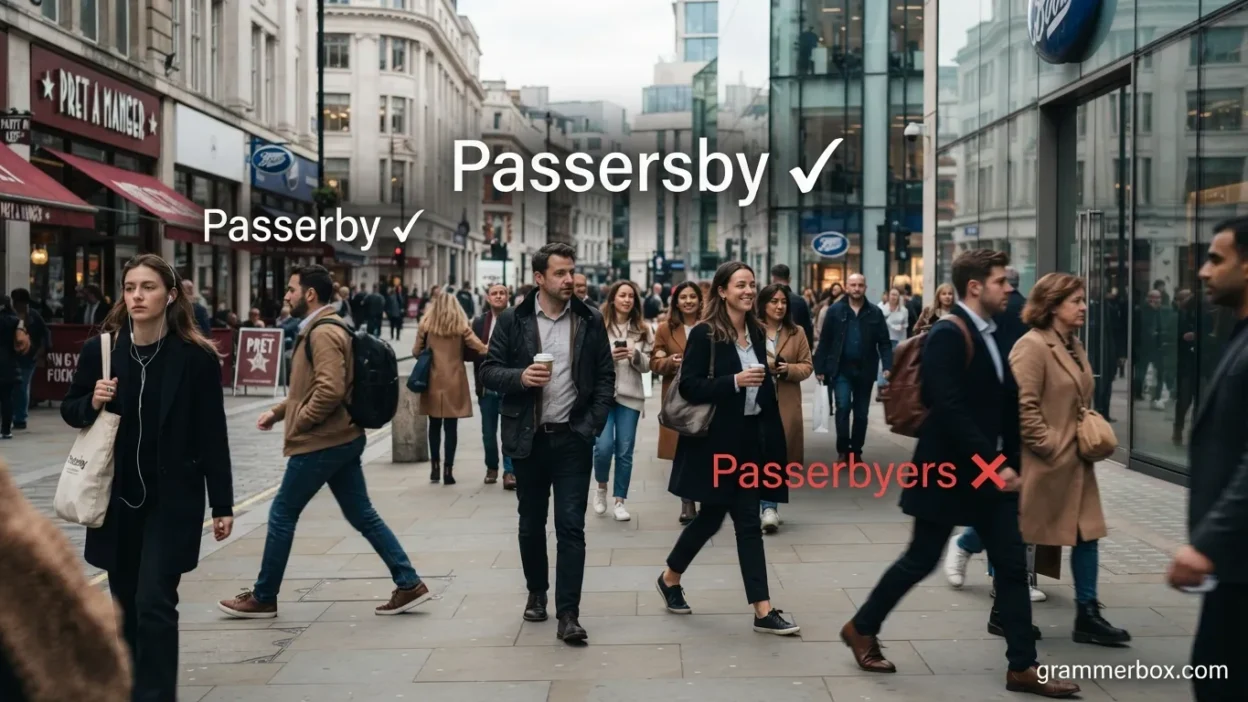
English has many words whose plural forms do not follow the usual pattern, and passerby is a good example. If you have ever wondered whether the correct forms are passerby, passersby, or passerbyers, you are not alone. These words look similar, but only two are standard English forms, and they have different meanings based on whether you are talking about one person or more than one person.
The confusion usually comes from treating passerby like an ordinary noun and adding -ers to make it plural. However, the word has a special structure: passer is the noun describing a person who passes, while by is part of the compound word.
Understanding this structure makes the plural much easier to remember. In this guide, you will learn the correct spelling, meaning, pronunciation, plural form, common mistakes, and plenty of examples of passerby vs passersby vs passerbyers.
Quick Answer
Passerby is the correct singular form, while passersby is the standard plural form. Passerbyers is generally incorrect and should be avoided in standard English. Say “one passerby” but “two passersby” when referring to people passing by.
Why People Confuse It
The main reason people confuse these forms is that passerby looks like an ordinary compound noun. When speakers want to make it plural, they may naturally add -s or -ers to the end.
For example:
- One passerby
- Two passersby ✓
- Two passerbyers ✗
The unusual plural form comes from the structure of the compound noun. In passerby, passer is the part that describes the person, while by functions as the accompanying particle.
Because the plural changes passer rather than simply adding a suffix to the entire word, passersby is the accepted plural.
Another source of confusion is the word passers. Someone may reason that if passer becomes passers, then passerby should become passerbyers. That logic sounds reasonable, but it does not produce the standard English plural.
First Word: Passerby
Passerby is the correct singular noun.
It refers to one person who happens to be passing a particular place.
Meaning of passerby
A passerby is someone who is walking or moving past a person, building, street, event, or other location.
Examples:
- A passerby stopped to help the injured cyclist.
- The passerby noticed smoke coming from the building.
- I asked a passerby for directions.
- A kind passerby returned the lost wallet.
When you are talking about exactly one person, use passerby.
Second Word: Passersby
Passersby is the standard plural form of passerby.
It means two or more people who are passing by.
The plural is formed by changing passer to passers while keeping by at the end:
passerby → passersby
Examples:
- Several passersby stopped to watch the performance.
- The passersby ignored the unusual noise.
- Two passersby helped the driver.
- Many passersby gathered around the street performer.
Although passersby may look unusual, it is the correct standard form.
What About “Passerbyers”?
Passerbyers is generally considered incorrect in standard English.
It is easy to understand why someone might create this form. The ending -er appears in many English words for people, such as runner, worker, and driver. However, passerby already contains the word passer, so adding another -er creates an unnecessary and nonstandard form.
Use:
- One passerby ✓
- Several passersby ✓
- Several passerbyers ✗
If you are writing an essay, article, report, email, or other formal text, avoid passerbyers.
Comparison Table
| Word | Correct? | Number | Meaning | Example |
|---|---|---|---|---|
| Passerby | ✓ | Singular | One person passing by | A passerby called for help. |
| Passersby | ✓ | Plural | Two or more people passing by | Several passersby stopped. |
| Passerbyers | ✗ | Intended plural | Nonstandard attempt at pluralizing passerby | Avoid this form. |
Simple rule
One = passerby
More than one = passersby
When to Use Each
Use “passerby” for one person
Choose passerby when the noun refers to a single individual.
- A passerby helped me.
- The passerby called the police.
- I spoke with a passerby.
Use “passersby” for multiple people
Choose passersby when referring to two or more people.
- Several passersby witnessed the accident.
- The passersby moved away from the crowd.
- A group of passersby gathered nearby.
Avoid “passerbyers”
Do not use passerbyers in standard English.
Instead, replace it with passersby.
Incorrect: The passerbyers watched the parade.
Correct: The passersby watched the parade.
Examples: Passerby and Passersby in Sentences
Here are more examples to make the difference clear:
- A passerby noticed that the child was lost.
- The passerby offered to call the child’s parents.
- Several passersby stopped near the accident.
- Two passersby helped move the bicycle.
- A friendly passerby gave us directions.
- Many passersby admired the artist’s work.
- The police asked a passerby what he had seen.
- Several passersby gathered outside the store.
- One passerby heard the alarm first.
- The passersby continued walking despite the rain.
- A passerby found the missing phone.
- Dozens of passersby watched the street performance.
Notice the pattern: passerby is used with singular nouns such as a, one, or the, while passersby is used with plural quantities such as several, many, two, or dozens.
Common Mistakes
1. Using “passerbyers”
Incorrect: Several passerbyers saw the accident.
Correct: Several passersby saw the accident.
2. Using “passerbys”
Some writers simply add -s to the end.
Incorrect: Three passerbys were standing outside.
Correct: Three passersby were standing outside.
The plural s belongs after passer, not at the very end.
3. Confusing singular and plural
Incorrect: Many passerby watched the show.
Correct: Many passersby watched the show.
Since many requires a plural noun, passersby is needed.
4. Using “passersby” for one person
Incorrect: A passersby helped me.
Correct: A passerby helped me.
5. Treating it like “passer-byers”
The word is not normally pluralized by adding -ers. Remember its established compound-noun pattern instead.
Memory Trick
Use this simple trick:
Passerby = one person passes by.
Passersby = several people pass by.
Think of the plural as:
passer + s + by = passersby
Do not add another -er.
A quick mental sentence can help:
If you remember that pair, you will rarely need to think about passerbyers again.
American vs British English
The standard forms passerby and passersby are used in both American and British English.
There is no major American-versus-British difference in the basic singular and plural forms.
For example, both varieties can use:
- An American article: “A passerby helped the tourist.”
- A British article: “A passerby helped the tourist.”
- American English: “Several passersby saw the event.”
- British English: “Several passersby saw the event.”
The spelling and pluralization remain essentially the same in standard usage.
Similar Words
Several words have meanings related to passerby.
Bystander
A bystander is someone who is present at an event but is not directly involved.
Example: A bystander called emergency services.
Pedestrian
A pedestrian is a person traveling on foot, especially in relation to roads and traffic.
Example: The pedestrian waited for the light to change.
Onlooker
An onlooker is someone who watches an event or situation.
Example: Several onlookers watched the performance.
Spectator
A spectator is someone who watches an event, especially a competition or show.
Example: The spectators cheered loudly.
Passerby
A passerby specifically refers to someone who is passing a particular place or person.
Example: A passerby noticed the broken window.
These words can overlap in some contexts, but they are not always interchangeable.
Final Verdict
The correct forms are straightforward once you understand the pattern:
- Passerby = singular
- Passersby = plural
- Passerbyers = nonstandard/incorrect
If you are talking about one person walking or moving past something, use passerby. If you are talking about several people, use passersby.
The most important point is that the plural s appears inside the compound: passersby, not passerbys or passerbyers.
FAQs:
Is “passersby” the correct plural of “passerby”?
Yes. Passersby is the standard plural form of passerby.
Is “passerbyers” a word?
Passerbyers is not the standard plural form. In formal and standard English, use passersby instead.
Is “passerbys” correct?
No. The standard plural is passersby, with the plural marker attached to passer.
What is the singular of “passersby”?
The singular form is passerby.
One passerby → two passersby.
Do you hyphenate “passerby”?
Passerby is normally written as one word. The plural is also one word: passersby.
Can I use “passerby” for a woman?
Yes. Passerby is gender-neutral and can refer to any person passing by.
Is “passers-by” correct?
Passers-by is an older or alternative hyphenated spelling that you may encounter, particularly in some British usage and older texts. Passersby is the common modern form.
Conclusion
Choosing between passerby, passersby, and passerbyers becomes easy when you focus on number. Passerby refers to one person who passes by, while passersby refers to two or more people. The form passerbyers may seem logical at first, but it is not the standard plural.
For clear, polished English, remember the simple pair: one passerby, several passersby. Whether you are writing an academic assignment, website content, professional message, or everyday sentence, this rule will help you avoid one of the most common pluralization mistakes involving compound nouns.
Remember This
One person = passerby
Two or more people = passersby
Passerbyers = avoid
The easiest rule is: passerby → passersby.