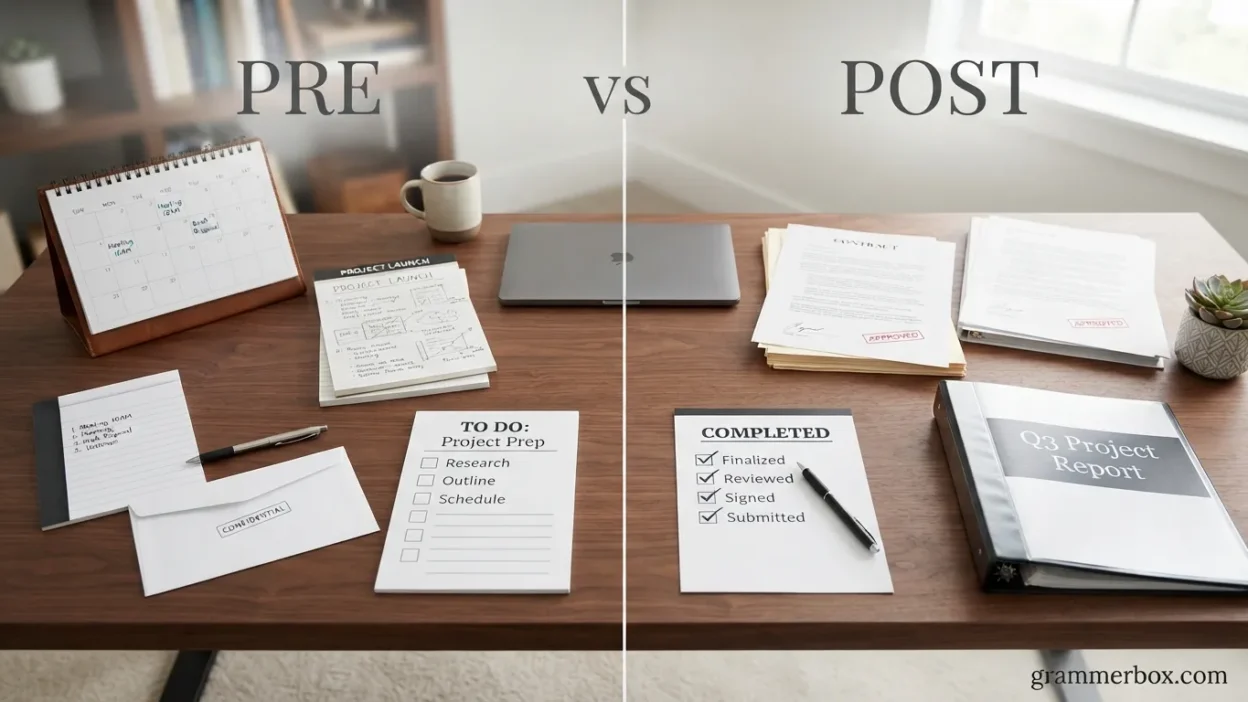
The words pre and post are short, common terms that can be confusing because both describe a relationship to an event, action, or time. Their meanings are actually quite straightforward: pre generally means “before,” while post generally means “after.” You will see them frequently in formal writing, academic language, business communication, medicine, technology, and everyday English.
The confusion usually happens when these words appear as prefixes, standalone terms, or parts of compound expressions. For example, pretest happens before a test, while posttest happens afterward.
Understanding this simple time relationship makes it much easier to choose the correct word. In this guide, we will explain pre vs post, show how each word works, compare their meanings, and provide practical examples so you can use them confidently in your writing and speech.
Quick Answer
Pre means “before,” while post means “after.” Use pre for something that happens before an event, process, or period. Use post for something that happens afterward. For example, pre-game means before a game, while post-game means after it.
Why People Confuse Pre and Post
People often confuse pre and post because both are commonly attached to other words to create new terms.
For example:
- Pre-event = before an event
- Post-event = after an event
- Preoperative = before an operation
- Postoperative = after an operation
- Prewar = before a war
- Postwar = after a war
The key difference is the time relationship.
Think of an event as a central point:
PRE → EVENT → POST
Once you remember this sequence, choosing between the two becomes much easier.
Pre: Meaning and Usage
Pre means before. It is commonly used as a prefix to indicate that something happens earlier than a particular event, activity, condition, or period.
The prefix pre- comes from Latin and carries the idea of something occurring beforehand.
Common examples of pre-
- Pretest — a test given before instruction or a main test
- Preview — something viewed before the main event
- Prepayment — payment made before it is due
- Preorder — an order placed before a product is available
- Preseason — the period before the main sports season
- Prehistoric — relating to the time before recorded history
Example sentences with pre
- We completed a pretest before starting the lesson.
- Customers can preorder the new phone.
- The coach scheduled a preseason training camp.
- Please make a prepayment before the service begins.
- The teacher gave us a preview of tomorrow’s topic.
Post: Meaning and Usage
Post generally means after when it functions as a prefix.
Like pre-, the prefix post- is used to show a relationship with time or sequence.
Common examples of post-
- Posttest — a test given after instruction
- Postgame — occurring after a game
- Postwar — relating to the period after a war
- Postgraduate — relating to education after completing an undergraduate degree
- Postoperative — relating to the period after an operation
- Postproduction — work completed after the main production stage
Example sentences with post
- Students took a posttest after completing the course.
- The players attended a postgame interview.
- She is pursuing postgraduate studies.
- The doctor explained the postoperative care instructions.
- The film is currently in postproduction.
Pre vs Post: Comparison Table
| Feature | Pre | Post |
|---|---|---|
| Basic meaning | Before | After |
| Main function | Shows something happens earlier | Shows something happens later |
| Common form | Prefix pre- | Prefix post- |
| Example | Pretest | Posttest |
| Time relationship | Before an event | After an event |
| Example phrase | Pre-event meeting | Post-event review |
| Memory clue | Pre = prior | Post = afterward |
The simplest rule is:
Pre = before
Post = after
When to Use Each
Use pre when you are referring to something that occurs before another event, activity, or period.
For example:
We attended a pre-game meeting.
The meeting happened before the game.
Use post when something occurs after another event, activity, or period.
We attended a post-game meeting.
The meeting happened after the game.
A simple timeline
Pre-event → Main event → Post-event
This pattern works across many contexts:
- Pretest → Test → Posttest
- Preproduction → Production → Postproduction
- Prewar → War → Postwar
- Pre-event → Event → Post-event
Examples of Pre and Post
Here are more examples showing the difference clearly:
- Pretest: The teacher gave students a pretest before teaching the new material.
- Posttest: Students completed a posttest after the lesson.
- Pre-game: The team held a pre-game meeting.
- Post-game: The coach spoke to reporters during the post-game interview.
- Prepayment: The company requires prepayment before beginning the project.
- Postpayment: The contract specifies certain postpayment conditions.
- Pre-event: Staff arrived early for the pre-event preparation.
- Post-event: The organizers conducted a post-event review.
- Preoperative: The patient received preoperative instructions.
- Postoperative: The nurse explained the postoperative recovery process.
- Preproduction: The filmmakers spent several months in preproduction.
- Postproduction: The editing team handled the movie’s postproduction work.
- Prewar: The museum displays photographs from the prewar period.
- Postwar: The book examines changes in postwar society.
Common Mistakes
Mistake 1: Treating pre and post as synonyms
They have opposite time meanings.
Incorrect idea: Pre and post both mean something related to an event.
Correct idea:
- Pre = before
- Post = after
Mistake 2: Choosing based on the word that sounds familiar
Do not choose pre or post simply because one sounds more natural.
Instead, ask:
Did this happen before or after?
Mistake 3: Confusing post as a prefix with post as a noun or verb
The word post has several meanings.
For example:
She wrote a post online.
Here, post means an online publication.
But:
The company conducted a post-event survey.
Here, post- means “after.”
Context determines the meaning.
Mistake 4: Assuming every word beginning with “post” means after
Not every word containing the letters post uses the prefix post-.
For example, postman does not mean “after man.” Its meaning comes from a different use of the word post.
Memory Trick
Use this easy trick:
PRE = PRIOR
Both begin with P, and prior means earlier or before.
POST = AFTER
Think of something being post-event as something that happens after the event.
Remember the timeline:
PRE → NOW/EVENT → POST
If you are unsure, replace the word with before or after.
- Pre-event → before the event
- Post-event → after the event
American vs British English
There is generally no major difference in the basic meanings of pre- and post- between American and British English.
Both varieties use these prefixes to indicate something happening before or after another event.
For example, these forms are understood in both varieties:
- pretest
- posttest
- preseason
- postwar
- preoperative
- postgraduate
There can sometimes be differences in spelling, punctuation, or preferred terminology between American and British English, but the fundamental meanings of pre and post remain the same.
Similar Words
Several words can help express the same time relationships.
Words related to pre
- Before
- Prior
- Earlier
- Previous
- Preliminary
- Antecedent
- In advance
- Ahead of
Words related to post
- After
- Later
- Following
- Subsequent
- Afterwards
- Thereafter
- Subsequently
- In the aftermath
However, these alternatives are not always interchangeable. Pre- and post- are especially useful when forming technical, academic, professional, and compound terms.
FAQs:
Is pre before or after?
Pre means before. It indicates that something happens before an event, action, period, or condition.
Is post before or after?
Post generally means after. It indicates that something occurs following an event, action, period, or condition.
What is the difference between pre and post?
The main difference is timing. Pre refers to something occurring before, while post refers to something occurring after.
Is pre a word or a prefix?
Pre can be used informally as a standalone term, but pre- is most commonly used as a prefix attached to another word, such as pretest or preorder.
Is post always a prefix?
No. Post can be a noun, verb, or prefix. As a prefix, post- means “after,” but the standalone word post has several unrelated meanings.
What is an example of pre and post?
Pretest happens before instruction or a main test, while posttest happens after instruction or the main test.
How can I remember pre vs post?
Remember: PRE = PRIOR = before, while POST = after. Think of a timeline: pre → event → post.
Final Verdict
The difference between pre and post is simple once you focus on sequence. Pre means before, and post generally means after.
Use pre- for something that takes place beforehand, such as a pretest, preseason, or pre-event meeting. Use post- for something that takes place afterward, such as a posttest, postseason, or post-event review.
When in doubt, identify the main event and place the action on the timeline. If it comes before the event, choose pre. If it comes after, choose post.
Remember This
PRE = BEFORE
POST = AFTER
Think of the sequence:
Pre → Event → Post
Once you remember that timeline, choosing between pre and post becomes quick and easy.
Conclusion
Understanding pre vs post is mainly about recognizing time and sequence. Pre signals something that happens before a particular event, while post signals something that happens afterward. These prefixes appear in everyday English as well as academic, medical, business, and technical vocabulary.
The next time you see a word such as pretest, posttest, pre-event, or post-event, pause and identify when the action takes place. That simple habit will help you choose the correct form and avoid common mistakes. Remember the core rule: pre means before, and post means after.