
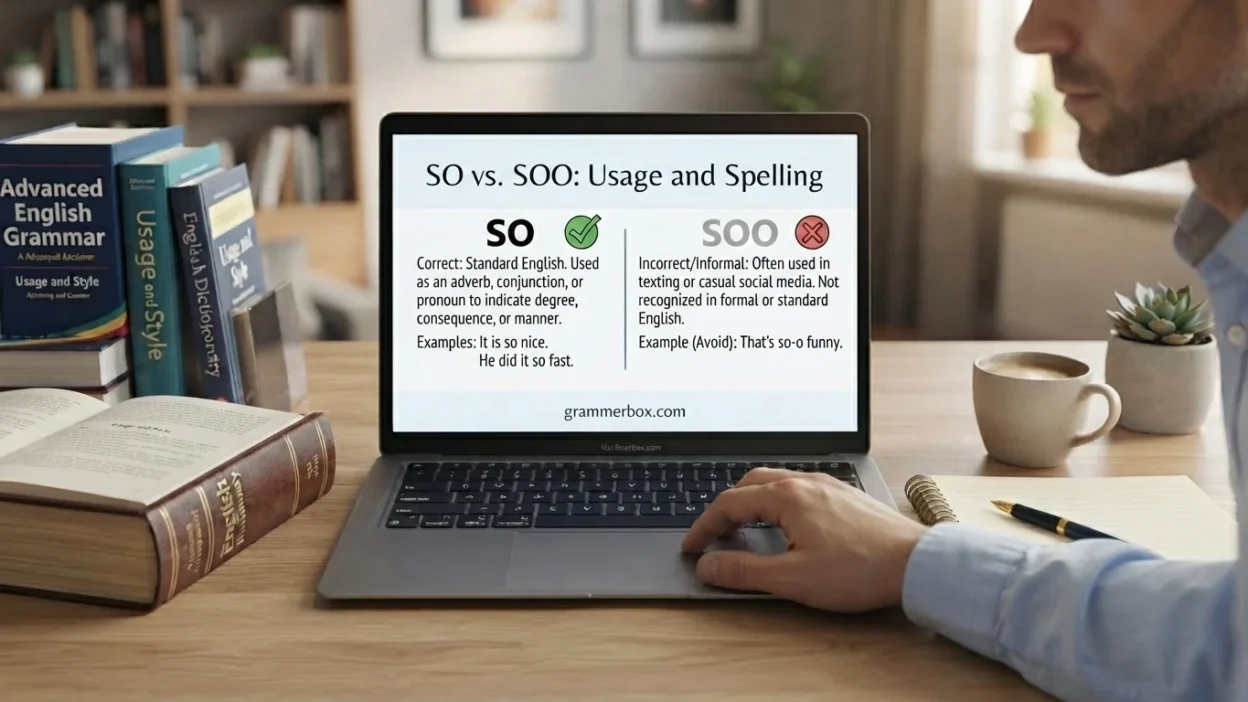
If you have ever wondered whether to write “so” or “soo,” you are not alone. These two forms look almost identical, but they do not have the same status in standard English. So is a correct and extremely common English word, while soo is generally not considered a standard spelling in formal writing. You may still see “soo” in texts, social media posts, comments, or informal online conversations.
Understanding the difference between so vs soo is useful if you want your English to sound natural and grammatically correct. In this guide, we will explain what “so” means, why people sometimes write “soo,” and when each form may appear. You will also see clear examples, common mistakes, a comparison table, and a simple memory trick to help you remember the correct spelling.
Quick Answer
So is the standard English spelling and can mean “to such a degree,” “therefore,” or “in order to.” Soo is usually an informal or playful internet spelling used to stretch the sound of “so,” especially in texting. Use so in standard and formal English.
Why People Confuse It
The confusion comes mainly from informal digital communication.
People sometimes write “soo” to emphasize pronunciation or emotion. For example:
- “I’m soo tired!”
- “That was soo funny!”
- “I missed you soo much!”
In these examples, the extra o does not create a new standard English word. It simply makes the word feel longer or more expressive.
This is similar to writing “sooo” or “soooo.” These spellings can communicate excitement, exaggeration, affection, frustration, or emphasis in casual messages.
However, in essays, emails, academic writing, business communication, and other formal contexts, so is the appropriate choice.
The First Word: So
So is the correct standard spelling.
It has several important uses in English.
1. To show degree
“So” can mean to a great or specified degree.
- The movie was so interesting.
- She was so happy.
- It is so cold today.
2. To show a result
“So” can connect an action with its result.
- I was tired, so I went home.
- It was raining, so we stayed inside.
3. To mean “in order to”
“So” can appear in phrases that express purpose.
- Speak clearly so everyone can understand you.
- I left early so I could catch the train.
4. In expressions and responses
“So” also appears in many common expressions.
- So what?
- So do I.
- So far, everything is fine.
- And so on.
Because “so” has many grammatical functions, it is a very important English word.
The Second Word: Soo
Soo is generally not a standard English spelling of the word “so.”
You may encounter it online, especially in:
- Text messages
- Social media
- Online comments
- Memes
- Casual chats
- Informal fan communities
In these contexts, “soo” may be used intentionally for emphasis.
For example:
“That puppy is soo cute!”
Here, the writer probably means:
“That puppy is so cute!”
The additional o gives the impression that the speaker is stretching the pronunciation.
It can also appear as “sooo,” “soooo,” or even longer forms. These are expressive spellings rather than standard grammatical forms.
Important distinction
If you are writing something that needs correct standard English, choose so, not soo.
So vs Soo: Comparison Table
| Feature | So | Soo |
|---|---|---|
| Standard English word | Yes | No, generally |
| Common in formal writing | Yes | No |
| Used in academic writing | Yes | No |
| Common in texting | Yes | Sometimes |
| Used for emphasis online | Yes | Yes, informally |
| Can show degree | Yes | No |
| Can show a result | Yes | No |
| Standard dictionary spelling | Yes | Generally not as the intended spelling of “so” |
| Best choice for professional writing | Yes | No |
When to Use Each
Use “so” when:
- Writing an essay
- Writing a business email
- Completing schoolwork
- Writing an article
- Communicating professionally
- Taking an English test
- Writing formal correspondence
- Speaking or writing standard English
Examples:
- The instructions were so clear.
- I was late, so I called ahead.
- She studied hard so she could pass the exam.
Use “soo” only in informal contexts
You might use “soo” deliberately in a casual text when you want to exaggerate the word.
For example:
- “I’m soo excited!”
- “That was soo adorable!”
- “You are soo lucky!”
Even then, so is the standard spelling. “Soo” is better understood as playful internet language.
Examples of So vs Soo
Here are more examples showing how the two forms work.
- Standard: The weather is so beautiful today.
- Informal: The weather is soo beautiful today!
- Standard: I am so tired after work.
- Informal: I am soo tired right now.
- Standard: She was so excited about the trip.
- Informal: She was soo excited!
- Standard: It was so funny that everyone laughed.
- Informal: That video was soo funny.
- Standard: I was hungry, so I ordered dinner.
- Standard: Please speak slowly so I can understand.
- Standard: He is so kind to everyone.
- Informal: He is soo sweet!
Notice that the standard form remains so in every example. The informal soo simply adds emotional emphasis.
Common Mistakes
Mistake 1: Using “soo” in formal writing
Incorrect for standard formal English:
The results were soo impressive.
Better:
The results were so impressive.
Mistake 2: Thinking “soo” is a different grammatical word
Usually, it is not. When people write “soo” online, they normally intend the same word so, with extra letters for emphasis.
Mistake 3: Assuming extra letters make a word grammatically stronger
Writing “sooo” can make a message more expressive, but it does not make the grammar more correct.
Mistake 4: Using internet spelling in academic work
Social media conventions do not automatically belong in essays, reports, or professional communication.
Memory Trick
Remember:
So = standard.
Both words have only two letters, and so is the normal dictionary spelling you should use.
Think of it this way:
Formal or correct English? → SO
Playful texting? → SOO can be used for emphasis
When in doubt, choose so.
American vs British English
There is no major American-versus-British spelling difference between so and soo.
American English uses so, and British English also uses so.
For example:
- American English: “It was so good.”
- British English: “It was so good.”
The informal spelling soo is not a standard alternative associated specifically with either variety of English. It is primarily an expressive spelling used in casual digital communication.
Similar Words
Several words and expressions can sometimes appear in contexts where learners wonder about “so.”
Very
“Very” emphasizes an adjective or adverb.
- She is very happy.
- She is so happy.
Too
“Too” can mean more than necessary or also.
- It is too expensive.
- I want to go too.
Such
“Such” is commonly used before a noun phrase.
- It was such a beautiful day.
- She is such a kind person.
Therefore
“Therefore” can show a logical result.
- He was sick; therefore, he stayed home.
Unlike these words, soo is generally not a standard replacement for any of them.
FAQs:
Is “soo” a correct English word?
Usually, no. When “soo” is used as an extended spelling of “so,” it is informal and nonstandard. It is common in texting and online communication but should generally be avoided in formal writing.
Is “sooo” grammatically correct?
“Sooo” is an informal expressive spelling. It can be used intentionally in casual messages to emphasize emotion, but so is the standard form.
Should I use “so” or “soo” in an essay?
Use so. Academic and formal writing should follow standard English spelling and grammar.
Can I use “soo” in a text message?
Yes, if you are deliberately using an informal, playful style. For example, “I’m soo excited!” can convey extra enthusiasm.
Why do people spell “so” as “soo”?
People often add letters to imitate stretched pronunciation or express stronger emotion. Similar patterns include “nooo,” “yesss,” and “sooo.”
Is “soo” British English?
No. “Soo” is not a standard British spelling of “so.” The standard form is so in both British and American English.
Is “so” always correct?
For standard English, so is the correct spelling when you mean the ordinary word “so.” However, the correct word in a sentence can depend on what you are trying to express.
What is the easiest way to remember “so vs soo”?
Remember that so is the standard spelling. Extra letters such as the second “o” are normally used only for informal emphasis.
Final Verdict
The difference between so vs soo is mainly one of standard spelling and informal expression. So is the correct standard English word and has several grammatical functions, including expressing degree, showing a result, and expressing purpose.
Soo, on the other hand, is usually an informal internet spelling. It may appear in texts and social media when someone wants to stretch the pronunciation of “so” for emphasis. It can be fun and expressive, but it should not replace so in formal English.
Remember This
SO = standard English.
SOO = informal, playful emphasis.
If you are writing an essay, email, article, application, or professional message, always choose so.
Conclusion
When deciding between so and soo, the safest choice is simple: use so. It is the standard English spelling and works naturally in both formal and informal communication. If you are expressing degree, showing a result, or introducing a purpose clause, “so” is the form you need.
You may see “soo” online because people often stretch words to show excitement, affection, surprise, or exaggeration. That makes “soo” understandable in casual digital language, but it does not make it the standard spelling. Knowing this small distinction can help you switch confidently between casual internet language and polished English writing.