
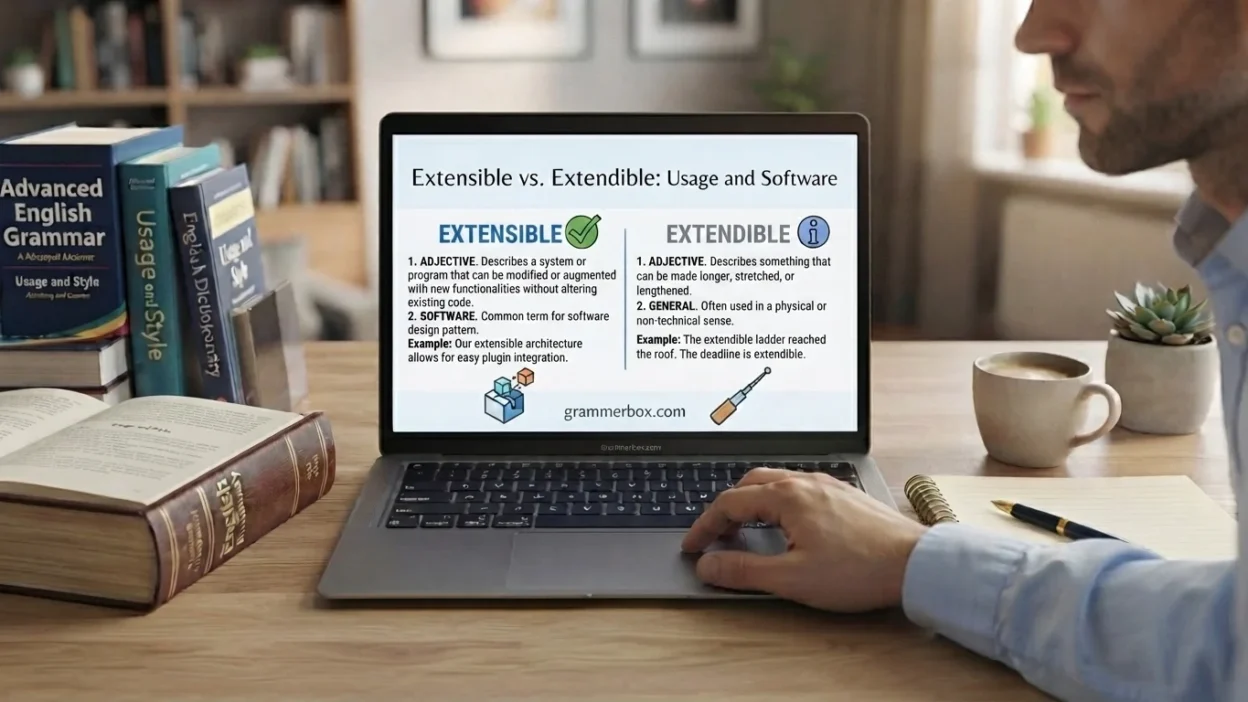
When you see extensible vs extendible, it is easy to assume that one spelling must be wrong. Both words are legitimate English adjectives, and both are related to the verb extend, meaning to make something longer, larger, broader, or more capable. However, they are not always used in exactly the same contexts. Understanding the difference can help you choose the more natural word in technical writing, software documentation, business communication, and everyday English.
The main distinction is one of usage and emphasis. Extensible commonly describes something that can be expanded, modified, or enhanced, especially a system, software platform, framework, or design.
Extendible can also mean capable of being extended, but it is less common in modern usage and may appear more often in general or specialized contexts. This guide explains the meanings, usage patterns, common mistakes, and examples so you can confidently choose between extensible and extendible.
Quick Answer
Extensible and extendible both mean “capable of being extended.” However, extensible is generally the more common choice, especially in technology and software. Use extendible when it specifically fits your context, but extensible is usually the safer and more natural option.
Why People Confuse Extensible and Extendible
The confusion comes from their nearly identical spelling and meaning.
Both words are formed from extend, and both can describe something that can be made longer, broader, or more capable. Their suffixes, -ible and -able, also have similar functions in English.
For example:
- The software is extensible.
- The software is extendible.
Both sentences can be grammatically possible, but the first sounds much more natural in modern technical English.
The key issue is not simply correctness. Frequency, context, and established terminology matter.
Extensible
Extensible means capable of being extended, expanded, or enhanced.
It is especially common when discussing:
- Software
- Programming languages
- Computer systems
- APIs
- Frameworks
- Architecture
- Platforms
- Product designs
Examples
- The platform has an extensible architecture.
- This framework is highly extensible.
- Developers need an extensible API.
- The application was designed to be extensible.
In technology, extensible often suggests that additional features or functionality can be added without completely redesigning the original system.
Simple definition
Extensible = designed or able to be expanded or enhanced.
Extendible
Extendible also means capable of being extended.
It can refer to something that can be made longer, larger, or more extensive.
Examples
- The table has an extendible surface.
- The contract is extendible under certain conditions.
- The handle is extendible to reach higher shelves.
- The agreement contains an extendible renewal period.
Although extendible is a valid word, it is generally less common than extensible, particularly when discussing software or system design.
Simple definition
Extendible = capable of being extended or made longer or larger.
Extensible vs Extendible: Comparison Table
| Feature | Extensible | Extendible |
|---|---|---|
| Basic meaning | Capable of being extended or expanded | Capable of being extended |
| Commonness | More common | Less common |
| Technology | Very common | Uncommon |
| Software | Preferred | Usually avoided |
| General English | Common enough | Possible but less frequent |
| Meaning | Often emphasizes expansion or enhancement | Often emphasizes the ability to extend |
| Example | An extensible software framework | An extendible table |
| Recommended choice | Usually the safer choice | Use when appropriate to context |
When to Use Each
Use “Extensible” for Technology
When talking about software, systems, platforms, or programming, extensible is normally the best choice.
- extensible software
- extensible framework
- extensible architecture
- extensible API
- extensible platform
For example:
The company built an extensible platform that can support future features.
Use “Extendible” When Describing Physical or General Extension
Extendible may work naturally when something can physically or practically be extended.
For example:
We bought an extendible dining table for the larger family gatherings.
However, even here, extendable is often more natural in everyday English.
A Useful Rule
If you are writing about software or systems, choose extensible.
If you mean something that can simply be extended, both extendible and other alternatives such as extendable may be possible depending on the context.
Extensible vs Extendible Examples
Here are examples showing how the two words work in sentences:
- The software has an extensible architecture that supports new modules.
- Our API is designed to be highly extensible.
- The framework provides an extensible plugin system.
- Developers prefer extensible platforms for long-term projects.
- The application uses an extensible design.
- The table has an extendible center section.
- The contract includes an extendible renewal period.
- The handle is extendible for easier access.
- The company developed an extensible system for future upgrades.
- An extensible programming environment allows developers to add functionality.
- The equipment includes an extendible support arm.
- The software was deliberately made extensible for third-party developers.
Notice that extensible is particularly natural when the idea involves adding functionality or capabilities.
Common Mistakes
1. Assuming “Extendible” Is Incorrect
Extendible is not automatically wrong. It is a legitimate adjective.
The problem is that it is less common in many contexts.
2. Using “Extendible” in Technical Writing
In software documentation, phrases such as extensible architecture and extensible framework are well established.
Writing extendible architecture may sound unusual to readers familiar with technology.
3. Confusing “Extensible” With “Extendable”
These words can overlap, but extendable is also common when describing something that can physically or practically be extended.
For example:
The table is extendable.
This may sound more natural than:
The table is extensible.
4. Treating Them as Completely Different Concepts
The two words have substantial semantic overlap. The difference is mainly about usage, context, and conventional preference, rather than a completely different dictionary meaning.
Memory Trick
Use this simple trick:
Extensible → Expandable systems
Think:
EXtensible = EXpandable
If you are talking about software, applications, platforms, APIs, or frameworks, extensible is usually the word you want.
For physical objects, remember that extendable is often a more natural everyday alternative.
American vs British English
There is no major American-versus-British spelling difference that makes extensible correct in one variety and extendible correct in the other.
Both forms can be found in English usage.
However, extensible is widely used in modern technical English on both sides of the Atlantic. Technology companies, programmers, and software documentation commonly use expressions such as:
- extensible architecture
- extensible framework
- extensible platform
- extensible software
- extensible API
Therefore, the choice is usually determined more by context and established terminology than by whether you are writing American or British English.
Similar Words
Several words are related to extensible and extendible, but they are not always interchangeable.
Extendable
Means capable of being extended. It is particularly common for physical objects or practical arrangements.
We purchased an extendable dining table.
Expandable
Means capable of being increased in size, capacity, or scope.
The storage system is expandable.
Flexible
Means able to adapt or change easily.
The software has a flexible configuration system.
Scalable
Means capable of growing effectively as demand increases.
The platform is scalable and can support millions of users.
Modular
Describes something built from separate components that can be added, removed, or changed.
The system uses a modular design.
These words overlap with extensible, but each emphasizes a slightly different idea.
Final Verdict
When choosing between extensible vs extendible, extensible is generally the better and more widely used option. It is especially preferred in technology, software development, programming, system architecture, and technical documentation.
Extendible is also a valid word and means capable of being extended, but it is less common. If your context is a software system or framework, extensible will almost always sound more natural to modern readers.
FAQs:
Is extensible or extendible correct?
Both extensible and extendible are valid English words. They can both mean capable of being extended, although extensible is generally more common.
Is extensible more common than extendible?
Yes. Extensible is considerably more common, particularly in technical and software-related writing.
What does extensible mean in software?
In software, extensible means that a system can be expanded or enhanced by adding new features, modules, plugins, or functionality without completely rebuilding it.
Is “extendible” a real word?
Yes. Extendible is a legitimate adjective meaning capable of being extended.
Should I use extensible or extendable?
It depends on context. Extensible is especially common for software and systems, while extendable is often more natural for physical objects or arrangements.
Is extensible the same as expandable?
They can be similar, but they are not always identical. Extensible often emphasizes adding functionality or capabilities, while expandable focuses more broadly on increasing size, capacity, or scope.
What is an example of an extensible system?
A software platform that allows developers to add plugins or new modules without changing its core architecture is an example of an extensible system.
Remember This
Extensible = capable of being expanded or enhanced, especially a software system, framework, or platform.
Extendible = capable of being extended, but less common.
Best general choice: Extensible
Technology: Extensible
Physical extension: Extendable is often more natural
General possibility: Extendible can be correct
Conclusion
The choice between extensible vs extendible is rarely about one word being completely right and the other being completely wrong. Both describe something that can be extended, but modern usage strongly favors extensible, especially in technology and professional writing. If you are describing software, an API, a framework, or an architecture that can accept new functionality, extensible is the clearest choice.
Keep extendible in your vocabulary, but use it thoughtfully. When in doubt, especially in technical writing, choose extensible. It is familiar, widely accepted, and immediately communicates the idea of a system that can grow or be enhanced.