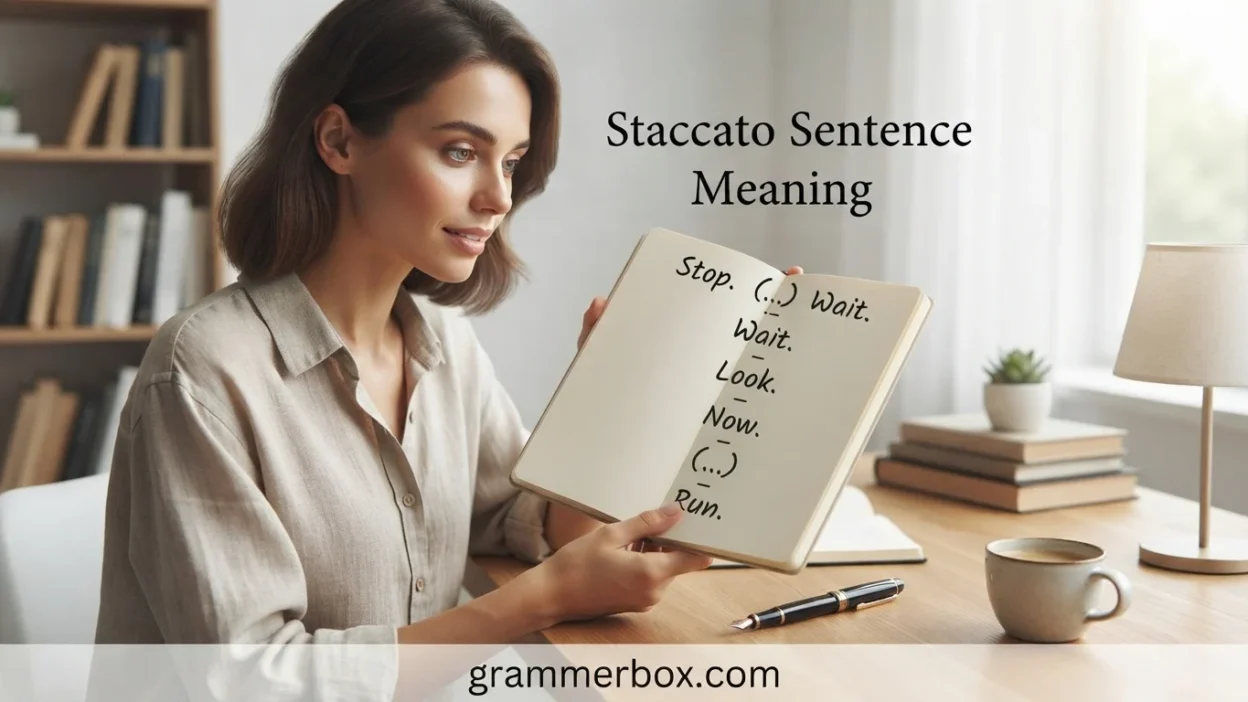
If you have ever read a sentence made up of short, sharp statements, you may have encountered a staccato sentence. The writing feels quick. Choppy. Dramatic. Each word or phrase seems to land with its own force. But what does “staccato sentence” actually mean, and why do writers use this style?
A staccato sentence uses brief, clipped wording and often several short sentences in succession to create a particular rhythm or emotional effect. It can make writing feel urgent, tense, energetic, confident, or dramatic. You will often see this technique in fiction, journalism, advertising, speeches, and online writing. Understanding the staccato sentence meaning can help you recognize the technique and use it intentionally rather than accidentally creating choppy prose.
Quick Answer
A staccato sentence is a sentence or series of very short, concise sentences that create a clipped, abrupt rhythm. Writers use staccato writing to emphasize ideas, increase tension, show urgency, or make prose feel fast and dramatic.
Why People Confuse It
People sometimes confuse a staccato sentence with simply “bad” or incomplete writing because both can contain short sentences.
The difference is purpose.
Choppy writing often results from poor sentence structure or too many unnecessary sentence breaks. Staccato writing, however, is usually deliberate. The short structure creates a specific rhythm or mood.
Compare these:
- Choppy: “I went to the store. I bought milk. I went home. I made dinner.”
- Staccato: “The door opened. Silence. Footsteps. Closer. Closer.”
The second example uses short units intentionally to build suspense.
The word staccato originally comes from music. In musical notation, staccato indicates that notes should be played in a short, detached manner. In writing, the same basic idea applies to language: the words or sentences feel short, separated, and sharply delivered.
First Word: “Staccato”
Staccato is an adjective that describes something characterized by short, detached, or sharply separated sounds or movements.
In writing, it describes a distinctive sentence rhythm.
Examples
- “His staccato speech made everyone nervous.”
- “The author uses staccato sentences to create suspense.”
- “Her staccato responses suggested impatience.”
- “The scene has a fast, staccato rhythm.”
When describing prose, staccato often suggests that the language has a clipped or punchy quality.
Second Word: “Sentence”
A sentence is a group of words that expresses a complete thought, usually containing a subject and a verb.
In the expression staccato sentence, “sentence” tells us that the technique concerns sentence structure and rhythm.
However, writers sometimes use the term more broadly. A passage can have a staccato style when it contains several short sentences, fragments, or brief phrases arranged to produce a sharp, interrupted rhythm.
For example:
“He stopped. Looked back. Listened.”
Not every part is a conventional complete sentence, but the sequence creates a clearly staccato effect.
Comparison Table
| Feature | Staccato Sentence | Ordinary Short Sentence | Choppy Writing |
|---|---|---|---|
| Length | Usually very short | Can be short or moderate | Often repeatedly short |
| Purpose | Creates rhythm or emphasis | Communicates an idea | May result from poor structure |
| Rhythm | Sharp and detached | Usually natural | Can feel awkward |
| Effect | Tension, urgency, drama, speed | Clarity and simplicity | Disjointed or repetitive |
| Intentional? | Usually yes | Not necessarily | Often accidental |
| Common in | Fiction, speeches, journalism, advertising | All types of writing | Drafts or poorly edited prose |
When to Use Each
A staccato sentence is especially useful when you want your writing to feel fast, tense, dramatic, forceful, or emotionally intense.
Use staccato sentences when:
- You want to build suspense.
- You want to show urgency.
- You want to emphasize important points.
- You want to imitate quick thoughts.
- You want dialogue to sound tense.
- You want an action scene to move quickly.
- You want a paragraph to end with impact.
- You want to contrast long sentences with sudden short ones.
Avoid overusing them
If every sentence is extremely short, the writing can become monotonous.
For example:
“He ran. He stopped. He looked. He waited. He moved. He turned. He ran.”
This can work in an action sequence, but overuse may make the prose feel mechanical.
A stronger approach is often to mix sentence lengths:
“He ran through the empty street, his footsteps echoing behind him. Then he stopped. Silence. He turned slowly.”
The contrast makes the staccato moments more powerful.
Staccato Sentence Examples
Here are several examples that demonstrate the meaning and effect of staccato sentences.
1. Building suspense
“The lights went out. Nothing. Then a sound.”
The short phrases create uncertainty and tension.
2. Showing urgency
“Move. Now. We have seconds.”
The clipped structure makes the speaker sound urgent.
3. Creating drama
“She opened the letter. Read it. Froze.”
The short sequence emphasizes her reaction.
4. Showing fear
“A noise upstairs. Again. Closer this time.”
The abrupt rhythm mirrors nervousness.
5. Showing anger
“Enough. I warned you. Leave.”
The short sentences make the speaker sound firm and aggressive.
6. Describing fast action
“He ducked. Rolled. Jumped back.”
The rhythm makes the action feel rapid.
7. Creating emphasis
“One mistake. One decision. Everything changed.”
The repeated short structures give each idea extra weight.
8. Mimicking quick thoughts
“Too late. Why did I wait? No. Think.”
The fragmented rhythm can resemble a person’s rapid internal thoughts.
9. Creating a dramatic ending
“The door closed behind him. Forever.”
The final short statement creates emphasis.
10. Showing shock
“She saw the result. Stared. Said nothing.”
The clipped structure reinforces the character’s stunned reaction.
11. Creating confidence
“We know the facts. We have the evidence. We are ready.”
The short, direct sentences make the speaker sound decisive.
12. Creating a cinematic effect
“Rain. Darkness. Empty streets. A single light.”
This style can make descriptive writing feel visual and dramatic.
Common Mistakes
1. Assuming every short sentence is staccato
A short sentence is not automatically a staccato sentence. Staccato refers to the rhythm and effect, not merely word count.
2. Using too many sentence fragments
Fragments can contribute to a staccato style, but excessive fragments may confuse readers.
3. Breaking sentences randomly
Sentence breaks should have a reason. If you split every idea into tiny pieces without purpose, the result may sound unnatural.
4. Making every sentence the same length
Staccato writing becomes more effective when it contrasts with longer sentences.
5. Confusing clarity with staccato style
Short sentences can improve clarity, but staccato writing usually does more than simplify information. It creates a deliberate emotional or rhythmic effect.
6. Forgetting the audience
A dramatic literary passage may benefit from staccato writing, while a formal academic paper usually requires more connected and carefully developed sentences.
Memory Trick
Think of staccato = short and sharp.
Remember the musical connection:
Staccato music → short, detached notes
Staccato writing → short, detached sentences or phrases
A simple memory sentence is:
Staccato sentences sound like quick taps.
If the writing feels like one brief beat after another, it may have a staccato rhythm.
American vs. British English
The term staccato has essentially the same meaning in American and British English.
Both varieties use the word to describe something that is:
- Short
- Abrupt
- Detached
- Intermittent
- Sharp or clipped in rhythm
For example:
American English:
“His staccato answers made the interview uncomfortable.”
British English:
“His staccato answers made the interview uncomfortable.”
There is no significant difference in the basic definition or usage.
The word is also common in discussions of music, speech, prose, and movement in both forms of English.
Similar Words
Several words can describe writing that resembles a staccato style, although they are not perfect synonyms.
Choppy
Choppy describes writing that lacks smooth flow. It can be intentional, but it often has a negative meaning.
Clipped
Clipped means brief and abrupt, especially when describing speech or responses.
“His clipped reply ended the conversation.”
Concise
Concise means expressing an idea clearly in few words. Concise writing is not necessarily staccato.
Terse
Terse means using very few words, sometimes suggesting a blunt or unfriendly manner.
Abrupt
Abrupt describes something sudden or unexpected.
Fragmented
Fragmented describes something broken into separate pieces. Fragmented prose can produce a staccato effect.
Punchy
Punchy describes writing that is energetic, forceful, and impactful.
Rapid-fire
Rapid-fire describes speech or writing delivered very quickly and continuously.
FAQs:
What is the meaning of a staccato sentence?
A staccato sentence is a short, clipped sentence or part of a sequence of short sentences that creates a sharp, detached rhythm. Writers often use it for emphasis, urgency, tension, or drama.
Is a staccato sentence always grammatically correct?
Not necessarily. A staccato style can include sentence fragments for deliberate effect. However, intentional fragments are different from accidental grammatical errors.
What is an example of staccato writing?
“Rain fell. Thunder crashed. The lights flickered. Then darkness.”
The short sentences create a quick, dramatic rhythm.
Is staccato writing the same as choppy writing?
No. Staccato writing is usually intentional and serves a stylistic purpose. Choppy writing often describes prose that feels disconnected because sentences are unnecessarily short or poorly structured.
Why do authors use staccato sentences?
Authors use them to create tension, speed, urgency, emphasis, suspense, emotional intensity, or a sense of rapid thought and action.
Can a staccato sentence be one sentence?
Yes. A single sentence can have a clipped or staccato rhythm, although the term is often used for a sequence of short sentences or phrases.
Is staccato used only in fiction?
No. Staccato language can appear in fiction, journalism, advertising, speeches, scripts, essays, and everyday communication. The suitability depends on the context and desired effect.
Final Verdict
The staccato sentence meaning is easiest to understand through its rhythm: short, sharp, and separated. Writers deliberately use this structure to control pacing and make particular words or moments stand out.
A staccato sentence is not simply a short sentence. Its real strength comes from the effect it creates. Used carefully, it can make prose feel tense, urgent, energetic, dramatic, or powerful. Used too frequently, however, it can make writing feel repetitive or choppy.
Remember This
Staccato sentence = short, sharp, deliberately separated language.
When you see sentences such as:
“He stopped. He listened. Nothing.”
the writer is using short units to control rhythm, pacing, tension, and emphasis.
The key is intention. If the short sentences create a specific effect, they are doing stylistic work. If they simply make the writing difficult to follow, they may be choppy rather than effectively staccato.
Conclusion
Understanding staccato sentence meaning gives you another useful tool for analyzing and improving English writing. The technique comes from the idea of short, detached musical notes and applies that same rhythm to language. Short sentences and fragments can make a scene feel faster, sharper, and more emotionally charged.
The best writers do not rely on one sentence length throughout a passage. They vary sentence structure to control the reader’s experience. A long sentence can establish context, while a sudden staccato sentence can deliver the impact: “The room went silent. Everyone waited.” Used intentionally, that contrast can make your writing much more engaging.