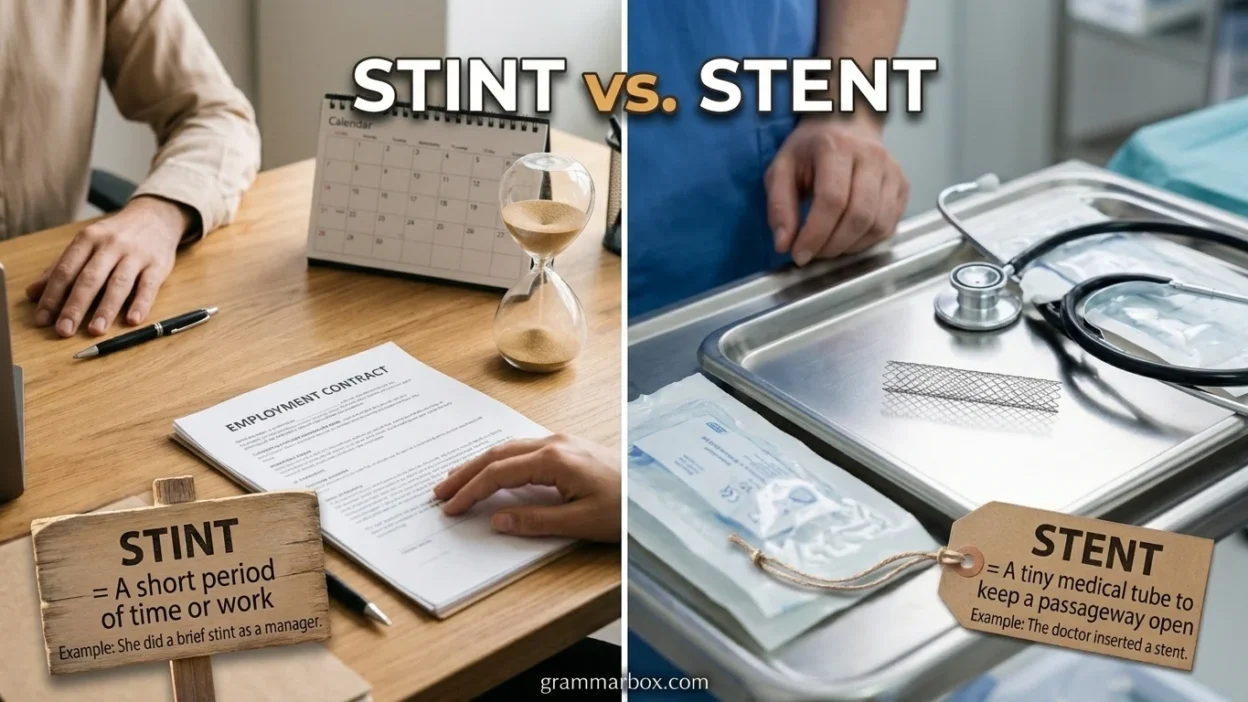
Have you ever confused stint vs stent while writing or reading English? These two words look and sound similar, but they have completely different meanings. One usually refers to a period spent doing a particular job or activity, while the other is a medical device used to help keep a blood vessel or another passage open. Understanding the difference can help you avoid spelling mistakes and communicate more clearly.
If you are a student, an English learner, a writer, or someone interested in medical terminology, knowing when to use stint and stent is useful. Although these words differ by only one letter, using the wrong one can change the meaning of an entire sentence. In this guide, you will learn the definitions of both words, explore their differences, review practical examples, and discover an easy memory trick to remember their correct usage.
Quick Answer
Stint means a period of time spent doing a particular job, task, or activity, or a limited amount of something. Stent is a small medical tube or mesh device inserted into a passage, such as an artery, to help keep it open. Use stint for work or time and stent for medical treatment.
Why People Confuse It
People often confuse stint and stent because their spellings differ by only one vowel. Both words begin with st and end with nt, making them easy to mix up when writing quickly.
However, their meanings belong to entirely different contexts.
Here are three reasons these words cause confusion:
- Similar spelling: Both words contain five letters and have nearly identical spellings.
- Similar pronunciation: Their sounds are close enough that some English learners may struggle to distinguish them.
- Different subject areas: Stint commonly appears in conversations about careers, activities, and time, while stent appears primarily in medical discussions.
The simplest way to avoid confusion is to consider the context. If you are discussing someone’s work experience or a period of service, stint is probably correct. If you are discussing a medical procedure involving an artery or another passage, stent is the appropriate word.
First Word: Stint
What Does Stint Mean?
Stint is a noun that refers to a period of time spent doing a particular job, activity, or type of work. It can also mean a limited amount of something, especially when discussing how much someone does, gives, or uses.
For example:
- She completed a two-year stint as a teacher.
- He had a brief stint in the military.
- The company hired an experienced manager after her stint abroad.
In each example, stint describes a period of time devoted to a particular role or experience.
Stint as a Verb
Stint can also function as a verb meaning to limit, restrict, or be sparing with something.
For example:
- The restaurant does not stint on quality.
- She never stints on praise when her students do well.
- The organization refused to stint on safety measures.
In these sentences, the word describes limiting something or, in negative constructions, not holding back.
Common Uses of Stint
You will frequently encounter stint in these expressions:
- A brief stint: A short period spent doing something.
- A three-year stint: A period of three years spent in a particular role.
- A stint in journalism: A period working in journalism.
- Without stint: Without restriction or limitation.
- Not stint on something: To avoid limiting the amount or effort devoted to something.
Example: After a successful stint in marketing, Daniel decided to start his own business.
Here, stint refers to Daniel’s period of professional experience in marketing.
Second Word: Stent
What Does Stent Mean?
Stent is a noun used primarily in medicine. It refers to a small tube or expandable mesh device that doctors place inside a blood vessel or another bodily passage to help keep it open.
Stents are commonly associated with procedures that treat narrowed or blocked arteries. Depending on the medical condition, they may also be used in other parts of the body, such as the urinary tract or bile ducts.
For example:
- The doctor inserted a stent into the patient’s artery.
- Her father received a coronary stent after medical evaluation.
- The surgeon used a stent to help keep the narrowed passage open.
In each sentence, stent refers to a medical device rather than a period of time or professional experience.
Types of Stents
Different stents are designed for different medical purposes.
Common examples include:
- Coronary stent: Used to help keep a coronary artery open.
- Peripheral stent: Used in certain blood vessels outside the heart.
- Ureteral stent: Used to help maintain drainage through the ureter.
- Biliary stent: Used to help keep a bile duct open.
- Drug-eluting stent: A stent designed to release medication that helps reduce the risk of tissue growth that could narrow the treated artery again.
The appropriate type depends on the patient’s condition and the treatment being performed.
How Is Stent Used in a Sentence?
The word stent generally appears in medical, hospital, or health-related contexts.
Consider these examples:
- The cardiologist explained how the stent would help maintain blood flow.
- The patient asked questions about the risks of receiving a stent.
- Her medical report described the placement of a stent in a narrowed artery.
These examples show that stent refers to a physical medical device.
Stint vs Stent: Comparison Table
The following table highlights the main differences between stint and stent.
| Feature | Stint | Stent |
|---|---|---|
| Part of speech | Noun and verb | Primarily a noun |
| Main meaning | A period of work or activity; a limited amount | A medical device that helps keep a passage open |
| Common context | Careers, work, activities, and effort | Medicine, surgery, and healthcare |
| Example phrase | A short stint in teaching | A coronary stent |
| Example sentence | He completed a stint overseas. | The doctor inserted a stent. |
| Related idea | Time, experience, limitation | Medical treatment and support |
| Typical audience | General English users | Patients, healthcare professionals, and readers of medical information |
| Easy association | Job or time | Medical device |
The key difference: A stint describes a period or limitation, while a stent is a medical device.
When to Use Each
Choosing between stint and stent becomes easy when you identify what you are trying to describe.
Use Stint When Talking About Work or Time
Choose stint when describing a period spent in a job, profession, activity, or position.
Examples:
- Maria had a successful stint as a journalist.
- His stint in customer service helped him develop communication skills.
- After a short stint at the company, she accepted a new position.
Use stint as a verb when discussing limiting or holding back something.
Examples:
- The school does not stint on educational resources.
- They refused to stint on quality.
Quick tip: If you can replace the word with period, spell, or time spent, you probably need stint.
Use Stent When Talking About Medical Treatment
Choose stent when referring to a device placed inside the body to help maintain an opening or passage.
Examples:
- The patient received a stent to help treat a narrowed artery.
- The doctor discussed the benefits and risks of stent placement.
- Her treatment involved placing a stent in the bile duct.
Quick tip: If the sentence discusses a medical procedure, an artery, or a device used to keep a passage open, stent is likely the correct word.
Compare These Sentences
- Correct: He completed a two-year stint in the navy.
- Incorrect in this context: He completed a two-year stent in the navy.
The first sentence describes a period of service, so stint is correct.
Now consider another example:
- Correct: The surgeon inserted a stent into the narrowed artery.
- Incorrect in this context: The surgeon inserted a stint into the narrowed artery.
The second sentence describes a medical device, so stent is correct.
Examples of Stint vs Stent in Sentences
Here are 16 examples to help you understand the difference between these words in everyday and specialized English.
Examples Using Stint
- Career: She completed a three-year stint as a software engineer before becoming a manager.
- Journalism: His stint as a newspaper reporter taught him how to investigate stories.
- Military service: After his stint in the military, he returned to university.
- Sports: The athlete had a brief stint with a professional basketball team.
- Education: During her stint as a teacher, she helped hundreds of students improve their writing.
- Travel: My stint overseas gave me a better understanding of different cultures.
- Business: The company’s new director previously had a successful stint at a major technology firm.
- Effort: The coach did not stint on encouragement during the difficult training sessions.
Examples Using Stent
- Heart treatment: The cardiologist explained why a coronary stent might be appropriate for the patient.
- Artery: The doctor inserted a stent to help keep the narrowed artery open.
- Medical consultation: Before the procedure, the patient discussed the possible risks of receiving a stent.
- Hospital care: The medical team monitored the patient following stent placement.
- Bile duct: The specialist placed a stent to help maintain drainage through the bile duct.
- Urinary tract: The doctor recommended a ureteral stent to help urine drain properly.
- Medical report: The patient’s report included information about the location of the stent.
- Follow-up appointment: During the follow-up visit, the doctor checked the patient’s progress after the stent procedure.
These examples demonstrate that stint generally relates to time, work, or limitation, while stent refers to a medical device.
Common Mistakes
Even though stint and stent have different meanings, writers sometimes use them interchangeably by mistake. Here are some common errors to avoid.
1. Using Stent to Describe a Job
Incorrect: She had a two-year stent as a teacher.
Correct: She had a two-year stint as a teacher.
The sentence describes a period of professional experience, so stint is the right choice.
2. Using Stint to Describe a Medical Device
Incorrect: The doctor inserted a stint into the patient’s artery.
Correct: The doctor inserted a stent into the patient’s artery.
The medical device is called a stent.
3. Assuming Both Words Have the Same Meaning
These words are not interchangeable synonyms. Their similar appearance does not make their meanings similar.
- Stint relates to a period of activity or the act of limiting something.
- Stent refers to a medical device.
Always consider the intended meaning before choosing the spelling.
4. Ignoring the Context
Incorrect: The patient received a stint after the examination.
Correct: The patient received a stent after the examination.
In a medical context involving a device, stent is the correct spelling.
However, if you write, “The patient completed a brief stint as a hospital volunteer,” the word stint is correct because the sentence describes a period of activity.
5. Forgetting the Verb Meaning of Stint
Some learners know stint only as a noun. However, it can also function as a verb.
For example:
- The organization does not stint on employee training.
- She never stints on attention to detail.
In these sentences, stint means to limit or be sparing with something.
Memory Trick: How to Remember Stint vs Stent
A simple memory trick can help you remember which word to use.
Remember Stint = Time
Think of stint as a time spent doing something.
For example:
- A stint in teaching.
- A stint in the military.
- A stint at a new company.
Each example refers to a period of experience or work.
Remember Stent = Treatment
Think of stent as a medical device used in treatment.
For example:
- A heart stent.
- An artery stent.
- A ureteral stent.
Each example relates to healthcare.
Use This Simple Formula
Stint = Time or work.
Stent = Medical device.
You can also remember the vowel difference:
- I in stint: Think of time spent in an activity.
- E in stent: Think of a medical device.
This is only a memory aid, but it provides a quick way to recall the correct spelling when writing.
American vs British English
The distinction between stint and stent remains the same in American and British English.
Neither word is a regional spelling variant of the other. They have different meanings in both varieties of English.
| Word | American English | British English |
|---|---|---|
| Stint | A period of work or activity; to limit something | A period of work or activity; to limit something |
| Stent | A medical device used to keep a passage open | A medical device used to keep a passage open |
Examples in American English
- She completed a short stint as a research assistant.
- The doctor explained how the stent would be used.
Examples in British English
- He had a brief stint working in London.
- The consultant discussed the patient’s stent procedure.
The spelling and core meanings remain consistent across both varieties.
Remember: If you are writing for an American or British audience, you should still choose stint for a period of work and stent for a medical device.
Similar Words
Understanding related words can help you expand your vocabulary and avoid choosing an incorrect term.
Words Similar to Stint
Depending on the context, words related to stint include:
- Period: A length of time during which something happens.
- Spell: A period spent doing a particular activity.
- Tenure: The period during which someone holds a position.
- Assignment: A task or period of assigned work.
- Limit: A boundary or restriction on something.
- Restrict: To control or limit the amount of something.
For example, “She had a brief stint in publishing” can be rewritten as “She spent a brief period working in publishing.”
However, these words are not interchangeable in every sentence. Stint can have a specific meaning that depends on context.
Words Related to Stent
Words and expressions associated with stent include:
- Implant: A device or material placed inside the body.
- Catheter: A tube inserted into the body for medical purposes.
- Angioplasty: A procedure used to widen narrowed or blocked blood vessels.
- Coronary artery: A blood vessel that supplies blood to the heart muscle.
- Vascular: Relating to blood vessels.
- Medical device: An instrument or device used for diagnosis, treatment, or healthcare.
These terms relate to medical treatment, but they do not all mean the same thing as stent.
For instance, a catheter is a tube used for medical purposes, while a stent is designed to support an opening or passage. Angioplasty is a procedure, not a device.
FAQs:
1. What is the difference between stint and stent?
Stint means a period spent doing a job or activity, or a limited amount of something. Stent is a medical device used to help keep a blood vessel or another passage open.
2. Is stint a real word?
Yes. Stint is a standard English word that can function as both a noun and a verb. As a noun, it often describes a period of work or activity. As a verb, it means to limit or be sparing with something.
3. Is stent a real word?
Yes. Stent is a standard medical term referring to a device placed inside a bodily passage to help keep it open. Stents are commonly used in certain treatments for narrowed arteries and other medical conditions.
4. What does a stint mean in a job?
A stint in a job means a period spent working in a particular position, profession, or organization.
For example: “He completed a five-year stint as a financial analyst.”
The phrase describes his period of professional experience.
5. What is a stent used for?
A stent is used to help keep a bodily passage open. For example, a coronary stent can help maintain blood flow through a narrowed coronary artery. The purpose and benefits depend on the patient’s condition and the type of stent used.
6. Are stint and stent pronounced the same way?
No. They have similar pronunciations, but their vowel sounds differ. The exact pronunciation can vary somewhat by accent, so listening to examples from a reliable dictionary can help you distinguish them.
7. Can stint be used as a verb?
Yes. Stint can mean to limit or be sparing with something.
For example: “The company did not stint on employee training.”
This means the company did not hold back on providing training.
8. Are stint and stent interchangeable?
No. These words have different meanings and cannot normally replace each other. Use stint when discussing a period of work or activity, and use stent when referring to the medical device.
Remember This
- Stint = Time, work, or a limited amount.
- Stent = A medical device.
- A person can have a stint in a profession.
- A patient can receive a stent during a medical procedure.
- Neither word is a spelling variation of the other.
The easiest rule to remember is this: If it describes a period of work, use stint. If it describes a medical device, use stent.
Conclusion
Learning the difference between stint and stent is a small but valuable step toward improving your English vocabulary. These words have similar spellings, yet they serve very different purposes. Stint commonly describes a period spent in a job or activity, while stent identifies a medical device used to support a bodily passage. Recognizing the context will help you choose the right word every time.
For students, writers, and English learners, practicing these words in complete sentences is an effective way to remember their meanings. Keep the simple distinction in mind, review the examples, and use the memory trick whenever you feel uncertain. With practice, choosing between stint and stent will become much easier.