Have you ever wondered if to write bazaar or bizarre? These two English words look almost identical, and their pronunciations are very similar. However, they have completely different meanings. Choosing the wrong word can change the meaning of your sentence and confuse your readers. Understanding the difference between bazaar and bizarre will help you write more accurately and communicate your ideas clearly.
The word bazaar refers to a marketplace where people sell goods, clothing, food, and other products. It is commonly associated with traditional markets, shopping areas, and fundraising events. In contrast, bizarre is an adjective that describes something strange, unusual, or unexpected. You might visit a busy bazaar while traveling, but you might describe a bizarre experience as something difficult to explain. In this guide, you will learn the definitions, pronunciations, grammatical uses, and differences between these confusing words. You will also discover practical examples, common mistakes, and a simple memory trick to help you remember which word to use.
Quick Answer
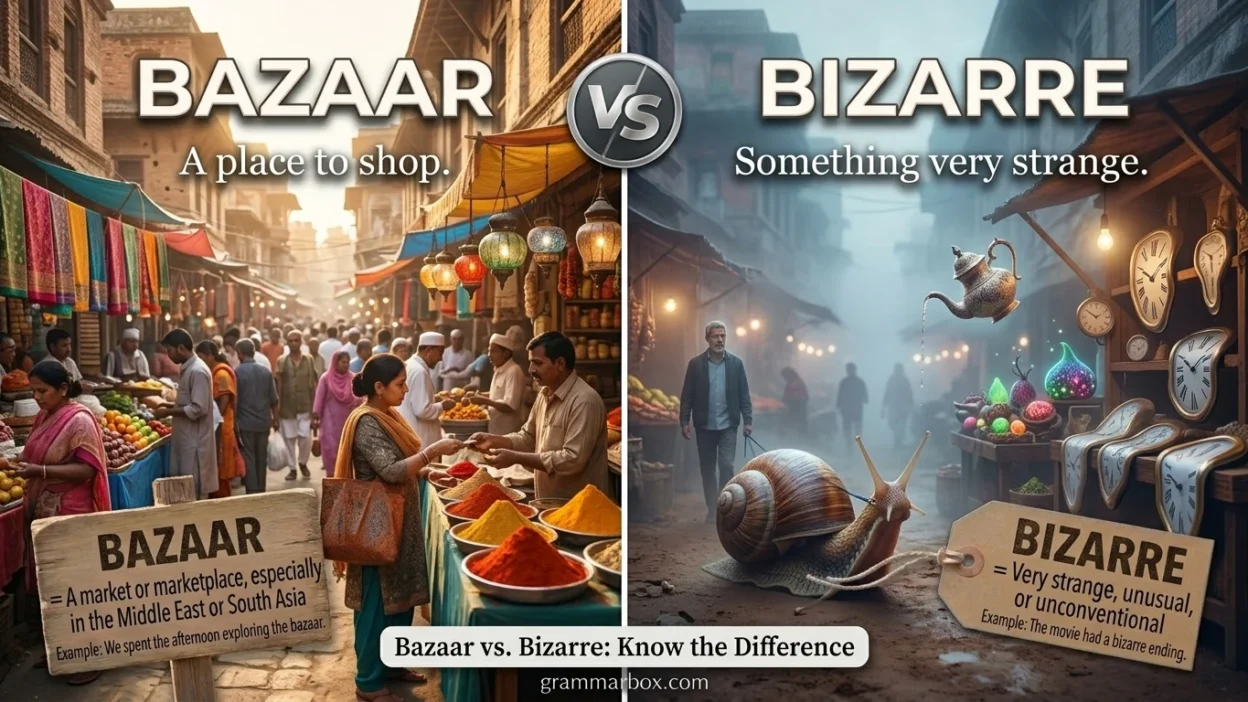
Bazaar is a noun meaning a marketplace or a fair where goods are sold. Bizarre is an adjective meaning strange, unusual, or unexpected. For example, “We visited a colorful bazaar” describes a market, while “That was a bizarre experience” describes something unusual.
Why People Confuse It
People often confuse bazaar and bizarre because the words have similar spellings and nearly identical pronunciations in many English accents.
Both words contain the letters b, a, z, and r, making them easy to mix up when writing quickly.
However, their meanings and grammatical functions are different.
Here are three reasons for the confusion:
- Similar spelling: Both words begin with “b” and contain a prominent “z” sound.
- Similar pronunciation: In many accents, both are pronounced approximately as buh-ZAAR or bih-ZAAR, although vowel sounds can vary.
- Different meanings: One describes a place where goods are sold, while the other describes something strange.
The easiest solution is to focus on the meaning of the sentence instead of relying on spelling or pronunciation alone.
First Word: Bazaar
Bazaar is a noun that refers to a marketplace, shopping area, or organized sale where different goods are offered for purchase.
The word has historical connections to Persian and other languages used across regions where traditional marketplaces developed. Today, English speakers use it for traditional markets, temporary fairs, and fundraising sales.
Meaning of Bazaar
A bazaar can refer to:
- A traditional marketplace: A place where vendors sell food, clothing, jewelry, spices, and household goods.
- A shopping area: A collection of shops or stalls selling different products.
- A fundraising event: An organized sale where people purchase handmade items, used goods, or donated products to support a cause.
Examples of Bazaar in Sentences
- We visited a traditional bazaar to buy colorful clothes.
- The local bazaar sells fresh vegetables and aromatic spices.
- Our school organized a charity bazaar to raise money.
- Tourists enjoyed exploring the crowded bazaar.
- She purchased a handmade necklace at the bazaar.
In each example, bazaar refers to a market, shopping location, or sales event.
Is Bazaar a Noun?
Yes. Bazaar is a noun because it names a place or event.
Common grammatical forms include:
- Singular: bazaar
- Plural: bazaars
- Article usage: a bazaar, the bazaar
For example:
“The town has several bazaars where visitors can purchase traditional crafts.”
Here, bazaars is the plural form of the noun.
Second Word: Bizarre
Bizarre is an adjective that describes something strange, unusual, unexpected, or difficult to understand.
You can use it when discussing unusual behavior, surprising situations, strange events, or ideas that seem out of the ordinary.
Meaning of Bizarre
The word bizarre can describe something that is:
- Strange: Different from what people normally expect.
- Unusual: Not common or ordinary.
- Unexpected: Surprising or difficult to anticipate.
- Odd: Seemingly peculiar or difficult to explain.
Depending on the context, bizarre can express surprise, confusion, amusement, or disbelief.
Examples of Bizarre in Sentences
- We witnessed a bizarre incident on our way home.
- He told us a bizarre story about a talking bird.
- The artist created a bizarre sculpture from recycled materials.
- She wore a bizarre costume to the party.
- It was bizarre to see snow falling in the middle of summer.
In these examples, bizarre describes something unusual rather than naming a place.
Is Bizarre an Adjective?
Yes. Bizarre is an adjective because it describes a noun.
For example:
- A bizarre dream: A dream that seems strange.
- A bizarre situation: An unusual or unexpected situation.
- Bizarre behavior: Behavior that seems peculiar.
- A bizarre coincidence: An unexpected or remarkable coincidence.
You can also use related forms such as bizarreness, a noun referring to the quality of being bizarre.
Bazaar vs. Bizarre: Comparison Table
| Feature | Bazaar | Bizarre |
|---|---|---|
| Meaning | A marketplace or sales fair | Strange or unusual |
| Part of speech | Noun | Adjective |
| Main purpose | Names a place or event | Describes a person, thing, or situation |
| Typical context | Shopping, trading, fundraising | Strange experiences, unusual behavior |
| Example | We visited the bazaar. | We witnessed a bizarre event. |
| Plural form | Bazaars | No ordinary plural form |
| Common phrase | Traditional bazaar | Bizarre situation |
| Memory clue | Think of buying goods | Think of something weird |
The key difference: A bazaar is somewhere you might shop, while something bizarre is something you might find strange.
When to Use Each
Choosing between bazaar and bizarre becomes easy when you identify what you want to communicate.
When to Use Bazaar
Use bazaar when referring to a marketplace, shopping area, or organized sale.
Examples:
- We bought spices at the bazaar.
- The community is holding a winter bazaar.
- The old bazaar attracts visitors from nearby towns.
- Local vendors gathered at the bazaar to sell handmade products.
Writing tip: If your sentence involves buying, selling, vendors, stalls, or a market, bazaar is probably the correct word.
When to Use Bizarre
Use bizarre when describing something unusual, strange, or unexpected.
Examples:
- That was a bizarre explanation.
- The movie has a bizarre ending.
- I had a bizarre dream last night.
- His bizarre behavior surprised everyone.
Writing tip: If you could replace the word with strange, odd, or unusual without changing the basic meaning, bizarre is likely the right choice.
A Simple Comparison
Consider these two sentences:
- “The bazaar was crowded with shoppers.”
- “The bazaar displayed a bizarre collection of antiques.”
In the first sentence, bazaar identifies a marketplace. In the second, bazaar still names the marketplace, while bizarre describes the unusual collection.
This example demonstrates how both words can appear naturally in the same sentence.
Examples of Bazaar vs. Bizarre
The following sentences show how to use each word correctly in everyday English.
Examples Using Bazaar
- My family visited the bazaar to purchase fresh fruit.
- The bazaar becomes especially busy before the holidays.
- We found beautiful handmade rugs at the local bazaar.
- The school bazaar raised money for educational supplies.
- Vendors arranged their products neatly throughout the bazaar.
- She bought a traditional dress from a shop in the bazaar.
- The historic bazaar attracts visitors from around the world.
- Many people visit the bazaar to find affordable household items.
- Our neighborhood is organizing a charity bazaar this weekend.
- The bazaar offers a wide selection of spices and souvenirs.
Examples Using Bizarre
- The magician performed a bizarre trick that amazed the audience.
- I heard a bizarre noise coming from the basement.
- Her bizarre explanation left everyone confused.
- The documentary explored a bizarre historical event.
- He had a bizarre dream about flying cars.
- The painting featured bizarre shapes and unexpected colors.
- It was a bizarre coincidence that we wore identical outfits.
- The stranger told us a bizarre story about his travels.
- The movie’s bizarre ending surprised the audience.
- We encountered a bizarre situation during our trip.
Examples Using Both Words
Here are additional sentences that demonstrate the difference:
- The bazaar sold several bizarre-looking decorations.
- We visited a bazaar where a vendor displayed a bizarre collection of masks.
- The bizarre rumor spread quickly among the bazaar’s merchants.
- A bizarre performance attracted a crowd outside the bazaar.
- The bazaar was ordinary, but one shop displayed bizarre inventions.
These examples make the distinction clear: bazaar names a market, while bizarre describes something unusual.
Common Mistakes
Even confident English writers sometimes mix up bazaar and bizarre. Understanding these common errors can help you avoid them.
Mistake 1: Using Bizarre for a Marketplace
Incorrect: We visited a bizarre to buy fresh vegetables.
Correct: We visited a bazaar to buy fresh vegetables.
Why? The sentence refers to a marketplace, so the noun bazaar is required.
Mistake 2: Using Bazaar to Describe Something Strange
Incorrect: That was a bazaar experience.
Correct: That was a bizarre experience.
Why? The writer wants to describe an unusual experience, so the adjective bizarre is appropriate.
Mistake 3: Confusing Their Parts of Speech
Remember that bazaar is a noun and bizarre is an adjective.
Correct examples:
- The bazaar was crowded.
- The bizarre event attracted attention.
- We visited a bazaar with bizarre decorations.
Using the correct grammatical form makes your writing clearer.
Mistake 4: Assuming They Are Interchangeable
Although the words sound similar, they cannot replace one another.
For example:
- “The bazaar opens at nine.” This refers to a marketplace.
- “The bizarre event began at nine.” This describes an unusual event.
Replacing one word with the other changes the sentence’s meaning.
Memory Trick: How to Remember Bazaar vs. Bizarre
The easiest way to remember the difference is to connect each word with a familiar idea.
Bazaar = Buy
Think of the letter B in bazaar as standing for buy.
A bazaar is a place where people buy and sell goods.
Remember this sentence:
“I buy bread at the bazaar.”
The connection between buy and bazaar can help you recall the correct spelling.
Bizarre = Weird
Think of bizarre as describing something weird.
For example:
“That bizarre story was strange.”
Both bizarre and strange describe something unusual.
One-Line Memory Rule
Bazaar is for buying; bizarre means strange.
If you remember this simple rule, you will be less likely to confuse the two words when writing essays, emails, articles, or everyday messages.
American vs. British English
The meanings of bazaar and bizarre remain essentially the same in American and British English.
Neither word is an exclusively American or British spelling. Both are standard English words used in different varieties of the language.
| Feature | American English | British English |
|---|---|---|
| Marketplace | Bazaar | Bazaar |
| Strange or unusual | Bizarre | Bizarre |
| Marketplace example | We visited a local bazaar. | We visited a local bazaar. |
| Strange situation example | That was a bizarre situation. | That was a bizarre situation. |
Are Their Pronunciations Different?
Pronunciation can vary by accent, particularly in the vowel sounds.
Both words are generally pronounced with a similar ending, but the first vowel may sound different depending on the speaker.
The important point is that pronunciation does not determine which word you should use. Choose bazaar for a marketplace and bizarre for something strange, regardless of whether you follow American or British English.
Similar Words
Learning related vocabulary can make it easier to understand the difference between bazaar and bizarre.
Words Similar to Bazaar
These words relate to shopping, selling, or marketplaces:
- Market: A place where people buy and sell goods.
- Marketplace: An area or platform where buyers and sellers meet.
- Fair: An event where people may sell products, display goods, or enjoy entertainment.
- Flea market: A market where vendors often sell secondhand or vintage items.
- Souk: A traditional marketplace commonly associated with Arab and North African regions.
These words are related to bazaar, although they are not interchangeable in every context.
Words Similar to Bizarre
These adjectives describe something unusual or strange:
- Strange: Different from what is normal or expected.
- Weird: Unusual in a way that may seem surprising or unsettling.
- Unusual: Not common or ordinary.
- Peculiar: Distinctively strange or unexpected.
- Outlandish: Extremely unusual or unconventional.
- Eccentric: Unconventional, especially in someone’s behavior or personality.
- 奇奇怪怪 (odd): A simple alternative meaning strange or peculiar.
For most everyday writing, strange, weird, and unusual are useful alternatives to bizarre. However, each word can carry a slightly different tone.
FAQs:
1. What Is the Main Difference Between Bazaar and Bizarre?
Bazaar is a noun referring to a marketplace or sales fair. Bizarre is an adjective describing something strange, unusual, or unexpected. The words sound similar but have different meanings and grammatical functions.
2. Is Bazaar a Real English Word?
Yes. Bazaar is a standard English noun used for traditional marketplaces, shopping areas, and organized sales events. For example, “We visited the bazaar to buy spices.”
3. What Does Bizarre Mean in Simple English?
Bizarre means very strange or unusual. It describes something that seems different from what people normally expect. For example, “He told a bizarre story” means he told a very strange story.
4. Are Bazaar and Bizarre Pronounced the Same?
They have very similar pronunciations, and they may sound almost identical in some accents. However, vowel sounds can differ. Their meanings, rather than their pronunciation, determine which word belongs in a sentence.
5. Can I Use Bazaar and Bizarre in the Same Sentence?
Yes. For example, “We visited the bazaar and saw a bizarre sculpture.” In this sentence, bazaar identifies the marketplace, while bizarre describes the sculpture.
6. What Is the Plural of Bazaar?
The plural of bazaar is bazaars. For example, “The city has several traditional bazaars.” The word bizarre is an adjective and does not normally have a plural form.
7. Is Bizarre a Positive or Negative Word?
Bizarre is generally neutral but can carry a negative, humorous, or positive tone depending on context. It may describe something confusing, disturbing, amusing, or creatively unusual.
8. How Can I Remember the Difference Between Bazaar and Bizarre?
Use this memory trick: bazaar = buy; bizarre = weird. A bazaar is a place where people buy and sell goods, while bizarre describes something strange or unexpected.
Remember This
- Bazaar = Marketplace: A place where people buy and sell goods.
- Bizarre = Strange: Something unusual, unexpected, or peculiar.
- Bazaar is a noun: You can visit a bazaar.
- Bizarre is an adjective: You can experience a bizarre situation.
The easiest rule to remember is this: You buy things at a bazaar, but you describe strange things as bizarre.