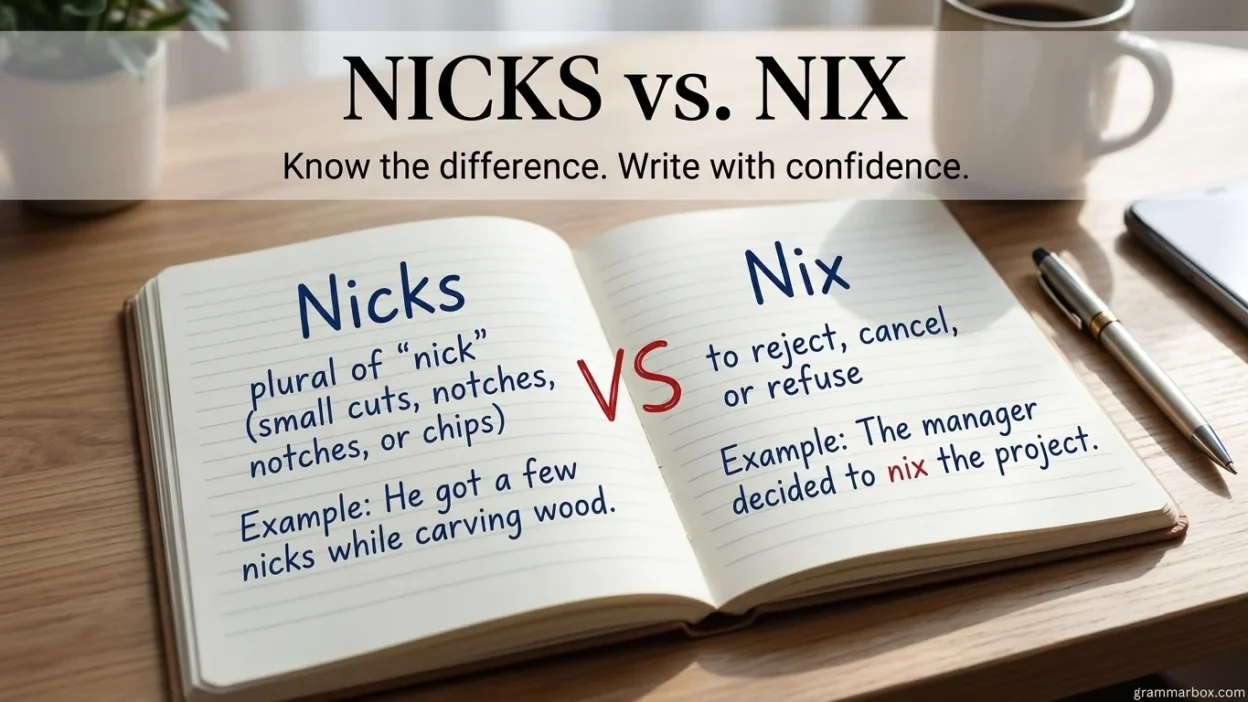
English contains many words that look or sound similar but have completely different meanings. Nicks vs. nix is one such comparison that can confuse English learners, writers, and readers. Although both words are short and easy to spell, they serve different purposes depending on the context. Understanding their meanings will help you use them correctly in everyday conversations and written English.
The word nicks is commonly used as a verb meaning to make small cuts or scratches. It can also refer to stealing something, catching someone, or reaching a particular time or amount in informal English. In contrast, nix is an informal verb meaning to reject, cancel, prohibit, or put an end to something. For example, you might nick a table while moving furniture, but a manager might nix a proposal during a meeting. Learning the difference between these words will improve your vocabulary and help you avoid common grammar mistakes.
Quick Answer
Nicks is the third-person singular form of nick, meaning to make a small cut, steal something, or catch someone. Nix is an informal verb meaning to reject, cancel, or prohibit something. Use nicks when describing an action associated with nicking and nix when something is rejected or stopped.
Why People Confuse It
People often confuse nicks and nix because they are short words with similar spellings and sounds. Both can function as verbs, but their meanings and grammatical uses differ.
Here are three reasons for the confusion:
- Similar appearance: Both words contain four letters and begin with the letter N.
- Informal usage: Both can appear in casual conversations, making their meanings less familiar to some English learners.
- Different meanings: The verb nick has several meanings, while nix generally refers to rejecting, canceling, or prohibiting something.
Understanding their definitions and examining example sentences makes the distinction much easier.
First Word: Nicks
Nicks is the third-person singular present-tense form of the verb nick. It can describe making a small cut or scratch, stealing something, or catching someone, depending on the context.
Meanings of Nicks
1. To make a small cut or scratch
The verb nick often describes accidentally cutting or damaging a surface.
Examples:
- She nicks her finger while chopping vegetables.
- The knife nicks the wooden table.
- He nicks his chin while shaving.
2. To steal something
In informal British English, nick can mean to steal something.
Examples:
- Someone nicks his bicycle outside the station.
- He nicks a biscuit from the kitchen.
- The thief nicks a wallet from an unattended bag.
3. To catch or arrest someone
In informal British English, nick can also mean to catch or arrest a person, especially someone suspected of committing an offense.
Examples:
- The police nick the suspect near the station.
- The officers nick a burglar during the investigation.
4. To achieve a narrow victory or reach a particular amount
Informally, nick can describe narrowly winning something or reaching a particular time or figure.
Examples:
- The team nicks a late victory.
- The total nicks the $100 mark.
Is Nicks a Noun?
Yes. Nicks can also be the plural of the noun nick, meaning small cuts or scratches.
For example:
- The knife left several nicks on the countertop.
- There are a few nicks on the car’s paintwork.
Remember that the grammatical function depends on the sentence. In She nicks the table, the word is a verb. In The table has several nicks, it is a plural noun.
Second Word: Nix
Nix is an informal verb meaning to reject, cancel, forbid, or stop something from happening. It is especially common in conversational English and informal writing.
Meanings of Nix
1. To reject an idea or proposal
Use nix when someone decides not to accept a suggestion, plan, or request.
Examples:
- The manager nixes the proposal.
- The committee nixes his suggestion.
- She nixes the idea of moving abroad.
2. To cancel a plan
Nix can describe deciding that a planned activity will not happen.
Examples:
- The organizers nix the outdoor concert.
- Bad weather nixes their picnic plans.
- The company nixes the scheduled event.
3. To prohibit or prevent something
The word can also mean refusing to allow something or stopping it from proceeding.
Examples:
- The school nixes mobile phones during examinations.
- The editor nixes unnecessary changes.
- The director nixes the expensive production plan.
Is Nix a Noun?
Yes, nix can also function as a noun in informal contexts, particularly in expressions meaning nothing or zero. However, its use as a verb meaning to reject or cancel is especially relevant when comparing nicks vs. nix.
For example:
- The proposal received the nix from the committee.
This noun construction is less common than the verb. In most everyday situations, nix is used to describe rejecting or canceling something.
Nicks vs. Nix: Comparison Table
| Feature | Nicks | Nix |
|---|---|---|
| Base word | Nick | Nix |
| Part of speech | Verb or plural noun | Verb; occasionally noun |
| Main verb meaning | Makes small cuts, steals, catches, or narrowly wins | Rejects, cancels, or prohibits |
| Verb form | Third-person singular of nick | Base form of nix |
| Example | She nicks her finger. | She nixes the proposal. |
| Informality | Common in everyday English; some meanings are especially British | Informal English |
| Common context | Scratches, minor cuts, stealing, catching | Plans, ideas, requests, decisions |
| Simple memory clue | A nick can leave a mark | A nix can stop a plan |
The main difference is that nicks describes an action such as making a small cut or stealing, whereas nix means rejecting or canceling something.
When to Use Each
Choosing between nicks and nix becomes easier when you focus on the intended meaning.
Use Nicks When Talking About Small Cuts
Choose nicks when describing a person or thing making a small cut or scratch.
Examples:
- The blade nicks the surface.
- He nicks his finger while cooking.
You can also use it when describing stealing or catching someone in informal English.
Examples:
- She nicks a pen from the office.
- The police nick the suspect.
Use Nix When Rejecting or Canceling Something
Choose nix when a person or organization decides against a plan, proposal, request, or activity.
Examples:
- The principal nixes the proposed schedule.
- The editor nixes the unnecessary paragraph.
- The company nixes the project because of budget concerns.
Check the Meaning Before Choosing
Ask yourself what the sentence describes.
- Is someone making a small cut or scratch? Use nicks if the subject is singular and the sentence is in the present tense.
- Is someone stealing or catching someone in an appropriate informal context? Nicks may be correct.
- Is someone rejecting or canceling a plan? Use nix for the base form or nixes for a singular third-person subject in the present tense.
Important grammar point: Nicks and nix are not interchangeable verb forms. The correct choice depends on both meaning and sentence structure.
Examples of Nicks vs. Nix
The following examples demonstrate how the words work in different situations.
Examples Using Nicks
- She nicks her finger while preparing dinner.
- The sharp blade nicks the wooden cutting board.
- He nicks his face while shaving in a hurry.
- The careless worker nicks the paint on the door.
- Someone nicks my umbrella from the office.
- The police nick the suspect after receiving a tip.
- Our team nicks a narrow victory in the final minutes.
- The knife nicks the edge of the plastic container.
- He nicks a cookie before dinner.
- The metal tool leaves small nicks on the surface.
Examples Using Nix
- The manager nixes the proposal during the meeting.
- The committee nixes the expensive project.
- She decides to nix her weekend travel plans.
- The editor nixes the unnecessary sentence.
- The school nixes the idea of extending the holiday.
- Bad weather nixes the outdoor celebration.
- The director nixes the scene because it adds no value.
- The company nixes the proposed advertising campaign.
- The organizers nix the event because of safety concerns.
- He nixes the suggestion before the discussion begins.
Examples Comparing Both Words
Example 1: The knife nicks the table, but the owner nixes the idea of repairing it immediately.
Example 2: The police nick the suspect, while the manager nixes the employee’s proposed schedule.
Example 3: She nicks her finger while cooking, so she nixes her plan to prepare a complicated meal.
These examples show that the two words express different actions even when they appear in the same sentence.
Common Mistakes
English learners sometimes use nicks and nix incorrectly because they focus on spelling rather than meaning.
Mistake 1: Using Nix to Describe a Small Cut
Incorrect: The knife nixs the table.
Correct: The knife nicks the table.
Why? Nick means to make a small cut or scratch. Its third-person singular form is nicks.
Mistake 2: Using Nicks to Mean Cancel
Incorrect: The committee nicks the proposal.
Correct: The committee nixes the proposal.
Why? Nix means to reject or cancel something. With a singular third-person subject in the present tense, the correct form is nixes.
Mistake 3: Confusing Nix and Nixes
Incorrect: She nix the plan.
Correct: She nixes the plan.
Why? In the simple present tense, a singular third-person subject such as she, he, or it generally requires a verb ending in -s or -es.
Mistake 4: Assuming Nicks Always Means Scratches
Incorrect assumption: Nicks can only refer to small cuts.
Correct understanding: Depending on the context, nicks can also mean steals, catches, or narrowly wins.
Mistake 5: Treating Nix as Formal Language
Although nix is widely understood in informal English, it can sound conversational. In formal academic or professional writing, words such as reject, cancel, prohibit, or discontinue may be more suitable.
Memory Trick: How to Remember Nicks vs. Nix
A simple memory trick can help you remember the difference.
Nicks = Marks
Think of a small nick on a table, a finger, or a painted surface. The word nicks often describes small cuts or scratches.
Nix = No
Think of nix as saying no to a proposal or stopping a plan.
For example:
- The knife nicks the table. It leaves a mark.
- The manager nixes the plan. The plan is rejected.
Remember these two short phrases:
- Nicks leave marks.
- Nix means no.
This trick is not a complete definition of every use, but it makes the main distinction easy to recall.
American vs. British English
The words nicks and nix are used in both American and British English, but some meanings and expressions are more common in one variety than the other.
Nicks in British English
In British English, nick is commonly used informally to mean steal or arrest.
Examples:
- Someone nicks a bicycle.
- The police nick a suspect.
The word also describes a small cut or scratch in both British and American English.
Nicks in American English
In American English, nick is familiar when referring to a small cut, scratch, or minor mark.
Examples:
- The knife nicks the counter.
- He gets a nick while shaving.
The stealing and arrest-related meanings are generally more strongly associated with British informal usage, although they may be understood elsewhere.
Nix in American English
Nix is well established in American English as an informal verb meaning reject, cancel, or rule out.
Examples:
- The manager nixes the proposal.
- The company nixes the planned expansion.
Nix in British English
Nix can also be used in British English with the same general meaning of rejecting or canceling something. However, its frequency may vary by context and speaker.
The key point: The basic difference between nicks and nix does not change between American and British English. Regional differences mainly affect how frequently certain meanings of nick are used.
Similar Words
Learning related words can help you understand the meanings of nicks and nix more clearly.
| Word | Meaning | Example |
|---|---|---|
| Nick | To make a small cut or steal something | He nicks his finger. |
| Nicked | Made a small cut or stole something | The blade nicked the surface. |
| Nicking | Making a small cut or stealing | He is nicking the paint. |
| Nix | To reject or cancel | They nix the proposal. |
| Nixes | Rejects or cancels | She nixes the plan. |
| Nixed | Rejected or canceled | The manager nixed the idea. |
| Nixing | Rejecting or canceling | They are nixing the event. |
| Reject | To refuse to accept something | The committee rejects the offer. |
| Cancel | To decide that something will not happen | They cancel the meeting. |
| Scratch | To mark or damage a surface slightly | The key scratches the door. |
| Prohibit | To officially forbid something | The rules prohibit smoking. |
| Scrap | To abandon or discard a plan | They scrap the project. |
These words are related by meaning or usage, but they are not always interchangeable. Choose the word that best fits the action and level of formality you intend to express.
FAQs:
1. What Is the Main Difference Between Nicks and Nix?
Nicks is the third-person singular form of nick, meaning to make a small cut, steal something, or catch someone. Nix means to reject, cancel, or prohibit something.
2. Does Nicks Mean Scratches?
Yes. As a noun, nicks refers to small cuts or scratches. As a verb, it can describe making those marks.
Example: The knife leaves several nicks on the countertop.
3. What Does Nix Mean in Slang?
Nix is an informal English word meaning to reject, cancel, or stop something.
Example: The manager decided to nix the proposal.
4. Is Nix a Formal or Informal Word?
Nix is generally informal. It is common in conversations and casual writing. In formal reports, reject, cancel, or prohibit may be more appropriate.
5. Is Nicks Grammatically Correct?
Yes. Nicks is correct as the third-person singular present-tense form of nick and as the plural noun referring to small cuts or scratches.
Examples: She nicks her finger. / The surface has several nicks.
6. What Is the Past Tense of Nix?
The past tense of nix is nixed.
Example: The committee nixed the proposal yesterday.
7. Can Nix and Cancel Be Used Interchangeably?
Sometimes. Both can describe stopping a planned activity. However, nix often suggests rejecting an idea or deciding against something, while cancel more directly describes calling off an existing arrangement or event.
Final Verdict
The difference between nicks and nix comes down to meaning and context. Nicks is associated with small cuts or scratches and can also mean steals or catches someone in informal usage. Nix means to reject, cancel, or prohibit something. Although the words look similar, they describe different actions.
To choose the right word, identify what is happening in your sentence. If someone makes a small cut in a surface, nicks may be correct. If someone rejects a proposal or cancels a plan, use nix in its base form or nixes with a singular third-person subject. Remembering the difference will help you write more clearly and communicate more accurately.
Remember This
- Nicks: Makes small cuts or scratches; can also mean steals or catches someone.
- Nix: Rejects, cancels, or prohibits something.
- Nixes: The third-person singular present-tense form of nix.
- Nicked: The past-tense form of nick.
- Nixed: The past-tense form of nix.
Easy rule: Nicks leave marks, while nix means saying no to a plan.