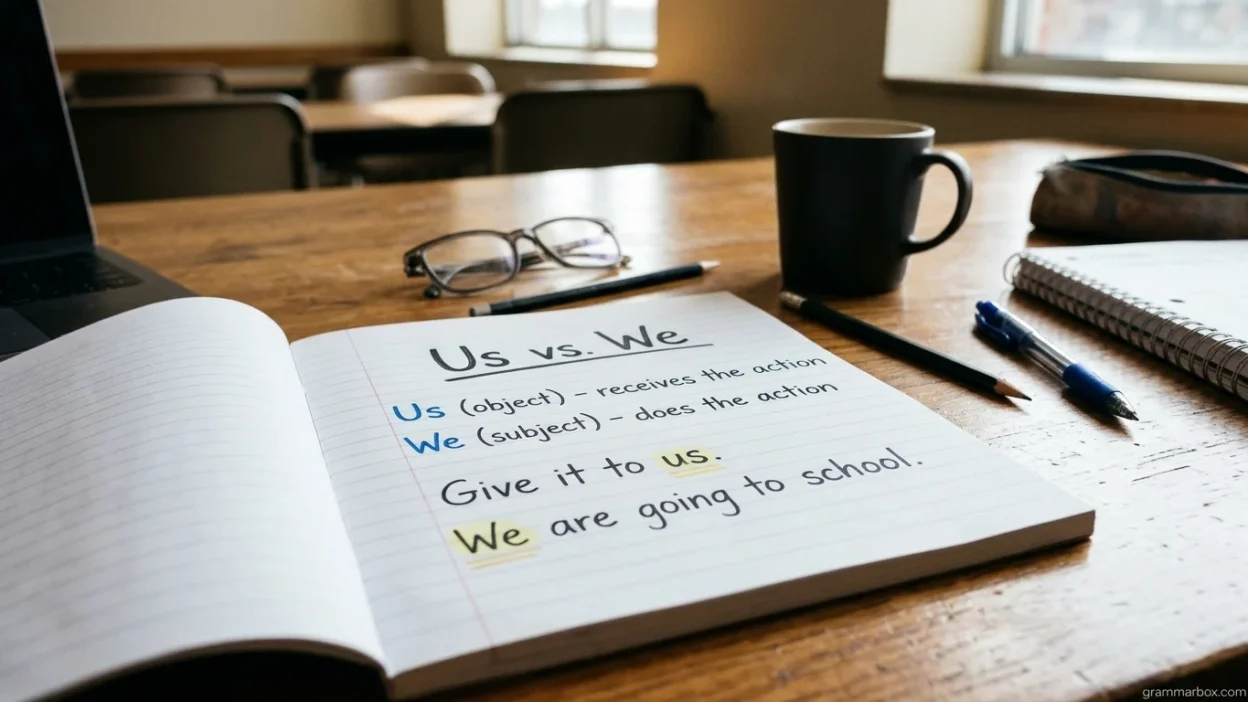
Choosing between us vs. we can be confusing, especially when both words refer to the same group of people. Although they have similar meanings, they serve different grammatical purposes in a sentence. Knowing when to use each word will help you write more naturally and avoid common English grammar mistakes.
The main difference is that we is a subject pronoun, while us is an object pronoun. This means you use we when a group performs an action and us when a group receives an action or follows a preposition. For example, you would say, “We finished the project,” but “The teacher helped us.” Understanding this simple distinction makes it easier to choose the correct pronoun in everyday conversations, academic writing, emails, and professional communication.
Quick Answer
We is a subject pronoun used when people perform an action, while us is an object pronoun used when people receive an action or follow a preposition. Say “We are ready” and “She invited us.” The correct choice depends on the word’s grammatical role.
Why People Confuse Us and We
People often confuse us and we because both pronouns refer to two or more people, including the speaker.
Their meanings are closely related, but their grammatical functions are different. English uses subject pronouns and object pronouns depending on how a person or group participates in a sentence.
Here are the main reasons for the confusion:
- Similar meanings: Both words refer to the speaker and at least one other person.
- Different sentence positions: Their placement depends on whether they act as subjects or objects.
- Informal speech: People sometimes use incorrect pronouns in casual conversations.
- Compound subjects and objects: Expressions such as “you and me” or “you and I” make pronoun selection more challenging.
- Everyday habits: Speakers may repeat grammatical patterns they hear from others without recognizing the difference.
The easiest way to remember the distinction is that we performs an action, while us receives an action.
First Word: We
We is a first-person plural subject pronoun. It refers to the speaker and one or more other people.
You use we when the speaker is part of the group performing an action or being described.
- We are going to the library.
- We finished our homework yesterday.
- We enjoy learning new languages.
- We have planned a family vacation.
- We need more time to complete the project.
- We were excited about the results.
- We understand the importance of education.
- We will attend the meeting tomorrow.
- We always support our friends.
- We believe everyone deserves an opportunity.
Common situations where you use we:
- Before an action verb: We play football.
- Before a helping verb: We are studying.
- As the subject of a sentence: We love reading.
- In questions: Are we ready?
- When describing a group: We are good friends.
Important grammar rule: Use we when the pronoun acts as the subject, regardless of whether the sentence is in the present, past, or future tense.
Second Word: Us
Us is a first-person plural object pronoun. It refers to the speaker and other people when they receive an action or are connected to a preposition.
You generally use us after verbs and prepositions.
Examples of us in sentences:
- She invited us to her birthday party.
- The teacher helped us with our homework.
- They gave us useful advice.
- Our parents encouraged us to study.
- The manager thanked us for our hard work.
- He waited for us outside the building.
- Please send us the complete report.
- The coach congratulated us after the match.
- This opportunity means a lot to us.
- Everyone supported us during difficult times.
Common situations where you use us:
- After an action verb: They called us.
- After a preposition: Come with us.
- As a direct object: She knows us.
- As an indirect object: He gave us a gift.
- After certain linking expressions: It is important to us.
Important grammar rule: Use us when the pronoun receives an action or follows a preposition.
Us vs. We: Comparison Table
The following table highlights the main grammatical differences between these two pronouns.
| Feature | We | Us |
|---|---|---|
| Part of speech | Subject pronoun | Object pronoun |
| Person | First person | First person |
| Number | Plural | Plural |
| Main function | Performs an action | Receives an action |
| Common position | Before the verb | After verbs or prepositions |
| Example | We are happy. | They helped us. |
| Case | Subjective | Objective |
Remember: Both words refer to the same group, but their grammatical roles determine which one is correct.
When to Use Each
Choosing between we and us becomes easier when you understand their roles in different sentence structures.
1. Use We as the Subject
Use we when the speaker and other people perform an action.
Examples:
- We completed the assignment.
- We are learning English.
- We visited our grandparents.
In each example, the group performs the action.
2. Use Us as the Object
Use us when someone or something performs an action toward the speaker and other people.
Examples:
- They invited us.
- The teacher praised us.
- My friends visited us.
Here, the group receives the action.
3. Use Us After Prepositions
Prepositions such as with, for, between, to, and among generally take object pronouns.
Examples:
- She came with us.
- This gift is for us.
- Keep this information between us.
- He spoke to us.
- The decision was made among us.
4. Use We Before Helping Verbs
When the group is the subject of a sentence containing a helping verb, use we.
Examples:
- We are working.
- We have finished.
- We will return soon.
- We were waiting.
5. Use We in Compound Subjects
When the speaker is grouped with another person as the subject, use we.
Examples:
- Sarah and we are classmates.
- My brother and we are going shopping.
- You and we should discuss the matter.
However, these sentences can sound more natural when rewritten:
- Sarah and I are classmates.
- My brother and I are going shopping.
- You and I should discuss the matter.
Examples of Us vs. We in Sentences
Here are 15 practical examples that show how to use us and we correctly.
| Incorrect or correct? | Sentence | Explanation |
|---|---|---|
| Correct | We are best friends. | We is the subject. |
| Correct | She called us yesterday. | Us is the object. |
| Incorrect | Us are going home. | Use we as the subject. |
| Incorrect | They helped we. | Use us as the object. |
| Correct | We need your support. | We performs the action. |
| Correct | Please come with us. | Us follows a preposition. |
| Correct | They invited us to dinner. | Us receives the invitation. |
| Correct | We enjoyed the movie. | We is the subject. |
| Correct | This belongs to us. | Us follows to. |
| Correct | We have a new teacher. | We is the subject. |
| Correct | Our friends visited us. | Us receives the action. |
| Correct | We were very happy. | We is the subject. |
| Correct | He gave us some advice. | Us is the indirect object. |
| Correct | The manager spoke with us. | Us follows with. |
| Correct | We will see you tomorrow. | We performs the action. |
More Examples in Everyday Conversations
Conversation 1
- Person A: Are we going to the park?
- Person B: Yes, we are.
Conversation 2
- Person A: Can you help us?
- Person B: Of course!
Conversation 3
- Person A: Who is joining the meeting?
- Person B: We are.
These examples demonstrate how both pronouns work naturally in everyday English.
Common Mistakes
Even experienced English speakers sometimes confuse us and we. Understanding the following mistakes can help you avoid incorrect pronoun usage.
1. Using Us as a Subject
Incorrect: Us are ready for the competition.
Correct: We are ready for the competition.
Why? The pronoun is the subject performing the action or being described.
2. Using We as an Object
Incorrect: She invited we to the wedding.
Correct: She invited us to the wedding.
Why? The pronoun receives the action of the verb invited.
3. Confusing We and Us After Prepositions
Incorrect: This is between you and we.
Correct: This is between you and us.
Why? The preposition between requires an object pronoun.
4. Using the Wrong Pronoun in Compound Subjects
Incorrect: Me and my brother are playing football.
Correct: My brother and I are playing football.
Why? The compound phrase is the subject, so I is the correct form.
5. Confusing Compound Objects
Incorrect: The teacher helped my sister and I.
Correct: The teacher helped my sister and me.
Why? The compound phrase is the object of helped, so me is correct.
Memory Trick: How to Remember Us vs. We
A simple memory trick can help you choose the correct pronoun without memorizing complicated grammar rules.
WE = DOERS
We perform the action.
Example: We are writing an article.
US = RECEIVERS
Us receives the action.
Example: The editor helped us.
You can also use the replacement trick:
- Replace we with I. If the sentence sounds correct, use we.
- Replace us with me. If the sentence sounds correct, use us.
For example:
- We are happy → I am happy. (Correct)
- They helped us → They helped me. (Correct)
This trick is especially useful when choosing between pronouns in longer sentences.
American vs. British English
There is no difference between American and British English when it comes to the basic grammatical rules for us and we.
Both varieties use we as a subject pronoun and us as an object pronoun.
| Usage | American English | British English |
|---|---|---|
| Subject | We are ready. | We are ready. |
| Object | They helped us. | They helped us. |
| After prepositions | Come with us. | Come with us. |
| Compound subject | You and I agree. | You and I agree. |
| Compound object | They invited you and me. | They invited you and me. |
Examples:
- American English: We are going to the store.
- British English: We are going to the shop.
The vocabulary may change, but the pronoun rules remain the same.
Therefore, whether you write for an American, British, Australian, or international audience, the same grammatical distinction applies.
Similar Words
Understanding other personal pronouns can make the difference between us and we even clearer.
| Subject Pronoun | Object Pronoun | Example |
|---|---|---|
| I | Me | I called her. / She called me. |
| We | Us | We called them. / They called us. |
| He | Him | He helped me. / I helped him. |
| She | Her | She knows us. / We know her. |
| They | Them | They invited us. / We invited them. |
| You | You | You helped me. / I helped you. |
| It | It | It surprised me. / I noticed it. |
Other Related Grammar Comparisons
- We vs. I: We refers to a group, while I refers to the speaker alone.
- Us vs. Me: Us refers to the speaker and others, while me refers only to the speaker.
- We vs. They: We includes the speaker, while they generally refers to other people or things.
- Us vs. Them: Us includes the speaker, while them refers to people or things outside the speaker’s group.
These comparisons can help you understand subject and object pronouns more effectively.
Final Verdict
The difference between us and we is based on grammatical function, not meaning. Both pronouns refer to the speaker and other people, but they cannot be used interchangeably. Use we when the group performs an action or acts as the subject of a sentence. Use us when the group receives an action or follows a preposition.
For example, “We are learning English” is correct because the group performs the action. Similarly, “The teacher is helping us” is correct because the group receives the action. Once you understand this simple subject-versus-object distinction, choosing between us and we becomes much easier in everyday speaking and writing.
FAQs:
1. Is it we or us?
Both are correct words, but their usage depends on the sentence. Use we as a subject pronoun and us as an object pronoun. For example, “We are ready” and “They helped us.”
2. Can I use us at the beginning of a sentence?
Yes, but only when the sentence structure allows it. For example, “Us? We already finished the assignment” is acceptable in informal conversation. However, use we when it is the grammatical subject, as in “We finished the assignment.”
3. Is it correct to say “me and we”?
No, “me and we” is generally incorrect in standard English. Use the appropriate subject or object forms depending on the sentence. For example, say “You and I are friends” or “They invited you and me.”
4. Is “between you and us” grammatically correct?
Yes. Between you and us” is grammatically correct because between is a preposition that requires object pronouns.
5. Why do we say “we are” instead of “us are”?
Because we is a subject pronoun and us is an object pronoun. The subject of a sentence uses we, so “We are happy” is correct.
6. Can we and us refer to the same people?
Yes. Both pronouns can refer to the same group of people, including the speaker. Their difference is grammatical: we is used as a subject, while us is used as an object.
7. Is “thank you for helping us” correct?
Yes. This sentence is grammatically correct because us receives the action of helping. The preposition for also takes the object form in this expression.
Conclusion
Learning the difference between us and we is an important part of improving English grammar. Although both words refer to the same group of people, they have different roles in a sentence. We acts as the subject, while us functions as the object. Recognizing these roles will help you construct clearer and more grammatically correct sentences.
If you are writing an academic assignment, sending a professional email, or having a casual conversation, remember to check how the pronoun functions in your sentence. Practice with everyday examples, use the replacement trick, and pay attention to prepositions. With regular practice, you will confidently know when to use us and when to use we.
Remember This
- We = Subject pronoun (the group performs the action).
- Us = Object pronoun (the group receives the action).
- Use we before verbs when it is the subject.
- Use us after verbs and prepositions when it is the object.
- American and British English follow the same rules.