
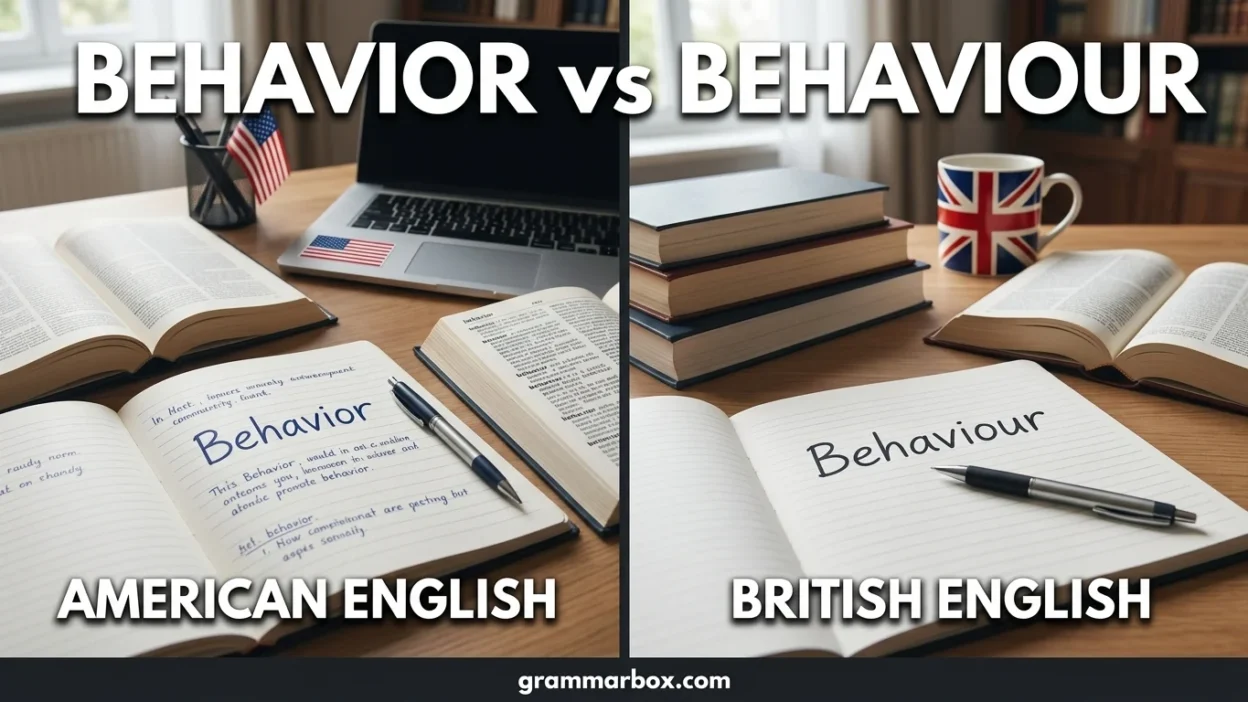
The English language has many words that are spelled differently depending on where they are used, and behavior vs behaviour is a common example. Both spellings refer to the way a person, animal, or group acts in a particular situation. Although they look slightly different, their meaning remains the same. The main difference is the variety of English in which each spelling is preferred.
Understanding the difference between behavior and behaviour can help you write more clearly in school assignments, professional emails, academic papers, and online content. If you use American English, behavior is the standard spelling. If you follow British English, behaviour is generally preferred. Both forms are correct, so neither should automatically be considered a spelling mistake.
In this guide, you will learn the meanings of both words, explore their differences with practical examples, and discover how to choose the right spelling for your audience. You will also find useful grammar tips, common mistakes, and a simple memory trick to make the distinction easier to remember.
Quick Answer
Behavior is the American English spelling, while behaviour is the British English spelling. Both words have the same meaning: the way someone or something acts. Use behavior when writing for an American audience and behaviour when following British, Canadian, Australian, or other relevant English spelling conventions.
Why People Confuse It
People often confuse behavior and behaviour because both spellings are accepted in English and have exactly the same meaning. The only difference is the letter u in behaviour.
This spelling difference is part of a broader pattern between American and British English. For example, American English uses color, while British English usually uses colour. Similarly, favor is common in the United States, whereas favour is preferred in British English.
The confusion usually occurs for three reasons:
- Different spelling standards: American and British English follow different conventions for certain words.
- International exposure: Readers encounter both forms in books, websites, news articles, and educational materials.
- Writing consistency: Writers sometimes mix American and British spellings in the same document without realizing it.
The important point is that both spellings are correct. Your choice should depend on your audience and the spelling style you want to follow.
First Word: Behavior
Behavior is the standard American English spelling of the noun that describes how a person, animal, or organization acts.
It can refer to actions, habits, reactions, manners, or responses to different circumstances. The word is widely used in psychology, education, science, business, and everyday conversations.
Meaning of Behavior
Behavior means the way someone or something acts or responds in a particular situation.
Examples include:
- A child’s behavior in the classroom.
- The behavior of customers when shopping.
- Animal behavior in the wild.
- Employee behavior in the workplace.
- Changes in human behavior during stressful situations.
Example Sentences with Behavior
- The teacher praised the students for their excellent behavior.
- His behavior changed after he started his new job.
- Scientists study animal behavior to understand wildlife.
- Parents should encourage positive behavior at home.
- The manager discussed the employee’s behavior during the meeting.
When to Use Behavior
Use behavior when writing in American English, especially for readers in the United States.
For example:
- The school has a strict behavior policy.
- Researchers examined consumer behavior.
- Good behavior helps create a positive learning environment.
Remember: Behavior is the preferred spelling in American English.
Second Word: Behaviour
Behaviour is the standard British English spelling of the same noun. It has the same definition and is used in the same grammatical situations as behavior.
The extra letter u does not change the pronunciation or meaning of the word. Behaviour is common in British publications and is also used in many other varieties of English that follow British spelling conventions.
Meaning of Behaviour
Behaviour means the way a person, animal, or group acts or responds to particular circumstances.
It can describe positive or negative actions, social habits, emotional responses, and patterns of conduct.
Examples include:
- A student’s behaviour during a lesson.
- The behaviour of wild animals.
- Changes in social behaviour.
- Professional behaviour in an office.
- Children’s behaviour at home.
Example Sentences with Behaviour
- The teacher praised the children for their excellent behaviour.
- His behaviour surprised everyone at the meeting.
- Scientists observed the behaviour of birds during winter.
- Parents can encourage good behaviour through positive reinforcement.
- The company expects professional behaviour from all employees.
When to Use Behaviour
Use behaviour when writing in British English or following a publication’s British spelling requirements.
For example:
- The school has introduced a new behaviour policy.
- Researchers studied consumer behaviour.
- Her behaviour was polite and respectful.
Remember: Behaviour is the preferred spelling in British English.
Behavior vs Behaviour: Comparison Table
| Feature | Behavior | Behaviour |
|---|---|---|
| English variety | American English | British English |
| Meaning | The way someone or something acts | The way someone or something acts |
| Spelling | Without u | With u |
| Pronunciation | Same | Same |
| Part of speech | Noun | Noun |
| Common usage | US publications and writing | UK publications and writing |
| Correctness | Correct | Correct |
| Example | Positive behavior | Positive behaviour |
The table shows that the difference is purely a spelling convention. Neither word has a different meaning, and both are grammatically correct.
When to Use Each
Choosing between behavior and behaviour is simple once you know which English spelling standard your writing follows.
Use Behavior in American English
Choose behavior when writing for an American audience or following an American style guide.
Examples:
- The company has a strict code of behavior.
- The study examined human behavior.
- The teacher addressed disruptive behavior in class.
- Customer behavior can influence business decisions.
American English generally removes the u from certain words ending in -our, such as color, honor, and labor.
Use Behaviour in British English
Choose behaviour when writing for a British audience or following a British spelling guide.
Examples:
- The school has a clear code of behaviour.
- The study examined human behaviour.
- The teacher addressed disruptive behaviour in class.
- Customer behaviour can influence business decisions.
British English generally retains the u in words such as colour, honour, and labour.
What About Canadian and Australian English?
Canadian and Australian English often use behaviour, following British-style spelling for this word. However, English conventions vary by country, publisher, institution, and style guide.
If you are writing for a specific organization or publication, follow its preferred spelling rather than assuming that every word follows one national pattern.
Examples of Behavior vs Behaviour in Sentences
Here are 12 examples showing how both spellings work in everyday and professional writing.
1. American: The student’s behavior improved after the discussion.
British: The student’s behaviour improved after the discussion.
2. American: Scientists studied the behavior of dolphins.
British: Scientists studied the behaviour of dolphins.
3. American: Good behavior is important in the classroom.
British: Good behaviour is important in the classroom.
4. American: The manager appreciated her professional behavior.
British: The manager appreciated her professional behaviour.
5. American: The report describes changes in consumer behavior.
British: The report describes changes in consumer behaviour.
6. American: His behavior during the interview was impressive.
British: His behaviour during the interview was impressive.
7. American: Parents should model respectful behavior.
British: Parents should model respectful behaviour.
8. American: Researchers examined human behavior under pressure.
British: Researchers examined human behaviour under pressure.
9. American: The school introduced a new behavior policy.
British: The school introduced a new behaviour policy.
10. American: The dog’s behavior became calmer over time.
British: The dog’s behaviour became calmer over time.
11. American: Social behavior can change across cultures.
British: Social behaviour can change across cultures.
12. American: The company encourages ethical behavior among employees.
British: The company encourages ethical behaviour among employees.
Notice that the meaning, sentence structure, and grammar remain unchanged. Only the spelling differs.
Common Mistakes
Although behavior and behaviour are both correct, writers sometimes make mistakes when choosing between them.
1. Thinking One Spelling Is Incorrect
A common misconception is that behaviour is a misspelling because it contains an extra letter. In reality, it is the standard British spelling.
Incorrect assumption: Behaviour is always wrong.
Correct understanding: Both spellings are correct in their respective English conventions.
2. Mixing American and British Spellings
Using behavior in one paragraph and behaviour in another can make an article look inconsistent.
For example:
- The school improved student behavior.
- The new behaviour policy helped teachers.
Both sentences are correct individually, but using both spellings in the same document may be undesirable if consistency is expected.
Tip: Choose one spelling standard and apply it throughout your writing.
3. Confusing Spelling with Meaning
Some writers believe that behavior and behaviour describe different types of actions.
This is incorrect. Both words refer to the same concept and can be used in the same contexts.
4. Ignoring the Target Audience
A writer preparing content for a US school may prefer behavior, while a writer preparing a document for a UK institution may need behaviour.
Always consider the intended readers and the applicable style guide.
5. Assuming Every British-Style Word Follows the Same Rule
Not all spelling differences between American and British English are identical. Some words have more complicated variations, so it is best to check individual words when necessary.
Memory Trick: How to Remember Behavior vs Behaviour
Use this simple memory trick to remember which spelling belongs to which English variety.
- Behavior = American English: Think of the United States spelling color, which also drops the u.
- Behaviour = British English: Think of British spelling colour, which keeps the u.
You can also remember this short rule:
American English drops the “u”; British English keeps it.
This pattern works for several common pairs, including:
| American English | British English |
|---|---|
| Behavior | Behaviour |
| Color | Colour |
| Favor | Favour |
| Honor | Honour |
| Labor | Labour |
| Neighbor | Neighbour |
This memory trick is useful for students, teachers, editors, bloggers, and anyone learning English spelling differences.
American vs British English
American and British English share the same basic grammar and vocabulary, but they differ in spelling, punctuation conventions, and some word choices.
Behavior and behaviour are examples of regional spelling variation rather than differences in definition.
American English
American English typically uses shorter spellings for words ending in -our when the British equivalent retains the u.
Common examples include:
- Behavior
- Color
- Favor
- Honor
- Neighbor
These forms are standard in American dictionaries and widely used in US education, journalism, and business writing.
British English
British English generally retains the u in these words.
Common examples include:
- Behaviour
- Colour
- Favour
- Honour
- Neighbour
These forms are standard in many UK dictionaries and publications.
Which Version Should English Learners Choose?
The best choice depends on your learning goals. If you study or work primarily with American English materials, learn behavior. If your course, workplace, or audience uses British English, learn behaviour.
Neither variety is inherently better. The most important thing is to understand both forms and use the appropriate one consistently.
Similar Words
Several words related to behavior and behaviour can help you express the idea of actions, habits, and conduct more precisely.
| Word | Meaning | Example |
|---|---|---|
| Conduct | The way someone behaves, especially in a particular setting | His conduct was professional. |
| Manner | The way someone acts or does something | She spoke in a friendly manner. |
| Actions | Things someone does | His actions showed kindness. |
| Attitude | A person’s way of thinking or feeling about something | She has a positive attitude. |
| Habits | Regular or repeated actions | Reading is one of his daily habits. |
| Demeanor | A person’s outward manner or appearance | Her calm demeanor reassured the team. |
| Deportment | The way someone stands, moves, or behaves | The class learned appropriate deportment. |
| Conductivity | The ability of a material to conduct heat or electricity | Copper has high electrical conductivity. |
The last word, conductivity, is not a synonym for behavior. It is included to highlight why choosing a related-looking word without checking its meaning can create confusion.
For most everyday contexts, conduct, actions, attitude, and habits are useful alternatives, depending on the precise meaning you want to communicate.
FAQs:
1. Is behavior or behaviour correct?
Both are correct. Behavior is the standard American English spelling, while behaviour is the standard British English spelling. The correct choice depends on your audience and preferred spelling convention.
2. What is the difference between behavior and behaviour?
The only difference is spelling. Behavior does not contain the letter u, whereas behaviour does. Both words have the same meaning and pronunciation.
3. Is behaviour British or American English?
Behaviour is the standard British English spelling. It is also commonly used in countries such as Australia and Canada, although individual spelling conventions may vary.
4. Is behavior spelled without a u in the United States?
Yes. American English uses behavior without the letter u. This spelling is standard in American dictionaries, schools, publications, and professional documents.
5. Does behaviour have a different meaning from behavior?
No. Both words mean the way a person, animal, or group acts or responds in a particular situation. The spelling difference does not change their definition.
6. Should I use behavior or behaviour in an academic paper?
Follow the spelling conventions required by your institution, professor, journal, or style guide. Use behavior for American English and behaviour for British English, and remain consistent throughout your paper.
7. Which spelling should I use on my website?
Choose the spelling that matches your primary audience and editorial style. For a US audience, behavior is generally appropriate; for a UK audience, behaviour is generally appropriate. International websites should adopt a consistent standard.
Conclusion
Understanding behavior vs behaviour helps you recognize one of the most common spelling differences in English. Although the two forms look slightly different, they communicate exactly the same idea. Learning this distinction can improve your spelling accuracy, strengthen your editing skills, and help you produce clearer academic, professional, and online content.
The easiest way to remember the rule is to associate behavior with American English and behaviour with British English. Apply the appropriate spelling throughout your writing, and check your audience’s preferences when working on formal documents. Once you remember this simple pattern, choosing between the two spellings becomes easy.
Remember This
- Behavior: American English.
- Behaviour: British English.
- Meaning: Identical in both forms.
- Pronunciation: The same.
- Best practice: Choose one spelling convention and use it consistently.