Have you ever wondered whether to say “I ate breakfast” or “I have eaten breakfast”? The difference between eaten vs ate can be confusing because both words come from the verb eat, but they serve different grammatical purposes. Choosing the right form depends mainly on the tense and the helping verb used in the sentence.
The good news is that the rule is simple once you understand the difference between the simple past tense and the past participle. In this guide, we’ll explain when to use ate and eaten, show clear examples, compare them in a handy table, and highlight common mistakes. Whether you are an English learner, student, writer, or simply trying to improve your grammar, these practical examples will help you use ate and eaten naturally and confidently.
Quick Answer
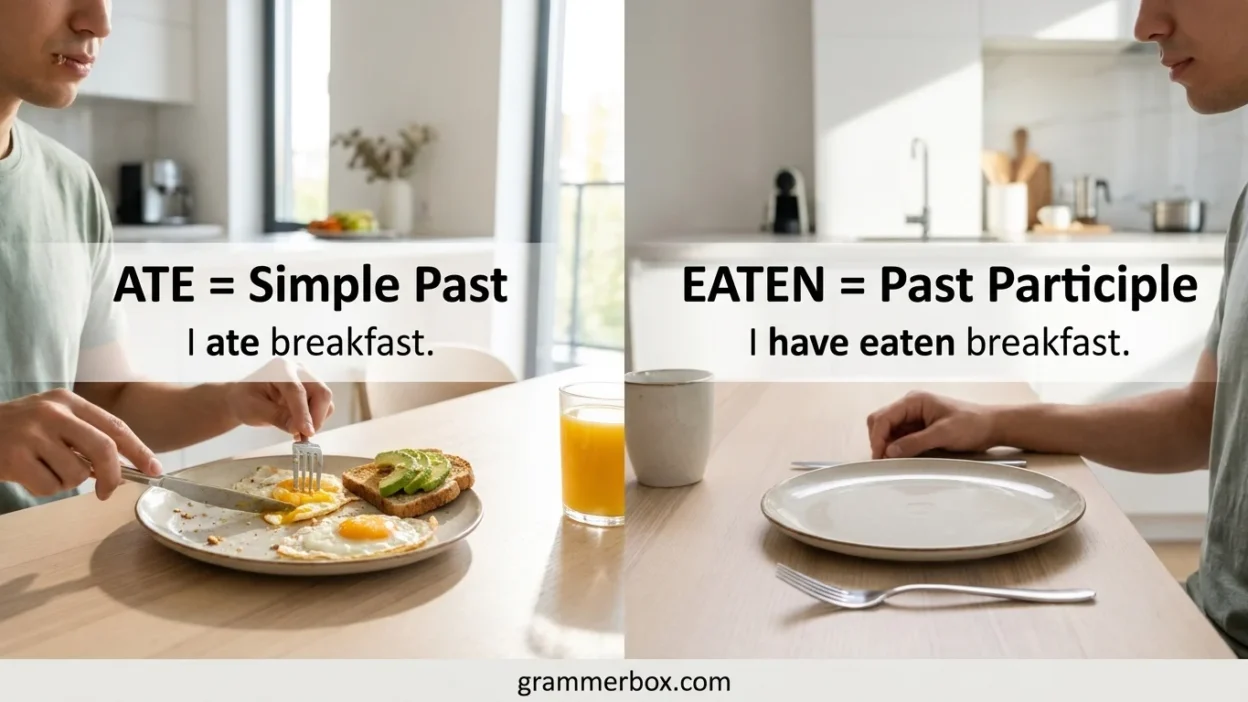
Ate is the simple past tense of eat and is used for a completed action in the past: “I ate lunch.” Eaten is the past participle and normally needs a helping verb such as have, has, or had: “I have eaten lunch.”
Why People Confuse It
The confusion happens because ate and eaten are both forms of the same irregular verb:
- Eat — present/base form
- Ate — simple past
- Eaten — past participle
Unlike regular verbs, eat does not form its past tense by simply adding -ed.
For example:
- Present: I eat apples every day.
- Past: I ate an apple yesterday.
- Present perfect: I have eaten an apple.
- Past perfect: I had eaten an apple before dinner.
The key is to look at what comes before the verb.
Ate: Meaning and Usage
Ate is the simple past tense of eat. Use it when talking about an eating action that happened and was completed in the past.
Examples with “Ate”
- I ate breakfast at 8 a.m.
- She ate the last slice of pizza.
- We ate dinner together last night.
- He ate too much cake at the party.
- They ate lunch before leaving.
- Sarah ate an apple yesterday.
- I ate sushi for the first time last weekend.
You can often use ate with a specific past-time expression such as:
- yesterday
- last night
- last week
- two hours ago
- this morning
- in 2024
Example:
“I ate breakfast at 7:30 this morning.”
Eaten: Meaning and Usage
Eaten is the past participle of eat. It generally cannot stand alone as the main past-tense verb. It usually appears with a helping verb such as have, has, or had.
Common Structures
- have + eaten
- has + eaten
- had + eaten
- will have + eaten
Examples:
- I have eaten breakfast already.
- She has eaten all the cookies.
- We had eaten before the guests arrived.
- By noon, they will have eaten lunch.
Notice that eaten works with an auxiliary or helping verb.
Eaten in the Passive Voice
Eaten can also appear in passive constructions:
- The cake was eaten by the children.
- All the food has been eaten.
- The apples were eaten before lunch.
Here, eaten is still the past participle.
Eaten vs Ate Comparison Table
| Feature | Ate | Eaten |
|---|---|---|
| Base verb | Eat | Eat |
| Verb form | Simple past | Past participle |
| Usually used with | No helping verb required | Have, has, had, etc. |
| Example | I ate lunch. | I have eaten lunch. |
| Tense commonly associated with | Simple past | Perfect tenses |
| Can stand alone as the main past verb? | Yes | Usually no |
| Specific past time | Common | Generally avoided with present perfect |
The easiest distinction is this: ate tells you that something happened in the past, while eaten usually works with a helping verb to form a perfect tense or passive construction.
When to Use Ate vs Eaten
Use “Ate” When:
Use ate for a completed action at a definite or understood time in the past.
Example:
“I ate pizza last night.”
The action happened in the past and is finished.
Use “Eaten” When:
Use eaten after helping verbs such as have, has, or had.
Examples:
- I have eaten already.
- He has eaten lunch.
- They had eaten before we arrived.
Use eaten when forming perfect constructions or passive sentences.
A Simple Test
Ask yourself:
Is there a helping verb such as have, has, or had?
- If no → ate may be correct.
- If yes → eaten is usually required.
Compare:
- ❌ I have ate breakfast.
- ✅ I have eaten breakfast.
But:
- ❌ I eaten breakfast yesterday.
- ✅ I ate breakfast yesterday.
Ate vs Eaten Examples
Here are practical examples showing the difference in everyday English:
- I ate breakfast early this morning.
- I have eaten breakfast already.
- She ate the whole sandwich.
- She has eaten the whole sandwich.
- We ate dinner at a restaurant last night.
- We had eaten dinner before the movie started.
- He ate three pieces of cake.
- He has eaten three pieces of cake.
- They ate lunch before the meeting.
- They had eaten lunch before the meeting began.
- Sarah ate an orange yesterday.
- Sarah has eaten an orange today.
Notice how the meaning and grammatical structure change depending on the verb form.
Common Mistakes
1. Using “Ate” After “Have”
Incorrect:
“I have ate lunch.”
Correct:
“I have eaten lunch.”
After have, has, or had, use the past participle eaten.
2. Using “Eaten” Without a Helping Verb
Incorrect:
“I eaten breakfast.”
Correct:
“I ate breakfast.”
Or:
“I have eaten breakfast.”
3. Using “Ate” in the Present Perfect
Incorrect:
“She has ate the cake.”
Correct:
“She has eaten the cake.”
4. Confusing “Had Ate” and “Had Eaten”
Incorrect:
“They had ate before we arrived.”
Correct:
“They had eaten before we arrived.”
Remember: had + past participle = had eaten.
Memory Trick: Eat, Ate, Eaten
A quick way to remember the three forms is:
Eat → Ate → Eaten
Think of them as:
- Eat = now or generally
- Ate = finished past action
- Eaten = needs a helper
For example:
I eat breakfast every day.
I ate breakfast at 8.
I have eaten breakfast already.
Another useful trick is:
“Have/has/had? Choose eaten!”
If you see have, has, or had, your brain should immediately think eaten.
American vs British English
There is no major difference between American and British English when it comes to the basic grammatical distinction between ate and eaten.
Both varieties use:
- ate as the simple past form
- eaten as the past participle
For example, both American and British speakers can say:
- “I ate breakfast at seven.”
- “I have eaten already.”
Differences may sometimes appear in how speakers use the present perfect versus the simple past, particularly with expressions such as already, just, and yet. However, the forms ate and eaten themselves follow the same basic rules.
Similar Words and Verb Forms
Understanding related forms of eat can make the grammar easier to remember.
Eat
The base or present form.
Example:
“I eat fruit every morning.”
Ate
The simple past form.
Example:
“I ate fruit yesterday.”
Eaten
The past participle.
Example:
“I have eaten fruit today.”
Eating
The present participle or gerund.
Example:
“I am eating lunch.”
These four forms cover many common situations in everyday English.
Final Verdict: Eaten vs Ate
The difference between eaten and ate comes down to verb form and sentence structure.
- Ate = simple past
- Eaten = past participle
- Eat = base/present form
- Eating = present participle
Use ate when describing a completed action in the past: “I ate lunch.” Use eaten when it follows a helping verb such as have, has, or had: “I have eaten lunch.”
Once you recognize whether your sentence needs the simple past or past participle, choosing the correct form becomes much easier.
FAQs:
1. Is “ate” or “eaten” correct?
Both are correct, but they are used differently. Ate is the simple past form, while eaten is the past participle.
2. Is it “I ate” or “I eaten”?
The correct sentence is “I ate.” You need a helping verb to use eaten, as in “I have eaten.”
3. Is “I have ate” grammatically correct?
No. The correct form is “I have eaten.” The structure have + past participle requires eaten.
4. Is “I had ate” correct?
No. Say “I had eaten.” After had, use the past participle eaten.
5. What is the past tense of eat?
The simple past tense of eat is ate.
Example: “She ate dinner at six.”
6. What is the past participle of eat?
The past participle of eat is eaten.
Example: “She has eaten dinner.”
7. Can “eaten” be used without “have”?
Yes, but it generally needs another auxiliary or grammatical structure. For example, “The cake was eaten” is correct passive voice.
Conclusion
Understanding eaten vs ate becomes straightforward once you remember their grammatical roles. Ate is the simple past form used for completed actions in the past, while eaten is the past participle used with helping verbs such as have, has, and had. This small distinction can make a big difference in accurate English writing and speaking.
When you are unsure, look at the sentence structure rather than the meaning alone. If you are talking about a completed past action, ate is usually the right choice. If your sentence contains have, has, or had, you will generally need eaten. With a little practice, these two forms will quickly become natural.
Remember This
Eat = present/base form
Ate = simple past
Eaten = past participle
No helping verb → ate: “I ate lunch.”
Have/has/had → eaten: “I have eaten lunch.”