If someone says, “We’re back to square one,” they usually mean that their efforts have failed or a plan has not worked, so they must start again from the beginning. This common English idiom is often used when a project, decision, or attempt returns to its original starting point after a setback. For example, if a company rejects a proposed design after months of work, the team may have to go back to square one.
Understanding “back to square one” is useful for everyday conversations, workplace English, writing, and informal discussions. The phrase does not literally mean returning to a numbered square. Instead, it describes a situation in which progress has been lost and a person must reconsider the original problem or begin the process again. In this guide, you’ll learn the meaning, correct usage, examples, common mistakes, and similar expressions.
Quick Answer
“Back to square one” means returning to the beginning because an attempt, plan, or solution has failed or produced no useful progress. It is an idiom commonly used for setbacks in projects, decisions, negotiations, and problem-solving.
Why People Confuse It
People sometimes misunderstand this idiom because “square one” sounds like a physical location. However, it is not normally referring to an actual square.
The phrase uses “square one” to represent the starting point of an activity or process.
For example:
- We lost the contract, so we’re back to square one.
- The experiment failed, putting the researchers back to square one.
- If this plan doesn’t work, we’ll be back to square one.
The important idea is lost progress followed by a return to the beginning.
First Word: “Back”
The word back indicates a return to an earlier position, condition, or stage.
In “back to square one,” it suggests that someone has moved away from the starting point but now has to return to it.
Examples
- The negotiations are back to where they started.
- After the error, we had to go back and check everything.
- The team went back to the original plan.
Here, “back” helps create the idea of returning to an earlier stage.
Second Word: “Square One”
Square one means the starting point of something.
It can refer to the beginning of a project, process, investigation, plan, or attempt.
For example:
“The new evidence disproved our theory, so we’re back to square one.”
This means the researchers have to reconsider the problem from the beginning.
The expression is usually used figuratively rather than literally.
Comparison Table
| Expression | Meaning | Example |
|---|---|---|
| Back to square one | Return to the beginning after a setback | The plan failed, so we’re back to square one. |
| Start from scratch | Begin again without using previous work | We had to start the design from scratch. |
| Back where we started | Return to the previous situation | After the discussion, we’re back where we started. |
| Make a fresh start | Begin again with a new approach | She decided to make a fresh start. |
| Hit a dead end | Reach a point where progress is impossible | The investigation hit a dead end. |
When to Use “Back to Square One”
Use this idiom when someone has made progress but a problem, failure, or change forces them to return to the beginning.
Common situations include:
- Projects: A rejected proposal may send a team back to square one.
- Business: Failed negotiations can put both sides back to square one.
- Problem-solving: A failed solution may require starting again.
- Research: New evidence can force researchers to reconsider their original assumptions.
- Relationships: A disagreement may leave two people back at the beginning of a discussion.
- Planning: A major change can require a completely new plan.
The expression is especially natural in informal and conversational English.
Back to Square One Examples
Here are more than 10 examples showing how the idiom works naturally in sentences:
- The client rejected our proposal, so we’re back to square one.
- Our first solution didn’t work, which put us back to square one.
- The negotiations broke down, and both sides were back to square one.
- If this application is rejected, we’ll be back to square one.
- The broken equipment forced the engineers back to square one.
- We thought we had solved the problem, but the latest test sent us back to square one.
- The team lost its main investor and was suddenly back to square one.
- After discovering a major error in the data, the researchers went back to square one.
- The new regulations mean that the company may have to go back to square one.
- Our original plan fell apart, leaving us back to square one.
- I deleted the wrong file and ended up back to square one with the project.
- The architect changed the design completely, sending the builders back to square one.
- After the trial failed, the scientists had to return to square one.
- We couldn’t agree on the budget, so we’re back to square one.
“Go back to square one” vs. “Be back to square one”
Both forms are common, but they emphasize slightly different things.
- Go back to square one focuses on the action of returning.
- Be back to square one focuses on the resulting situation.
For example:
We may have to go back to square one.
After the failed test, we’re back to square one.
Common Mistakes
1. Treating it as a literal location
Incorrect understanding:
“Square one” is always a physical square.
In normal idiomatic use, it means the beginning or starting point.
2. Using “square zero”
The established expression is “back to square one,” not “back to square zero.”
3. Assuming it always means complete failure
The phrase often suggests that progress has been lost, but it does not necessarily mean that every previous effort was completely useless.
For example:
The first design failed, but we learned a lot and now we’re back to square one.
4. Using it in extremely formal writing without considering tone
“Back to square one” is widely understood, but it has an idiomatic, conversational tone. In highly formal writing, alternatives such as “return to the initial stage” may sometimes be more appropriate.
5. Confusing it with “start from scratch”
These expressions overlap, but they are not always identical.
Start from scratch emphasizes beginning with nothing or very little from the previous attempt.
Back to square one emphasizes returning to the starting point after making progress or encountering a setback.
Memory Trick
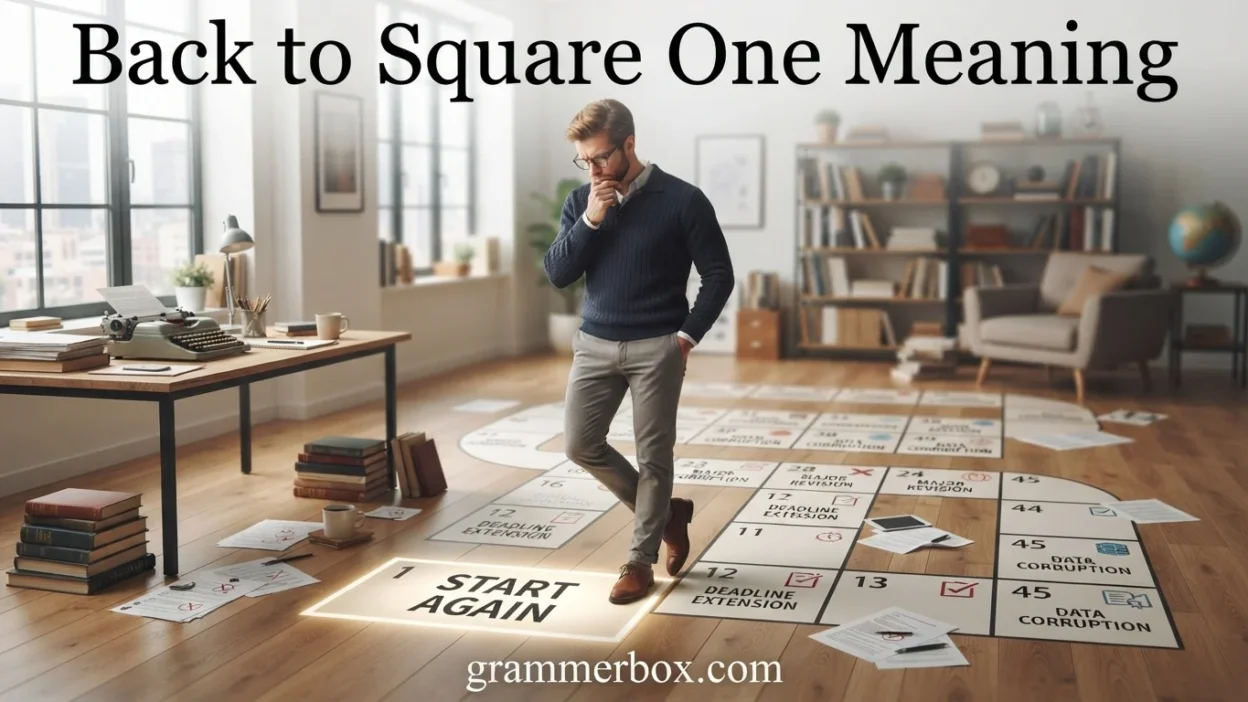
Think of a board game.
You move forward through several squares, but something happens and you are sent back to Square 1.
That is the basic idea behind:
Back to square one = back to the beginning.
A simple memory sentence is:
“The plan failed, so we’re back at the beginning.”
If you can replace “back to square one” with “back to the beginning,” you probably understand the idiom correctly.
American vs. British English
“Back to square one” is used in both American and British English.
There is no major difference in its basic meaning between the two varieties.
Examples:
American English:
The deal fell through, so we’re back to square one.
British English:
The deal fell through, so we’re back to square one.
The phrase is also widely understood in other varieties of English, especially among speakers familiar with international English.
Similar Words and Expressions
Several expressions have a similar meaning to back to square one:
Start from scratch
Begin again without relying much on previous work.
We had to start the website from scratch.
Back to the drawing board
Return to the planning stage because an idea or design has not worked.
The prototype failed, so it’s back to the drawing board.
Back where we started
Return to the same position or situation as before.
After two hours of discussion, we’re back where we started.
Begin again
Simply means to start another time.
The first attempt failed, so we had to begin again.
At a dead end
Reach a point where further progress is not possible.
The investigation has reached a dead end.
Among these expressions, “back to the drawing board” is especially close in meaning when discussing plans, designs, or proposed solutions.
FAQs:
1. What does “back to square one” mean?
“Back to square one” means returning to the beginning after an attempt has failed, a plan has changed, or progress has been lost.
2. Is “back to square one” an idiom?
Yes. “Back to square one” is an English idiom meaning to return to the starting point.
3. What is an example of “back to square one”?
A simple example is: “The client rejected our proposal, so we’re back to square one.”
4. Is “back to square one” negative?
It usually describes a setback or loss of progress, so it often has a negative or frustrating context. However, it does not necessarily mean the final outcome will be negative.
5. What is another way to say “back to square one”?
Depending on the context, you can say “start from scratch,” “back to the drawing board,” “back where we started,” or “begin again.”
6. Can I use “back to square one” in formal writing?
Yes, but it is somewhat conversational. In very formal writing, “return to the initial stage” or “return to the starting point” may sound more appropriate.
7. What is the opposite of “back to square one”?
There is no single exact opposite, but expressions such as “make progress,” “move forward,” or “reach the next stage” can express the contrasting idea.
Remember This
Back to square one = back to the beginning after a setback.
Think:
Progress → Problem → Start again = Back to square one
Conclusion
The idiom “back to square one” is a useful expression for describing situations where progress has been interrupted and you need to return to the beginning. It is easy to use once you connect “square one” with the idea of a starting point.
If you’re talking about a failed business plan, an unsuccessful experiment, a difficult negotiation, or an everyday problem, this phrase can clearly describe the frustration of having to begin again. Just remember: back to square one means back to the starting point.