
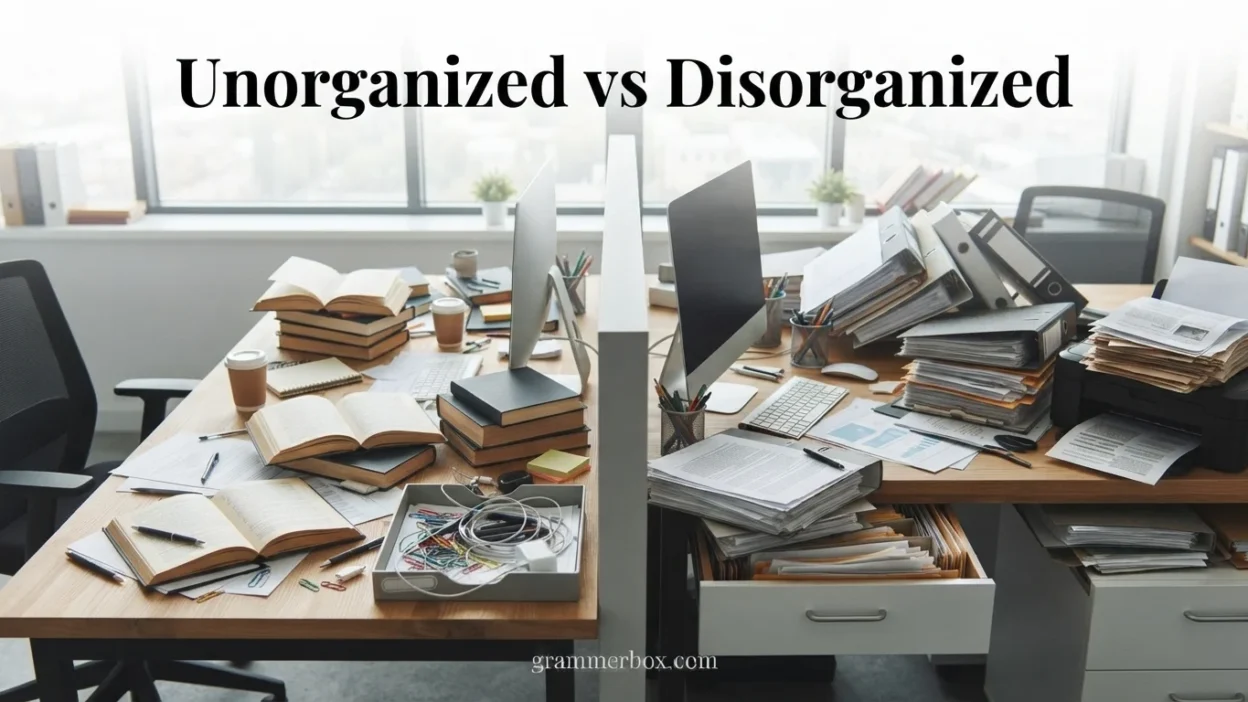
When describing something messy, poorly arranged, or lacking a clear system, unorganized and disorganized often seem interchangeable. Both words can describe people, rooms, schedules, files, ideas, or activities that lack order. However, there can be a subtle difference in emphasis, especially depending on context.
Unorganized vs disorganized is a common English usage question because the two adjectives overlap considerably. In everyday English, disorganized is generally more common when you mean that something is poorly arranged or managed. Unorganized can simply mean that something has not been organized or arranged. Understanding this distinction can help you choose the more natural word in writing and conversation.
Quick Answer
Disorganized usually means lacking order, structure, or effective organization. Unorganized means not organized or arranged. They can overlap, but disorganized often suggests poor organization, while unorganized can be more neutral.
Why People Confuse It
The confusion comes from the fact that both words contain the idea of organization.
- Unorganized = not organized
- Disorganized = lacking organization or organized in a poor, ineffective way
The prefixes un- and dis- can both create negative meanings in English, but they do not always produce exactly the same nuance.
For example:
The documents are unorganized.
This can simply mean the documents have not been arranged.
The documents are disorganized.
This suggests that the documents are arranged poorly or are difficult to navigate.
In many everyday situations, either word may be understood. However, disorganized is often the more natural choice when describing messy systems, poor planning, or a person who struggles to stay organized.
Unorganized: Meaning and Usage
Unorganized means not organized, arranged, or structured.
It can describe something that has not been put into an organized system.
Examples
- The files are completely unorganized.
- We received an unorganized collection of documents.
- The information was presented in an unorganized way.
- The books were still unorganized after the move.
- The notes are unorganized, so I need to sort them.
The word can have a relatively neutral meaning. It does not necessarily suggest that someone attempted to organize something and did a poor job.
Unorganized can mean “not organized at all”
For example:
The photographs were unorganized in several boxes.
The sentence focuses on the absence of organization rather than poor organizational ability.
Disorganized: Meaning and Usage
Disorganized means lacking order, structure, planning, or effective organization.
It can describe both things and people.
Examples
- Her desk is extremely disorganized.
- The meeting was disorganized.
- He is often disorganized at work.
- The company has a disorganized filing system.
- Their travel plans became disorganized after the cancellation.
When describing a person, disorganized commonly means that the person has difficulty managing tasks, belongings, schedules, or responsibilities.
For example:
Tom is very disorganized and often forgets appointments.
Here, disorganized suggests an ongoing characteristic rather than simply saying that Tom has not organized one particular thing.
Unorganized vs Disorganized: Comparison Table
| Feature | Unorganized | Disorganized |
|---|---|---|
| Basic meaning | Not organized | Lacking effective organization |
| Tone | Often neutral | Often suggests a problem |
| Describes people | Possible but less common | Very common |
| Describes objects | Yes | Yes |
| Describes systems | Yes | Yes |
| Suggests poor planning | Not necessarily | Often |
| Suggests disorder | Sometimes | Usually |
| Common everyday choice | Less common | More common |
When to Use Each
Use “unorganized” when:
Choose unorganized when you simply want to say that something has not been organized.
Examples:
- The data is still unorganized.
- We found an unorganized pile of papers.
- The materials were unorganized when we arrived.
Use “disorganized” when:
Choose disorganized when something is poorly arranged, chaotic, inefficient, or difficult to manage.
Examples:
- The office is disorganized.
- His schedule is disorganized.
- The project became disorganized.
- She has a disorganized approach to her work.
A simple distinction
Think of it this way:
Unorganized = organization is absent.
Disorganized = organization is poor or ineffective.
This distinction is not absolute. Native speakers may use the two words interchangeably in many contexts.
Unorganized vs Disorganized Examples
Here are some examples showing how the words work in real sentences:
- The documents were unorganized, so we sorted them alphabetically.
- The office became disorganized after several employees left.
- His notes are unorganized, but the information is useful.
- Her approach to the project is disorganized.
- The photographs were unorganized in several boxes.
- The meeting was poorly planned and disorganized.
- We received an unorganized list of names.
- The manager thought the entire process was disorganized.
- The files remained unorganized for several weeks.
- He is naturally disorganized and frequently loses his keys.
- The research material was unorganized when I first received it.
- The event became disorganized because nobody knew who was responsible for each task.
Notice that disorganized often works especially well when there is a sense of disorder or ineffective management.
Common Mistakes
1. Assuming the words are always identical
Although they overlap, they can carry different shades of meaning.
Better distinction:
The files are unorganized.
This focuses on their lack of arrangement.
The filing system is disorganized.
This suggests that the system itself works poorly.
2. Using “unorganized” for every situation
While grammatically possible, disorganized is usually more natural for describing someone’s habits or behavior.
She is disorganized.
This is a natural description of a person’s organizational habits.
3. Thinking “disorganized” always means messy
Disorganization can involve more than physical mess.
Someone can have:
- a disorganized schedule
- disorganized thoughts
- a disorganized workflow
- a disorganized business
- a disorganized filing system
So the word can refer to poor structure or planning, not just physical clutter.
Memory Trick
Use this easy trick:
UN = not
DIS = poor/lacking order
So:
- Unorganized → not organized
- Disorganized → organized poorly or lacking effective order
If you are describing a person who constantly struggles with planning, remembering tasks, or keeping things in order, disorganized is usually the more natural choice.
American vs British English
Both unorganized and disorganized are understood in American and British English.
However, disorganized is widely used in both varieties when describing poor organization, disorder, or ineffective planning.
British English often uses disorganised with an -s-, while American English generally spells it disorganized with a -z-.
| American English | British English |
|---|---|
| disorganized | disorganised |
| organized | organised |
| unorganized | unorganized |
Similar Words
Several words are related to unorganized and disorganized, but each has its own nuance.
Messy
Usually describes something untidy or dirty.
My desk is messy.
Chaotic
Suggests extreme disorder or confusion.
The situation became chaotic.
Untidy
Often refers to physical appearance or cleanliness.
His room is untidy.
Disorderly
Means lacking order and may have a more formal tone.
The records were kept in a disorderly manner.
Unsystematic
Means lacking a clear or organized method.
They conducted an unsystematic review of the evidence.
Haphazard
Means done without a clear plan or method.
The information was collected in a haphazard way.
FAQs:
Is “unorganized” a correct word?
Yes. Unorganized is a correct English word meaning not organized or not arranged.
Is “disorganized” or “unorganized” more common?
Disorganized is generally more common when describing poor organization, messy systems, or people who have difficulty staying organized.
Can I use “unorganized” and “disorganized” interchangeably?
Sometimes. Their meanings overlap, but disorganized can suggest poor or ineffective organization, while unorganized can be more neutral.
Is it correct to say “I am unorganized”?
Yes, but “I am disorganized” is generally the more natural expression when describing a person’s organizational habits.
Is “unorganized” the opposite of “organized”?
Yes. Unorganized literally means not organized. However, disorganized can also contrast with organized when describing a lack of order or effective structure.
What is the difference between disorganized and messy?
Messy usually focuses on untidiness, while disorganized can refer to poor planning, structure, systems, schedules, or management.
Is “disorganised” British spelling?
Yes. Disorganised is the common British spelling, while disorganized is the standard American spelling.
Remember This
Unorganized = not organized.
Disorganized = poorly organized or lacking effective order.
When talking about someone’s habits, a chaotic schedule, poor planning, or an ineffective system, disorganized is usually the more natural choice.
Conclusion
The difference between unorganized vs disorganized is subtle but useful. Unorganized emphasizes the absence of organization, while disorganized generally suggests that something lacks order or is organized ineffectively. Because of this, disorganized is especially common for people, schedules, projects, offices, and systems.
When you’re unsure, consider what you want to emphasize. If something simply has not been arranged, unorganized may fit. If it is difficult to manage, poorly structured, or disorderly, disorganized will usually sound more natural.