
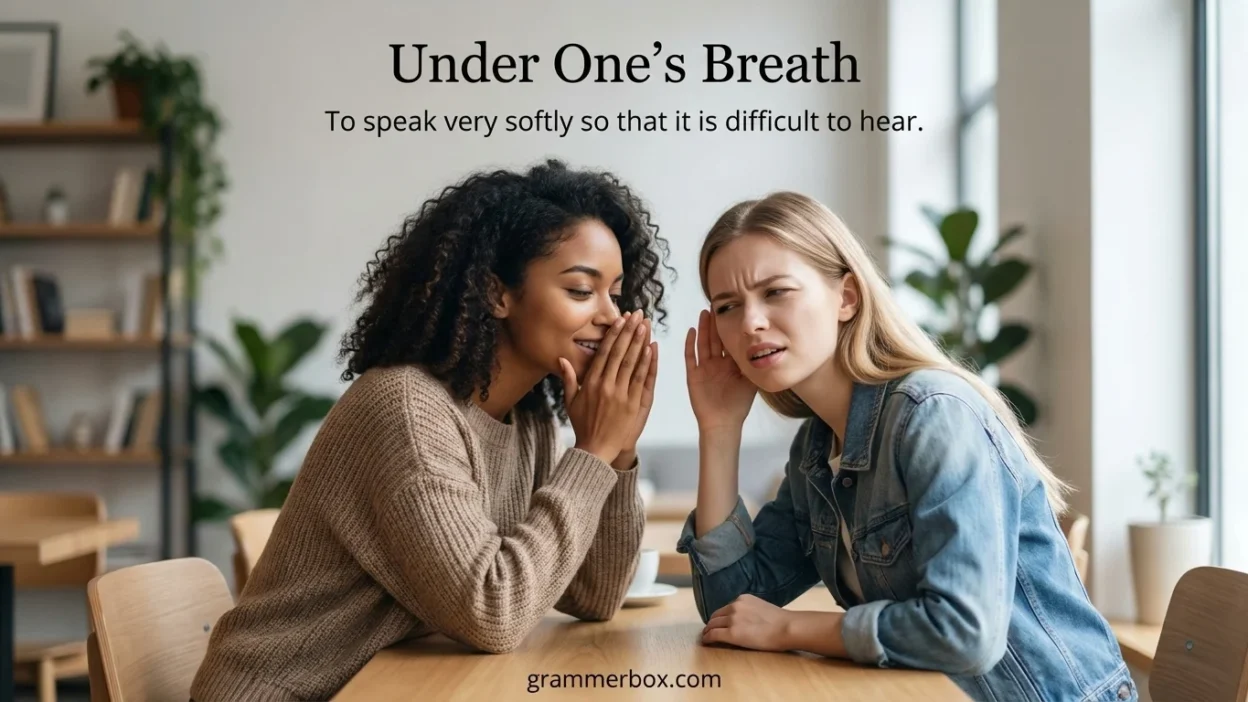
Have you ever said something so quietly that only you—or perhaps the person standing right beside you—could hear it? That is often described as speaking under one’s breath. This common English idiom refers to saying something in a very quiet voice, usually so that other people cannot clearly hear it. It can describe a whispered comment, a quiet complaint, or words spoken almost to yourself.
The expression is especially common when someone is annoyed, embarrassed, frustrated, or trying not to attract attention. For example, if someone mutters, “This is ridiculous,” while walking away from an argument, you could say that they said it under their breath. In this guide, we will explain the meaning of the idiom, break down its wording, compare it with similar expressions, and provide practical examples so you can use it confidently in everyday English.
Quick Answer
“Under one’s breath” means speaking very quietly, often so that other people cannot hear what is being said clearly. It commonly describes muttering, whispering, or quietly expressing a thought, complaint, or feeling.
Example: She muttered something under her breath and left the room.
Why People Confuse It
People sometimes misunderstand under one’s breath because the phrase does not have a literal meaning.
If you interpret it word for word, it sounds as though someone is physically speaking underneath their breathing. In reality, it is an idiomatic expression describing very quiet speech.
Another common source of confusion is the possessive pronoun. The expression changes depending on the subject:
- I said it under my breath.
- You said it under your breath.
- He said it under his breath.
- She said it under her breath.
- They said it under their breath.
The phrase often appears with verbs such as mutter, whisper, say, complain, curse, grumble, and murmur.
First Word: “Under”
The word under usually means below something. For example:
- The shoes are under the bed.
- The cat is hiding under the table.
However, in under one’s breath, “under” is part of an idiomatic expression rather than a literal description of location.
It helps create the idea of speech that is low, restrained, or barely audible.
So, you should not replace “under” with “below” or another word.
Correct:
He complained under his breath.
Incorrect:
He complained below his breath.
Second Word: “Breath”
Breath means the air that you take into or release from your lungs.
In this idiom, the word helps create the image of someone speaking so quietly that their voice almost blends with their breathing.
Remember the difference between:
- breath — the noun: Take a deep breath.
- breathe — the verb: Try to breathe slowly.
The idiom always uses the noun breath:
under one’s breath
Not:
under one’s breathe
Comparison Table
| Expression | Meaning | Typical Use | Example |
|---|---|---|---|
| Under one’s breath | Speak very quietly | Quiet comments or complaints | He complained under his breath. |
| In a whisper | Speak in a very soft voice | Secrets or situations requiring silence | She spoke in a whisper. |
| Mutter | Speak unclearly and quietly | Annoyance, frustration, or uncertainty | He muttered a response. |
| Murmur | Speak softly and gently | Quiet or gentle conversation | She murmured a few words. |
| Out loud | Speak audibly | Contrasting private thoughts with spoken words | I said it out loud. |
| To oneself | Speak or think privately | Personal thoughts or self-talk | He was talking to himself. |
When to Use “Under One’s Breath”
Use under one’s breath when someone speaks so quietly that the words are difficult for others to hear.
It is especially useful when the speaker is:
- expressing annoyance quietly
- making a private comment
- complaining without wanting attention
- muttering after an argument
- saying something to themselves
- trying to avoid being overheard
- reacting quietly to an unpleasant situation
Examples
- He muttered under his breath when the meeting was extended.
- She said something under her breath, but I couldn’t hear it.
- Tom cursed under his breath after dropping his phone.
- “This is taking forever,” she complained under her breath.
- The student whispered an answer under his breath.
- He grumbled under his breath as he cleaned the kitchen.
- She walked away, muttering under her breath.
- I heard him say my name under his breath.
- The employee quietly complained under her breath about the new schedule.
- He laughed under his breath when he realized his mistake.
- She apologized under her breath and returned to her desk.
- “I knew this would happen,” he said under his breath.
- The actor repeated his lines under his breath before going on stage.
- She was muttering something under her breath while reading the letter.
- He quietly swore under his breath after missing the train.
These examples show that the expression can be used with both neutral and emotional situations. However, it frequently carries the idea that the speaker does not want to speak loudly or openly.
Common Mistakes
1. Using “breathe” instead of “breath”
Incorrect:
She said it under her breathe.
Correct:
She said it under her breath.
“Breath” is the noun needed in this expression.
2. Forgetting the possessive pronoun
The pronoun should agree with the person speaking.
Incorrect:
He said it under my breath.
Correct:
He said it under his breath.
3. Treating it as a literal phrase
You do not need to imagine someone physically speaking beneath their breath. The phrase means very quietly.
4. Using “under the breath”
The standard expression is under one’s breath, with the appropriate possessive pronoun.
For example:
- under my breath
- under your breath
- under his breath
- under her breath
- under our breath
- under their breath
5. Assuming it always means whispering
Not necessarily. Someone can speak under their breath without producing a deliberate whisper. The important idea is that the speech is quiet or barely audible.
Memory Trick
Think of “under one’s breath” as speech hiding beneath normal volume.
Imagine someone saying something so quietly that their words seem to disappear into their breathing.
Under = hidden or low
Breath = quiet airflow
Under one’s breath = speaking very quietly
A simple memory sentence is:
American vs. British English
Under one’s breath is common in both American English and British English.
There is no important difference in meaning or standard usage between the two varieties.
You may hear the expression in everyday conversations, books, television shows, movies, journalism, and informal writing in both countries.
The only noticeable variation is the possessive pronoun:
- American English: He said it under his breath.
- British English: He said it under his breath.
The structure remains the same.
Similar Words and Expressions
Several expressions have meanings close to under one’s breath, but they are not always interchangeable.
Whisper
To whisper means to speak very softly, often intentionally so others cannot hear.
She whispered the secret to me.
Mutter
To mutter means to speak quietly and often unclearly. It frequently suggests annoyance or dissatisfaction.
He muttered about the long wait.
Murmur
To murmur means to speak in a low, soft voice. It often sounds gentler than “mutter.”
She murmured a quiet thank-you.
Grumble
To grumble means to complain in a bad-tempered way.
He grumbled about the cold weather.
Speak quietly
This is the straightforward, literal alternative.
Please speak quietly in the library.
Say something to oneself
This can describe speaking privately without necessarily implying that the voice is extremely quiet.
She said the answer to herself.
Final Verdict
“Under one’s breath” is a correct and widely used English idiom meaning to speak very quietly, often so that other people cannot hear clearly.
It is commonly associated with muttering, complaining, frustration, private comments, or restrained reactions. The phrase can be used naturally with different possessive pronouns, such as under my breath, under his breath, and under their breath.
If you want to describe someone speaking quietly without necessarily suggesting a secret, under one’s breath is an excellent choice. Just remember that the correct noun is breath, not breathe.
FAQs:
What does “under one’s breath” mean?
Under one’s breath means speaking very quietly, usually so that other people cannot hear the words clearly.
Is “under one’s breath” an idiom?
Yes. Under one’s breath is a common English idiom. Its meaning is not meant to be understood literally.
What is an example of “under one’s breath”?
A simple example is: “He complained under his breath about the noisy room.”
Is it “under your breath” or “under your breathe”?
The correct expression is under your breath. “Breath” is a noun, while “breathe” is a verb.
Does “under one’s breath” mean whispering?
It can involve whispering, but the expressions are not identical. Under one’s breath emphasizes very quiet speech, while whispering specifically describes speaking in a soft, breathy voice.
Can I say “under my breath”?
Yes. The possessive pronoun changes according to the subject.
Examples include under my breath, under your breath, under his breath, under her breath, and under their breath.
Is “under one’s breath” formal or informal?
It is a standard idiomatic expression that works in both everyday English and many forms of written English. It is especially common in conversational and narrative contexts.
Conclusion
The phrase under one’s breath is a useful English idiom for describing speech that is intentionally very quiet or barely audible. It often appears when someone is muttering a complaint, making a private remark, reacting to frustration, or speaking without wanting everyone nearby to hear.
Once you understand the expression, using it is simple. Choose the correct possessive pronoun—my, your, his, her, our, or their—and keep the noun breath. Whether you are writing dialogue, describing a character, or improving your everyday English vocabulary, this idiom can make your sentences sound more natural and expressive.
Remember This
Under one’s breath = speaking very quietly, often so others cannot hear clearly.
- Correct: She whispered something under her breath.
- Correct: He muttered under his breath.
- Incorrect: She said it under her breathe.
- Remember: breath = noun; breathe = verb.