
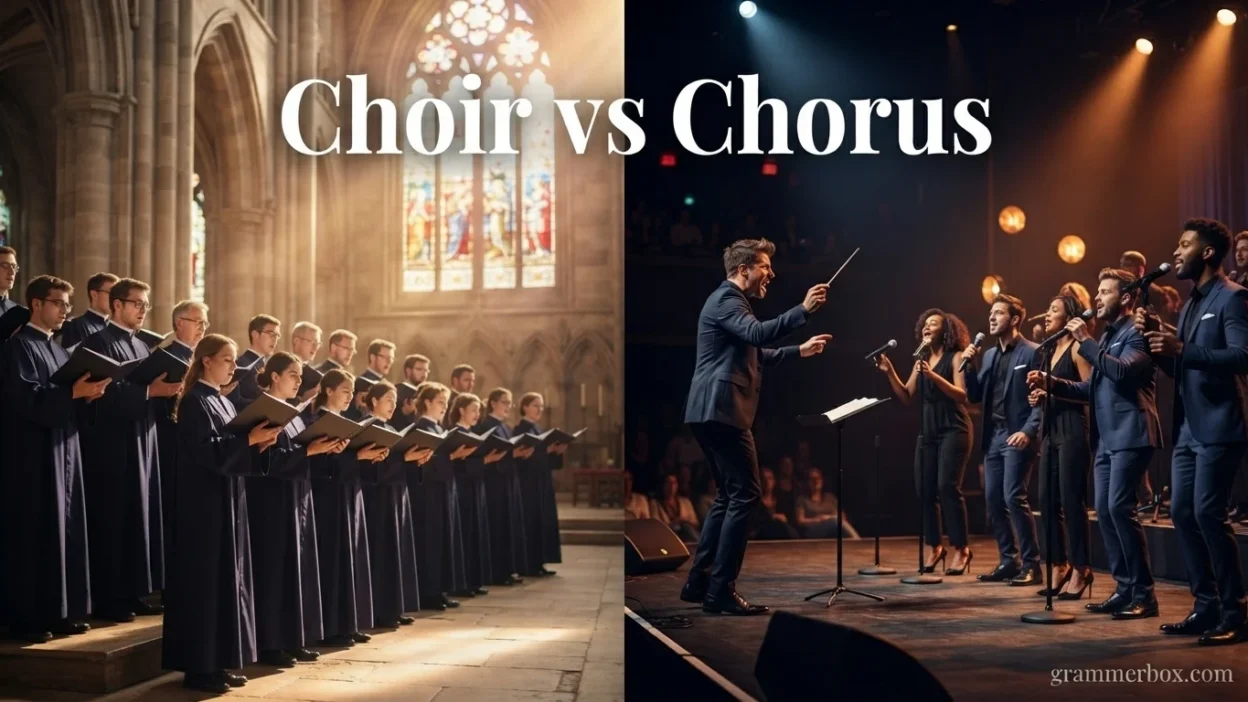
Have you ever wondered whether to use choir or chorus when talking about a group of singers? Although these words are closely related, they do not always mean exactly the same thing. Both refer to people singing together, but their meanings can vary depending on the musical setting, performance style, and context. Understanding the difference between choir vs chorus will help you choose the right word when writing about music, describing a performance, or discussing a singing group.
The confusion often arises because both terms are used in schools, churches, concerts, and theatrical productions. A choir is commonly associated with organized singing groups, especially those performing sacred, classical, or traditional music. A chorus can describe a singing group, a large ensemble in a musical production, or a repeated section of a song. By learning how each word works, you can improve your vocabulary and communicate more precisely. This guide explains their definitions, differences, examples, and common mistakes in simple English.
Quick Answer
A choir is a group of singers who perform together, often in churches, schools, or concert settings. A chorus can also mean a singing group, but it may refer to a large ensemble in a musical or the repeated part of a song. The correct word depends on the context.
Why People Confuse It
People confuse choir and chorus because both words describe group singing. In some situations, they can even refer to the same group of performers.
However, their typical uses are different:
- Choir: Usually refers to an organized group of singers that rehearses and performs together.
- Chorus: Can refer to a group of singers, a theatrical singing ensemble, or a repeated section of a song.
- Overlap: A choir may perform a chorus, and a group called a chorus may function much like a choir.
For example, a school might have a school choir that performs at ceremonies. A theater production might feature a chorus of singers and dancers. Meanwhile, a songwriter might ask the band to repeat the chorus of a pop song.
The key is to consider whether you mean a group of singers or a particular part of a musical composition.
Choir
Choir is a noun that describes a group of people who sing together, usually as an organized ensemble. Choirs often perform music arranged for different vocal ranges, including soprano, alto, tenor, and bass.
Meaning of Choir
A choir is a group of singers who practice and perform together under the direction of a choir director or conductor. Choirs may sing religious music, classical compositions, folk songs, or contemporary arrangements.
Common examples include:
- Church choir
- School choir
- Children’s choir
- Community choir
- University choir
- Chamber choir
A choir does not have to be religious. Although church choirs are familiar, many secular choirs perform at festivals, competitions, concerts, and community events.
Examples of Choir in Sentences
- The church choir performed beautifully during the Sunday service.
- My sister joined the school choir this semester.
- The choir rehearses every Wednesday evening.
- Our community choir performed at the annual music festival.
- The conductor helped the choir improve its harmony.
- The children’s choir sang three songs at the ceremony.
In these examples, choir refers to an organized group of people who sing together.
Chorus
Chorus is a noun with several musical meanings. It can describe a group of singers, particularly in a theatrical production, or the recurring section of a song. In some contexts, it can also refer to a group of people speaking or responding together.
Meaning of Chorus
The meaning of chorus depends on the situation.
1. A group of singers
A chorus may be a large group of performers who sing together in a musical, opera, or other production.
Example: The chorus performed a powerful song during the final scene.
2. A repeated section of a song
In popular music, the chorus is the part that typically returns after the verses. It often contains the song’s main hook or central message.
Example: Everyone sang along when the chorus began.
3. A collective response
The word can describe several people saying the same thing at once.
Example: The students answered, “Yes!” in chorus.
Examples of Chorus in Sentences
- The chorus sang during the final act of the musical.
- I remember the chorus of that song but not the verses.
- The audience joined in when the chorus repeated.
- A large chorus performed alongside the orchestra.
- The children shouted in chorus when the teacher asked a question.
- The songwriter rewrote the chorus to make it more memorable.
These examples demonstrate why chorus has a broader range of meanings than simply a group of singers.
Choir vs Chorus: Comparison Table
| Feature | Choir | Chorus |
|---|---|---|
| Part of speech | Noun | Noun |
| Main meaning | An organized group of singers | A singing group or repeated song section |
| Common setting | Churches, schools, concerts | Musicals, operas, popular songs |
| Religious association | Often associated with church singing, but not exclusively | Possible, but less defining |
| Refers to a song section | Generally no | Yes |
| Refers to collective speech | Less common | Yes, as in “in chorus” |
| Example | The choir sang at the ceremony. | The chorus repeated the main melody. |
The main difference: Choir usually emphasizes the singing group, while chorus can refer to either a group of performers or a recurring part of a song.
When to Use Each
Choosing between choir and chorus becomes easier when you identify what you want to describe.
Use Choir When Talking About a Singing Group
Choose choir when referring to an organized group whose main activity is singing together.
Examples:
- The school choir is preparing for its winter concert.
- She sings in a professional choir.
- The church choir practiced a new hymn.
Use this word when the group itself is the main focus.
Use Chorus When Talking About a Repeated Song Section
Use chorus when referring to the part of a song that returns between or after verses.
Examples:
- The chorus is the most memorable part of the song.
- The singer repeated the chorus twice.
- I learned the chorus before memorizing the verses.
Use Chorus for Theatrical Ensembles
In musical theater and opera, chorus can refer to a group of performers who sing together, sometimes while dancing or acting.
Examples:
- The chorus filled the stage during the opening number.
- The opera chorus sang behind the main characters.
Use “In Chorus” for a Collective Response
When people say or do something together, in chorus can describe their unified response.
Example: The entire class replied in chorus.
Examples: Choir vs Chorus in Everyday English
Here are 12 examples that show how to use both words correctly.
- Choir: Our school choir won first place in the singing competition.
- Chorus: The chorus of the song became popular on social media.
- Choir: The church choir sang a traditional hymn.
- Chorus: The musical featured a chorus of talented performers.
- Choir: She practices with the university choir every weekend.
- Chorus: Everyone waited for the chorus before singing along.
- Choir: The choir director selected a new piece for the concert.
- Chorus: The audience sang the chorus at the top of their voices.
- Choir: A children’s choir performed at the school assembly.
- Chorus: The students answered the teacher in chorus.
- Choir: The community choir rehearsed several classical compositions.
- Chorus: The songwriter changed the chorus to improve the melody.
Notice that choir identifies a singing group in these examples, while chorus has multiple uses depending on the context.
Common Mistakes
Even confident English speakers sometimes use choir and chorus interchangeably when a more precise word would be better.
Mistake 1: Calling Every Song Section a Choir
Incorrect: The choir of the song repeats after every verse.
Correct: The chorus of the song repeats after every verse.
Why? The repeated section of a song is called a chorus, not a choir.
Mistake 2: Assuming a Choir Must Be Religious
Incorrect assumption: Only church singers can form a choir.
Correct: A school, community, or professional group can also be a choir.
Why? A choir is defined by group singing, not by religious affiliation.
Mistake 3: Assuming Chorus Always Means a Song Section
Incorrect assumption: A chorus can never mean a group of singers.
Correct: The chorus performed the finale of the musical.
Why? In theatrical and operatic settings, chorus often refers to a group of performers.
Mistake 4: Treating the Two Words as Always Interchangeable
Incorrect assumption: Every choir can be called a chorus in every situation.
Better approach: Choose the term that matches the musical context.
Why? The words overlap, but they do not have identical meanings in all circumstances.
Memory Trick
Use this simple trick to remember the difference between choir and chorus.
- Choir = Group: Think of people gathered together to sing.
- Chorus = Repeat: Think of the catchy part of a song that comes back again.
For example, if you are describing the people singing at a school concert, use choir. If you are describing the part of a pop song that everyone remembers, use chorus.
Remember that a chorus can also be a group of singers, especially in theater. The memory trick is a useful starting point, not an absolute rule.
American vs British English
The words choir and chorus have broadly similar meanings in American and British English. Neither word is exclusively American or British.
| Context | American English | British English |
|---|---|---|
| Organized school singing group | School choir | School choir |
| Religious singing group | Church choir | Church choir |
| Repeated section of a song | Chorus | Chorus |
| Group singing in a musical | Chorus or ensemble, depending on context | Chorus or ensemble, depending on context |
Both varieties of English use choir for organized singing groups and chorus for repeated song sections.
There can be differences in how particular musical institutions name their ensembles. For example, one organization may call its performers a chorus while another uses choir. These choices can reflect musical tradition rather than a difference between American and British grammar.
Tip: When writing for an international audience, choose the term that best describes the group or musical feature rather than assuming that one word belongs to a particular country.
Similar Words
Several other musical terms are related to choir and chorus, but each has its own meaning.
- Ensemble: A group of musicians or performers who work together. An ensemble may include singers, instrumentalists, or both.
- Choir: An organized group of singers who perform together.
- Chorus: A group of singers or a recurring section of a song.
- Vocal group: A general term for people who perform music using their voices.
- Harmony: The combination of different notes played or sung together.
- Verse: A section of a song that often has changing lyrics between choruses.
- Refrain: A recurring line or phrase in a song or poem. Depending on the song, it may form part of the chorus or function as a recurring section.
- Orchestra: A large group of instrumental musicians who perform together.
Understanding these related words helps you discuss music more accurately and expand your English vocabulary.
FAQs:
1. What is the main difference between choir and chorus?
A choir is generally an organized group of singers. A chorus can refer to a singing group or the repeated section of a song. The intended meaning depends on the context.
2. Is a choir the same as a chorus?
Not always. Both can describe groups of singers, but choir commonly identifies an organized vocal group, while chorus has additional meanings in songs and theatrical productions.
3. Is the chorus the part of a song that repeats?
Yes. In many popular songs, the chorus is the recurring section that often contains the main hook or central message.
4. Can a choir sing a chorus?
Yes. A choir can perform a chorus from a song, just as it can sing verses, hymns, or other musical passages.
5. Is a church choir different from a musical chorus?
Usually, the terms describe different roles. A church choir is an organized group that often performs religious music. A musical chorus is commonly an ensemble that sings as part of a theatrical production.
6. Which word should I use for a school singing group?
Use choir if you mean an organized school singing group. For example, “The school choir performed at graduation.”
7. Does American English use choir and chorus differently from British English?
Their core meanings are similar in both varieties. The choice of name for a particular ensemble may vary by institution or musical tradition, but the basic distinction remains the same.
Final Verdict
The difference between choir and chorus comes down to meaning and context. A choir is typically an organized group of singers, often found in schools, churches, communities, and concert settings. A chorus may describe a group of singers in a musical production or the repeated section of a song. Although the words sometimes overlap, they are not interchangeable in every situation.
When writing about a group of people who regularly sing together, choir is often the clearest choice. When discussing a song’s recurring section, use chorus. If you are describing a theatrical ensemble, either term may be appropriate depending on the production. By paying attention to what you mean, you can use both words naturally and accurately.
Remember This
- Choir: An organized group of singers.
- Chorus: A singing group, a repeated section of a song, or a collective response.
- Quick rule: Use choir for the group and chorus for the recurring part of a song.
- Important exception: A chorus can also be a group of singers, especially in theater.