
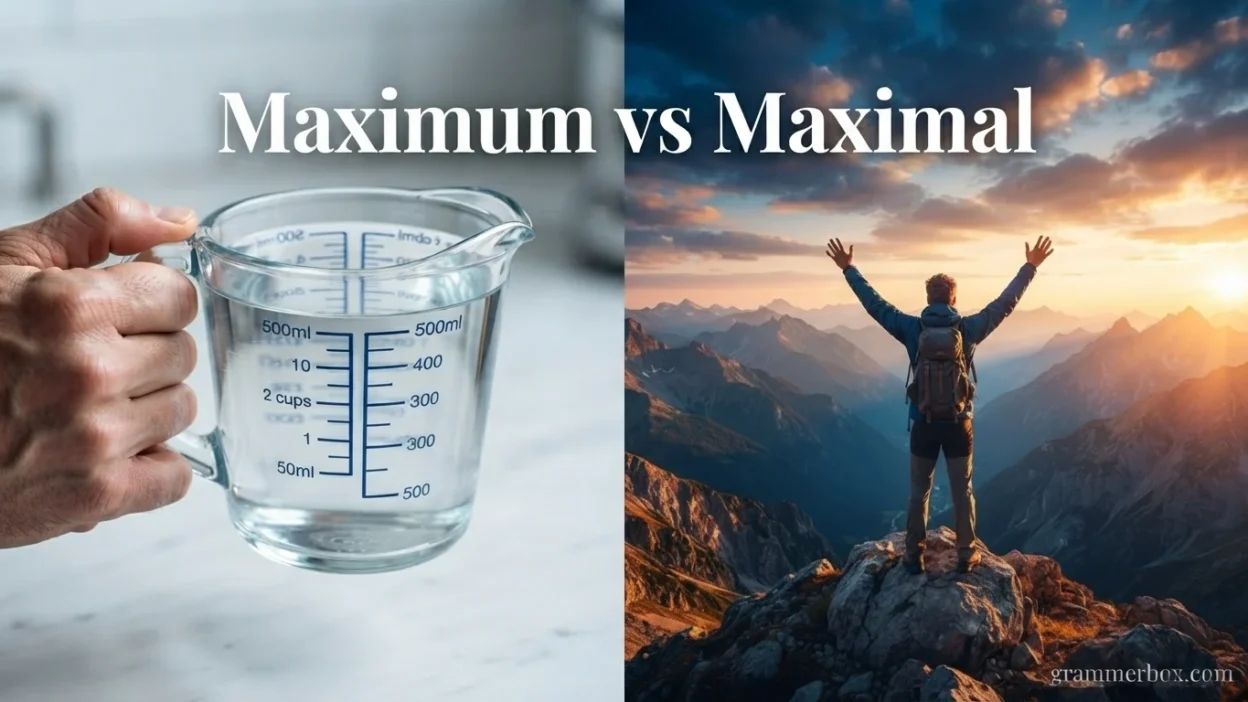
Have you ever wondered whether to use maximum vs maximal in a sentence? Both words describe something at its greatest level, extent, or possible amount, so it is easy to assume they are interchangeable. However, they have slightly different meanings and grammatical uses. Understanding these differences can help you choose the right word in academic writing, professional communication, and everyday English.
Although maximum often refers to the highest possible amount, limit, or degree, maximal usually describes something that reaches or involves the greatest possible extent under particular conditions. For example, you might talk about the maximum speed of a vehicle but describe a maximal effort during a challenging workout. Knowing when to use each term makes your writing more precise and natural. In this guide, you will learn their definitions, grammatical functions, practical examples, common mistakes, and differences in usage so you can confidently decide between maximum and maximal.
Quick Answer
Maximum usually means the greatest amount, level, or limit that is possible or permitted. Maximal means reaching or involving the greatest possible extent or degree. Maximum commonly functions as a noun or adjective, while maximal is primarily an adjective. Choose the word that best fits your sentence.
Why People Confuse It
People confuse maximum and maximal because both words relate to the idea of being as great or high as possible. They share the same Latin root associated with greatness, and their meanings sometimes overlap.
For example, both expressions can describe the greatest level of effort or performance. However, their grammatical roles and typical contexts are different.
Here are the main reasons for the confusion:
- Similar meanings: Both words refer to the highest possible degree or extent.
- Overlapping contexts: They can both appear in discussions of performance, capacity, and intensity.
- Different grammatical roles: Maximum can be a noun or adjective, whereas maximal is mainly an adjective.
- Specialized usage: Maximal is particularly common in technical, scientific, mathematical, and academic writing.
The easiest way to distinguish them is to remember that maximum often identifies a limit or highest value, while maximal describes the greatest possible extent of something.
Maximum
Maximum means the greatest amount, quantity, degree, or limit that is possible, available, or allowed.
It can function as both a noun and an adjective.
Maximum as a Noun
When used as a noun, maximum refers to the highest possible value or limit.
Examples:
- The speed limit has a maximum of 100 kilometers per hour.
- The hall has a maximum of 200 seats.
- You can borrow a maximum of three books at a time.
- The temperature reached its maximum at noon.
- The company established a maximum for daily expenses.
In these sentences, maximum identifies a highest value, capacity, or permitted amount.
Maximum as an Adjective
As an adjective, maximum describes the highest possible amount, level, or limit.
Examples:
- The vehicle has a maximum speed of 180 kilometers per hour.
- Please use the maximum available space.
- The machine operates at maximum capacity.
- We need maximum efficiency from the new system.
- The athlete reached maximum strength during training.
Maximum is particularly useful when discussing limits, measurements, capacity, and the greatest permitted amount.
Maximal
Maximal is an adjective meaning as great, extensive, or intense as possible within a particular situation or set of conditions.
It emphasizes the greatest possible extent rather than simply identifying a numerical limit.
Examples:
- The athlete made a maximal effort during the final race.
- Researchers examined the maximal response to the treatment.
- The team worked to achieve maximal efficiency.
- The experiment required maximal precision.
- The doctor evaluated the patient’s maximal exercise capacity.
Maximal is especially common in scientific research, medicine, mathematics, and formal writing.
How Maximal Works in Sentences
Maximal generally appears before a noun or after a linking verb.
Before a noun:
- The researchers measured maximal oxygen consumption.
- The athlete completed a maximal strength test.
- The project requires maximal concentration.
After a linking verb:
- The response was maximal under those conditions.
- The observed effect remained maximal throughout the test.
Remember that maximal is not usually used as a noun. In most situations, you would say the maximum rather than the maximal when referring to the highest value itself.
Comparison Table
| Feature | Maximum | Maximal |
|---|---|---|
| Main meaning | Greatest amount, level, or limit | Greatest possible extent or degree |
| Part of speech | Noun and adjective | Primarily an adjective |
| Common use | Limits, quantities, capacity, measurements | Effort, intensity, responses, technical descriptions |
| Example | The maximum speed is 120 km/h. | The athlete made a maximal effort. |
| Refers to a limit | Very common | Less common |
| Formal writing | Common in everyday and technical English | Especially common in formal and scientific English |
| Referring to a highest value | The maximum | Usually not used as a noun |
When to Use Each
Choosing between maximum and maximal depends on what you want to express and how the word functions in your sentence.
Use Maximum for Limits and Highest Values
Choose maximum when referring to a permitted limit, upper boundary, capacity, or highest measurable value.
Examples:
- The maximum weight allowed is 25 kilograms.
- The website accepts a maximum of five images.
- The maximum temperature today is expected to reach 35°C.
- The room has a maximum capacity of 60 people.
In these examples, maximum identifies a specific upper value or boundary.
Use Maximal for Greatest Possible Extent
Choose maximal when describing an effort, response, effect, or degree that reaches the greatest possible level under particular conditions.
Examples:
- The runners gave a maximal effort in the final lap.
- The researchers recorded a maximal response.
- The training program aims to produce maximal strength gains.
- The team used maximal concentration to solve the problem.
Maximal is especially appropriate when the emphasis is on the extent or intensity of an action, process, or response.
When Both Words Can Work
Sometimes both words are grammatically possible, but the emphasis changes slightly.
- Maximum performance: The highest level of performance, often considered in terms of a target or measurable limit.
- Maximal performance: Performance carried out at the greatest possible level under specified conditions.
Similarly:
- Maximum effort: The greatest amount of effort possible.
- Maximal effort: Effort exerted at the highest possible intensity.
These expressions overlap considerably. The choice often depends on the conventions of the subject and the writer’s intended emphasis.
Examples of Maximum vs Maximal
The following examples show how each word works in everyday, academic, and professional English.
- Maximum: The maximum speed on this road is 80 kilometers per hour.
- Maximal: The athlete made a maximal effort to win the competition.
- Maximum: The hotel offers a maximum of four guests per room.
- Maximal: The researchers sought maximal accuracy in their experiment.
- Maximum: Please keep your presentation within the maximum time limit.
- Maximal: The patient completed a maximal exercise test under medical supervision.
- Maximum: The battery can store a maximum amount of energy under specified conditions.
- Maximal: The team used maximal concentration during the final round.
- Maximum: The application allows a maximum file size of 20 MB.
- Maximal: The study investigated maximal muscle contraction.
- Maximum: The temperature reached its maximum during the afternoon.
- Maximal: The experiment produced a maximal response at a particular concentration.
- Maximum: Students can receive a maximum score of 100 points.
- Maximal: The organization aimed for maximal participation in the program.
- Maximum: The machine’s maximum operating capacity is listed in its manual.
- Maximal: The scientist examined maximal growth under controlled conditions.
These examples illustrate the general distinction: maximum commonly identifies an upper value or limit, while maximal describes something occurring at the greatest possible degree.
Common Mistakes
Even experienced English speakers sometimes use maximum and maximal incorrectly. These are the most common mistakes to avoid.
1. Using Maximal as a Noun
Incorrect: The maximal of the function is 15.
Correct: The maximum of the function is 15.
Why? Maximum can function as a noun referring to the highest value. Maximal is generally an adjective.
2. Using Maximum When an Adjective Is More Appropriate
Awkward: The athlete made a maximum effort during the race.
More natural in many contexts: The athlete made a maximal effort during the race.
The first sentence is understandable and can be acceptable. However, maximal effort is a conventional expression in sports science and exercise physiology, while maximum effort is also widely used in everyday English.
3. Assuming the Words Are Always Interchangeable
Incorrect assumption: Maximum and maximal can replace each other in every sentence.
Better understanding: Their meanings overlap, but their grammatical roles and common expressions differ. A maximum limit is natural, whereas a maximal limit may sound unusual when you simply mean an upper permitted value.
4. Using Maximal in Casual Conversation Unnecessarily
Awkward: I need maximal time to finish my homework.
More natural: I need as much time as possible to finish my homework.
Maximal is a valid word, but it can sound overly formal in everyday situations.
5. Ignoring the Context
Incorrect approach: Choosing a word only because it sounds more sophisticated.
Better approach: Consider whether you mean a numerical limit, an upper value, or the greatest possible degree of an activity or response.
Clear communication is more important than using complicated vocabulary.
Memory Trick
Here is a simple way to remember the difference between maximum and maximal.
Maximum = the highest limit or value.
Think of a speed limit, maximum score, maximum capacity, or maximum number of guests.
Maximal = the greatest possible extent.
Think of maximal effort, maximal response, maximal concentration, or maximal performance.
Try this quick memory test:
- What is the highest number of people allowed in a room? Maximum capacity.
- What kind of effort does an athlete make when working at the greatest possible intensity? Maximal effort.
- What do you call the highest value of a mathematical function? Maximum.
Remember the pattern: maximum often names the highest value, while maximal describes the greatest possible degree.
American vs British English
There is no major American-versus-British spelling difference between maximum and maximal. Both forms are standard in American English and British English.
| Usage | American English | British English |
|---|---|---|
| Maximum speed | Correct | Correct |
| Maximum capacity | Correct | Correct |
| Maximal effort | Correct | Correct |
| Maximal response | Correct | Correct |
| Spelling difference | None | None |
Both varieties use maximum for upper limits and highest values. Maximal is also used in both varieties, particularly in formal, scientific, medical, and technical contexts.
Differences are more likely to arise from professional conventions or sentence context than from regional spelling rules.
For example:
- American English: The laboratory measured maximal oxygen uptake.
- British English: The laboratory measured maximal oxygen uptake.
Both sentences are correct.
Similar Words
Several words have meanings related to maximum and maximal, but they are not always interchangeable.
1. Minimum
Minimum means the smallest amount, level, or value permitted or possible.
Example: The minimum age for entry is 18.
Difference: Maximum refers to the highest value, while minimum refers to the lowest.
2. Minimal
Minimal means very small in amount, degree, or extent.
Example: The project requires minimal maintenance.
Difference: Minimal is not the opposite grammatical form of maximal in every context, but the two adjectives commonly contrast in degree: minimal means very little, while maximal means the greatest possible extent.
3. Greatest
Greatest means larger, higher, or more important than all others in a comparison.
Example: She achieved the greatest score in her class.
Difference: Greatest is a common, flexible adjective, whereas maximum can identify a specific upper limit or value.
4. Optimal
Optimal means best or most favorable under particular conditions.
Example: The machine operates at its optimal temperature.
Difference: Optimal means best, not necessarily greatest. The highest possible output is not always the most efficient or desirable result.
5. Peak
Peak refers to the highest point, level, or period.
Example: The athlete reached peak performance during the championship.
Difference: Peak often describes the highest point reached, while maximum can refer to a defined limit or value.
6. Ultimate
Ultimate means final, most important, or greatest in degree, depending on context.
Example: Safety is our ultimate priority.
Difference: Ultimate can express finality or importance, while maximum and maximal focus more directly on quantity, degree, or extent.
FAQs:
1. What is the main difference between maximum and maximal?
Maximum usually refers to the greatest amount, value, or limit and can function as a noun or adjective. Maximal is primarily an adjective describing the greatest possible extent or degree.
2. Is maximum an adjective or a noun?
Maximum can be both a noun and an adjective.
- Noun: The maximum is 50.
- Adjective: The maximum speed is 100 km/h.
3. Is maximal a real English word?
Yes. Maximal is a standard English adjective meaning greatest in extent, degree, or intensity. It is frequently used in scientific, mathematical, medical, and formal contexts.
4. Can I use maximum and maximal interchangeably?
Sometimes, but not always. Both can describe the highest degree of something, yet maximum commonly refers to a value or limit, while maximal describes the greatest possible extent. Grammar also determines which word fits.
5. Is maximum effort or maximal effort correct?
Both expressions are correct. Maximum effort is common in everyday English, while maximal effort is particularly familiar in technical and sports-science contexts. The best choice depends on the intended meaning and context.
6. What is the opposite of maximal?
Minimal is a common opposite of maximal when describing degree or extent. For example, maximal effort contrasts with minimal effort.
7. Is there a spelling difference between American and British English?
No. Both American and British English use maximum and maximal with the same spelling. Their meanings and general grammatical functions are also consistent across the two varieties.
8. Which word should I use in academic writing?
Use maximum when identifying a highest value, limit, or quantity. Use maximal when describing the greatest possible degree, effort, response, or extent. In technical writing, follow the terminology commonly used in your particular field.
Final Verdict
The difference between maximum and maximal becomes clear when you focus on meaning and grammar. Maximum usually identifies the highest possible value, amount, capacity, or permitted limit. It can function as either a noun or an adjective, making it suitable for everyday conversations, professional documents, and technical descriptions.
Maximal, on the other hand, is primarily an adjective that emphasizes the greatest possible extent, intensity, or degree under particular conditions. It appears frequently in scientific research, medicine, mathematics, and discussions of effort or performance. Although the two words sometimes overlap, choosing the one that fits the sentence makes your writing more accurate and natural.
Remember This
- Maximum: The highest value, amount, or limit. Example: The maximum score is 100.
- Maximal: The greatest possible degree or extent. Example: The athlete made a maximal effort.
- Grammar tip: Use maximum as a noun when naming the highest value; use maximal when describing a noun.
- Writing tip: Choose the clearest and most natural expression for your context rather than automatically preferring the more formal word.
Once you understand this distinction, you can use maximum and maximal confidently in academic writing, professional communication, and everyday English.