Choosing between “my father and I” and “my father and me” can feel surprisingly tricky. Both phrases are grammatically correct, but they perform different jobs in a sentence. The right choice depends on whether the phrase is acting as the subject or the object. This is one of those English grammar questions where a simple test can save you from guessing.
In this guide, we’ll break down my father and I vs. my father and me with clear explanations, examples, a comparison table, common mistakes, and an easy memory trick. Whether you are writing an email, school assignment, professional document, or everyday message, understanding this subject-pronoun versus object-pronoun distinction will help you sound more natural and grammatically accurate.
Quick Answer
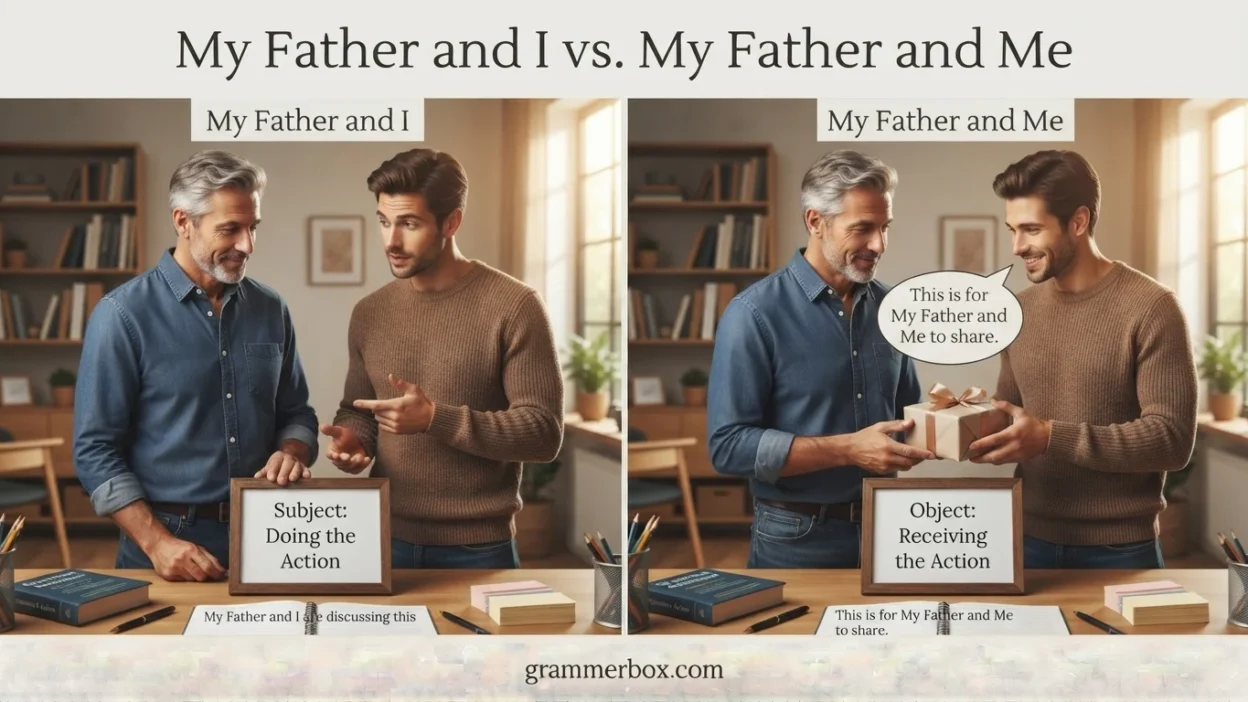
Use “my father and I” when the phrase is the subject performing an action: “My father and I went shopping.” Use “my father and me” when the phrase is the object receiving the action: “She invited my father and me.” Remove “my father” and test the sentence: “I went” is correct, while “She invited I” is not.
Why People Confuse It
The confusion usually happens because speakers are taught that “I” sounds more formal than “me.” As a result, some people use “my father and I” in almost every situation.
That is not the rule.
The important question is the grammatical role of the pronoun:
- I is a subject pronoun.
- Me is an object pronoun.
- My father and I can perform an action.
- My father and me can receive an action or follow a preposition.
For example:
- My father and I visited the museum.
- The guide welcomed my father and me.
Both sentences are correct because the pronoun has a different function in each one.
First Word: “My Father and I”
“My father and I” is correct when the phrase functions as the subject of a sentence.
The subject is the person or people performing the action.
Examples:
- My father and I went fishing.
- My father and I discussed the problem.
- My father and I are planning a trip.
- My father and I watched the game.
A useful test is to temporarily remove “my father and.”
My father and I went shopping.
→ I went shopping.
Because “I went shopping” is correct, “my father and I” is correct.
What Does “I” Mean?
I is the first-person singular subject pronoun. It refers to the speaker or writer when that person is performing the action.
So:
My father and I cooked dinner.
Here, my father and I are the people doing the cooking.
Second Word: “My Father and Me”
“My father and me” is correct when the phrase functions as an object.
An object receives an action or follows a preposition.
Examples:
- She invited my father and me.
- The teacher spoke to my father and me.
- They gave my father and me some advice.
- The gift was for my father and me.
Again, remove “my father and.”
She invited my father and me.
→ She invited me.
“Me” is correct after invited, so the complete phrase should be “my father and me.”
My Father and I vs. My Father and Me: Comparison Table
| Phrase | Grammatical Role | When to Use | Example |
|---|---|---|---|
| My father and I | Subject | When performing the action | My father and I traveled together. |
| My father and me | Object | When receiving the action | She called my father and me. |
| My father and I | Subject | Before a verb | My father and I agreed. |
| My father and me | Object | After a preposition | The message was for my father and me. |
| I | Subject pronoun | I perform an action | I called him. |
| Me | Object pronoun | I receive an action | He called me. |
When to Use Each
Use “My Father and I” as the Subject
Use my father and I when the two of you are doing something.
- My father and I visited the park.
- My father and I enjoy gardening.
- My father and I discussed the issue.
- My father and I arrived early.
Use “My Father and Me” as the Object
Use my father and me when someone does something to or for the two of you.
- She invited my father and me.
- He helped my father and me.
- They thanked my father and me.
- The tickets were for my father and me.
After Prepositions, Use “Me”
A preposition normally takes an object pronoun.
Correct:
- between my father and me
- for my father and me
- with my father and me
- to my father and me
- beside my father and me
For example:
There is a strong bond between my father and me.
Not:
There is a strong bond between my father and I.
Examples: My Father and I vs. My Father and Me
Here are more examples showing the difference clearly:
- My father and I went to the market.
Both people performed the action. - The shopkeeper greeted my father and me.
Both people received the action. - My father and I watched a movie.
The phrase is the subject. - The tickets were given to my father and me.
The phrase follows the preposition “to.” - My father and I cooked dinner together.
“I” is part of the subject. - She spoke with my father and me.
“Me” follows the preposition “with.” - My father and I are proud of our family.
The two people are performing the implied state/action. - The doctor talked to my father and me.
“Me” is the object of “to.” - My father and I visited our relatives.
“My father and I” is the subject. - Our relatives welcomed my father and me.
“My father and me” is the object. - Between my father and me, the decision was easy.
“Me” follows the preposition “between.” - My father and I decided to leave early.
The phrase performs the action of deciding.
Common Mistakes
Mistake 1: Using “I” Everywhere
Some writers assume that I is always more correct or formal.
Incorrect:
She invited my father and I.
Correct:
She invited my father and me.
The phrase is the object of invited, so me is required.
Mistake 2: Using “Me” as the Subject
The opposite mistake is also common.
Incorrect:
My father and me went to the store.
Correct:
My father and I went to the store.
The phrase is performing the action, so I is needed.
Mistake 3: Ignoring the Preposition Test
After prepositions such as to, for, with, between, and from, an object pronoun is generally required.
Correct:
This conversation is between my father and me.
Incorrect:
This conversation is between my father and I.
Mistake 4: Thinking the Order Changes the Grammar
Whether you say “my father and I” or “I and my father,” the pronoun still needs to match its grammatical role.
However, “my father and I” is the natural and conventional order in most contexts.
Memory Trick
Use the remove-the-other-person test.
Take the sentence:
My father and I went home.
Remove “my father and.”
I went home. ✅
So I is correct.
Now try:
The teacher praised my father and me.
Remove “my father and.”
The teacher praised me. ✅
So me is correct.
The Simple Rule
Doing the action → I
Receiving the action → me
This trick works for many sentences involving compound pronouns, not just those containing “my father.”
American vs. British English
There is no major American-versus-British difference in the basic grammatical rule for I and me.
In both varieties of standard English:
- I is used as a subject pronoun.
- Me is used as an object pronoun.
For example, both American and British English use:
My father and I went home.
And:
She spoke to my father and me.
Informal speech can vary from region to region, and native speakers sometimes use pronouns differently in casual conversation. However, for formal writing, academic work, and professional communication, the standard subject/object distinction is the safest choice.
Similar Words
Understanding related pronoun pairs can make this rule easier to remember.
I vs. Me
- I = subject
- Me = object
I called Sarah.
Sarah called me.
He vs. Him
- He = subject
- Him = object
He helped us.
We helped him.
She vs. Her
- She = subject
- Her = object
She called me.
I called her.
We vs. Us
- We = subject
- Us = object
We visited them.
They visited us.
The same grammatical principle applies throughout these pronoun pairs.
FAQs
Is “my father and I” grammatically correct?
Yes. “My father and I” is grammatically correct when the phrase functions as the subject of a sentence.
My father and I went to the restaurant.
Is “my father and me” grammatically correct?
Yes. “My father and me” is correct when the phrase functions as an object or follows a preposition.
She invited my father and me.
Which is correct: “between my father and I” or “between my father and me”?
The standard form is “between my father and me.” The preposition between is followed by an object pronoun.
Should I say “my father and I went” or “my father and me went”?
Use “my father and I went.” The phrase is the subject performing the action of going.
Should I say “she called my father and I” or “she called my father and me”?
Use “she called my father and me.” The phrase is the object of the verb called.
Is “my father and I” more formal than “my father and me”?
Neither phrase is inherently more formal. They have different grammatical functions. Choose I for a subject and me for an object.
What is the easiest way to choose between I and me?
Remove the other person from the sentence. If I sounds correct, use my father and I. If me sounds correct, use my father and me.
Final Verdict
The choice between “my father and I” and “my father and me” is not about which phrase sounds more educated or formal. It is about grammar.
Use my father and I when the phrase is the subject:
My father and I visited the museum.
Use my father and me when the phrase is the object or follows a preposition:
The guide spoke to my father and me.
When you are unsure, remove “my father and” and read the sentence again. This quick test usually makes the correct choice obvious.
Remember This
My father and I = subject
My father and me = object
Think:
I do the action.
Me receives the action.
If you can confidently use I or me by itself, you can confidently choose between “my father and I” and “my father and me.”
Conclusion
The difference between my father and I vs. my father and me becomes simple once you focus on sentence structure rather than formality. I is a subject pronoun, while me is an object pronoun. That distinction determines which phrase belongs in a sentence.
For everyday writing, remember the removal test: take away “my father and” and see whether I or me fits. With a little practice, sentences such as “My father and I traveled abroad” and “The teacher spoke to my father and me” will feel completely natural.