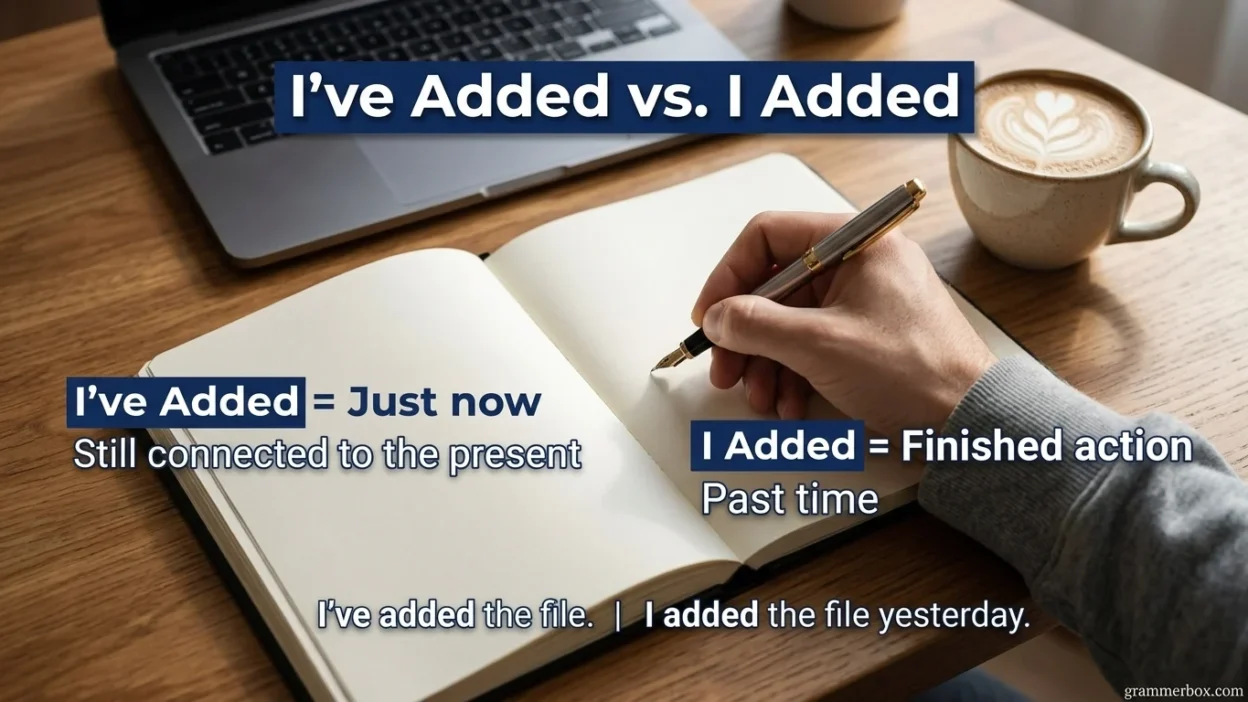
Have you ever wondered if to write “I’ve added” or “I added” when talking about something you included in a document, email, list, or project? Both expressions are grammatically correct, but they are used in different situations. Understanding the difference can help you communicate more clearly and avoid common English grammar mistakes.
The main difference between “I’ve added” and “I added” is the relationship between an action and time. “I’ve added” is the present perfect tense, which connects a past action to the present. In contrast, “I added” is the simple past tense, which describes an action completed in the past. Although their meanings can overlap, choosing the right expression depends on whether you want to emphasize the present result or simply report a completed action. In this guide, you’ll learn their meanings, grammar rules, practical examples, and the situations in which each expression sounds most natural.
Quick Answer
“I’ve added” is the present perfect tense, used when a past action has a connection to the present. “I added” is the simple past tense, used when reporting a completed action in the past, often with a specific past time.
Why People Confuse It
People often confuse “I’ve added” and “I added” because both expressions describe an action that has already happened.
For example:
- I’ve added your name to the list.
- I added your name to the list.
Both sentences communicate that someone’s name is now on the list. However, they emphasize different aspects of the action.
The confusion usually comes from three reasons:
- Similar meanings: Both expressions describe a completed action.
- Different verb tenses: One uses the present perfect, while the other uses the simple past.
- Overlapping situations: In everyday conversations, both can sometimes communicate almost the same message.
The easiest way to distinguish them is to consider whether you are emphasizing the present result or reporting a past event.
First Word: I’ve Added
“I’ve added” is the contraction of “I have added.” It uses the present perfect tense.
The present perfect combines the auxiliary verb “have” with the past participle “added.”
Structure:
I + have + past participle
Since “added” is the past participle of “add,” the expression “I’ve added” is grammatically correct.
Meaning of I’ve Added
“I’ve added” means that you completed an action in the past, and that action has a connection to the present.
It often emphasizes the result rather than the exact time when something happened.
Examples:
- I’ve added your suggestions to the document.
- I’ve added three new chapters to my book.
- I’ve added your email address to my contact list.
- I’ve added some important details to the report.
- I’ve added the latest information to the website.
In these examples, the speaker focuses on the current result of the action.
When to Use I’ve Added
Use “I’ve added” when:
- You want to inform someone that something is now included.
- The exact time of the action is not important.
- A past action has a present consequence.
- You are giving someone an update about completed work.
- You are discussing recent changes without specifying a finished past time.
Example:
“I’ve added your requested changes to the final draft.”
This sentence tells the reader that the changes have been made and are now part of the draft.
Second Word: I Added
“I added” is the simple past tense of the verb “add.”
It describes an action that started and finished in the past. The speaker usually focuses on the completed event rather than its present result.
Structure:
I + past-tense verb
The verb “add” becomes “added” in the simple past tense.
Meaning of I Added
“I added” means that you included something at an earlier time.
It is particularly useful when discussing past events, describing a sequence of actions, or mentioning a specific time.
Examples:
- I added your name to the list yesterday.
- I added two paragraphs to the article last night.
- I added the missing information during the meeting.
- I added some sugar to the coffee this morning.
- I added your phone number to my contacts last week.
These sentences describe completed actions in the past.
When to Use I Added
Use “I added” when:
- You mention a specific past time.
- You are describing something that happened yesterday, last week, or earlier.
- You are narrating a sequence of past events.
- You want to report a completed action without emphasizing its present result.
- The past situation or event is your main focus.
Example:
“I added your suggestions to the document yesterday.”
Here, the speaker identifies when the action happened, making the simple past tense appropriate.
Comparison Table
The following table highlights the main differences between “I’ve added” and “I added.”
| Feature | I’ve Added | I Added |
|---|---|---|
| Verb tense | Present perfect | Simple past |
| Structure | Have + added | Added |
| Main focus | Present result | Past action |
| Specific past time | Generally not used | Commonly used |
| Connection to present | Yes | Not grammatically emphasized |
| Example | I’ve added your name. | I added your name yesterday. |
| Common use | Giving updates | Reporting past events |
When to Use Each
Choosing between these expressions becomes easier when you understand the context.
1. When Giving Someone an Update
Use “I’ve added” when informing someone about a change that is now complete.
Example:
“I’ve added the new section to your assignment.”
The sentence emphasizes that the section is now included.
2. When Mentioning a Specific Past Time
Use “I added” when you mention when the action happened.
Example:
“I added the new section to your assignment yesterday.”
The word “yesterday” identifies a completed past time.
3. When Discussing Recent Work
Use “I’ve added” when the recent action matters because of its current result.
Example:
“I’ve added all the requested keywords to the article.”
This is natural when updating someone about the current status of a project.
4. When Describing Past Events
Use “I added” when telling someone what happened during an earlier event.
Example:
“I added some extra information during yesterday’s meeting.”
The sentence reports a past action.
5. When Writing Professional Emails
Both expressions are appropriate in professional communication.
However, “I’ve added” is particularly useful when confirming that a requested change has been completed.
Example:
“I’ve added the requested information to the attached document.”
On the other hand:
“I added the information during the previous revision.”
This sentence describes when the action took place.
Examples of I’ve Added vs. I Added
Here are 15 practical examples showing how these expressions work in everyday English.
Examples of I’ve Added
- I’ve added your name to the guest list.
- I’ve added some useful references to the article.
- I’ve added the missing information to the report.
- I’ve added a new category to my website.
- I’ve added your suggestions to the final version.
- I’ve added more examples to the grammar lesson.
- I’ve added the latest updates to the presentation.
- I’ve added some extra details to the description.
- I’ve added your email address to the mailing list.
- I’ve added a new feature to the application.
Examples of I Added
- I added your name to the list yesterday.
- I added some pictures to the presentation last night.
- I added the final paragraph before submitting the article.
- I added more examples during the editing process.
- I added your address to the form last week.
- I added some salt to the soup this morning.
- I added the missing chapter two days ago.
- I added a new page to the website last month.
- I added the references after completing the research.
- I added your comments during our last meeting.
Examples Showing Both Expressions
Consider these sentences:
- I’ve added the new images to the article. (Emphasizes the current result.)
- I added the new images to the article yesterday. (Reports a past action.)
- I’ve added your details to the database. (The details are now included.)
- I added your details during the previous update. (Focuses on an earlier event.)
Both forms can be correct, depending on what you want to communicate.
Common Mistakes
Even experienced English learners sometimes use these expressions incorrectly.
Here are some mistakes worth avoiding.
Mistake 1: Using I’ve Added With Yesterday
Incorrect in standard English
“I’ve added your name yesterday.”
Correct
“I added your name yesterday.”
Why? “Yesterday” refers to a specific, finished time in the past. The simple past tense is normally required.
Mistake 2: Confusing Have Added With Added
Incorrect:
“I have add your information.”
Correct:
“I have added your information.”
Why? The present perfect requires the past participle, not the base form of the verb.
Mistake 3: Using the Wrong Auxiliary Verb
Incorrect:
“I’ve adding your details.”
Correct:
“I’ve added your details.”
Why? The present perfect uses have + past participle. “Adding” is the present participle and does not fit this structure.
Mistake 4: Thinking Both Expressions Always Mean Exactly the Same Thing
Although both expressions can describe completed actions, their grammatical emphasis differs.
- I’ve added the information. (Focuses on the present result.)
- I added the information last Monday. (Focuses on the past event.)
Always consider the context before choosing a tense.
Memory Trick
Here is a simple way to remember the difference between “I’ve added” and “I added.”
Think about the present result versus the past event.
- I’ve added = Result now.
- I added = Action in the past.
Remember these two examples:
“I’ve added your name to the list.”
Your name is now included.
“I added your name yesterday.”
You are telling someone when the action happened.
Another useful trick is to look for time expressions.
| Time Expression | Commonly Used Tense |
|---|---|
| Yesterday | I added |
| Last week | I added |
| Two days ago | I added |
| Recently | I’ve added |
| Already | I’ve added |
| So far | I’ve added |
| Just | I’ve added |
Remember that time expressions provide useful clues, but the complete context determines the best tense.
American vs. British English
There is no major difference between American and British English regarding the basic grammatical rules for “I’ve added” and “I added.”
Both varieties use the present perfect and simple past tenses.
However, there can be differences in everyday usage.
American English
American English speakers frequently use the simple past tense in situations where British English speakers might prefer the present perfect.
For example:
- American English: I already added your name.
- British English: I’ve already added your name.
Both forms can be understood, and the first is particularly common in informal American conversation.
British English
British English traditionally uses the present perfect more frequently when discussing recent actions with present relevance.
For example:
- I’ve just added the new information.
- I’ve already added your details.
The present perfect is especially natural in these contexts.
Important: These are general tendencies, not strict rules. Both forms are used in American and British English, and context matters more than nationality.
Similar Words and Expressions
Understanding related expressions can help you improve your English vocabulary and grammar.
Here are some alternatives and related verb forms.
| Expression | Meaning | Example |
|---|---|---|
| I’ve included | Something is now part of something | I’ve included your suggestions. |
| I included | Something was included in the past | I included your name yesterday. |
| I’ve inserted | Something has been placed inside | I’ve inserted a new paragraph. |
| I inserted | Something was placed in the past | I inserted the image last night. |
| I’ve attached | Something has been included as an attachment | I’ve attached the file. |
| I attached | Something was attached in the past | I attached the file yesterday. |
| I’ve updated | Something has been brought up to date | I’ve updated the document. |
| I updated | Something was updated in the past | I updated the document last week. |
These expressions are useful in emails, professional writing, academic assignments, and everyday conversations.
FAQs:
1. Is it correct to say “I’ve added”?
Yes. “I’ve added” is grammatically correct. It is the present perfect tense of the verb “add” and describes a completed action with a connection to the present.
2. Is “I added” grammatically correct?
Yes. “I added” is the simple past tense. It describes an action that was completed in the past, often with a specific past time.
3. What is the difference between “I’ve added” and “I added”?
“I’ve added” emphasizes the present result of a past action, while “I added” emphasizes the completed past action itself.
4. Should I say “I’ve added it” or “I added it”?
Both are correct. Say “I’ve added it” when the current result matters. Use “I added it” when reporting a past event, especially with a specific past time.
5. Can I use “I’ve added” in a professional email?
Absolutely. “I’ve added” is natural and professional when confirming that you have completed a requested change.
For example: “I’ve added the requested information to the document.”
6. Can I use “I added” with yesterday?
Yes. “I added” is the correct choice with “yesterday” because it refers to a specific, finished time in the past.
Example: “I added your comments yesterday.”
7. Is “I’ve already added” correct?
Yes. “I’ve already added” is grammatically correct and commonly used when confirming that something has been completed.
Example: “I’ve already added your name to the list.”
Final Verdict
Both “I’ve added” and “I added” are grammatically correct, but they serve different purposes. “I’ve added” is the present perfect tense, which connects a completed past action to the present. It is particularly useful when giving updates, confirming changes, or explaining that something is now included.
On the other hand, “I added” is the simple past tense, which describes an action completed at an earlier time. It is the better choice when mentioning yesterday, last week, or another specific past time. Understanding this difference will help you write clearer emails, improve your English grammar, and communicate more naturally in everyday situations.
Remember This
- I’ve added: Use it when emphasizing a past action’s present result.
- I added: Use it when reporting a completed action in the past.
- Yesterday, last week, and two days ago: Generally use the simple past.
- Already, just, and so far: Often work naturally with the present perfect.
The easiest rule is: Use “I’ve added” for the result and “I added” for the past event.