
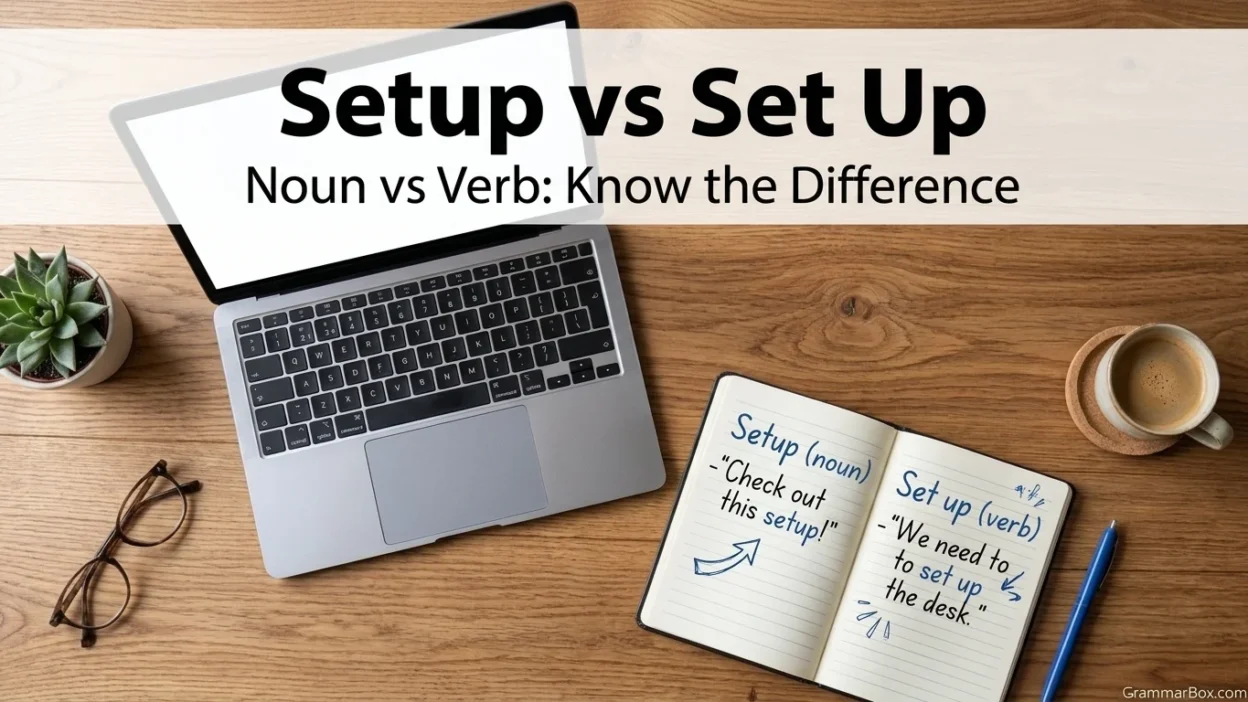
Have you ever wondered whether to write setup or set up? Although these two forms look almost identical, they serve different grammatical purposes. Choosing the correct form can make your writing clearer and help you avoid common English grammar mistakes. Whether you are writing an email, preparing an assignment, or creating professional content, understanding the difference between these expressions is essential.
The main difference between setup and set up is their part of speech. Setup is usually a noun that refers to an arrangement, configuration, or the way something is organized. In contrast, set up is a phrasal verb that means to arrange, establish, install, or prepare something for use. For example, you might describe your computer desk as a comfortable setup, but you set up your computer before using it. Once you understand this simple distinction, choosing the right expression becomes much easier. In this guide, you will learn their meanings, grammatical rules, practical examples, and common mistakes.
Quick Answer: Setup vs Set Up
Setup is a noun or adjective that describes an arrangement, configuration, or organized system. Set up is a phrasal verb meaning to arrange, establish, install, or prepare something. For example, “The setup is simple” uses the noun, while “I will set up the equipment” uses the verb.
Why People Confuse Setup and Set Up
People often confuse setup and set up because both expressions contain the same two words and have closely related meanings. The difference is not primarily about pronunciation; it is about grammar.
In everyday English, these expressions frequently appear in similar contexts, including technology, business, education, and event planning.
Consider these examples:
- Setup: The office setup is convenient.
- Set up: We need to set up the office before Monday.
In the first sentence, setup names an arrangement. In the second sentence, set up describes an action.
Another reason for the confusion is that English commonly combines words into compound nouns. However, not every expression that looks like a compound noun should be written as one word.
The easiest way to distinguish these forms is to identify what the sentence communicates:
- If you are naming an arrangement or configuration, use setup.
- If you are describing the action of arranging or preparing something, use set up.
First Word: What Does Setup Mean?
Setup is a noun that refers to the way something is arranged, organized, or configured. It can describe a physical arrangement, a technical configuration, a business structure, or a particular situation.
It is widely used in everyday conversations and professional writing.
Common Meanings of Setup
1. An arrangement
A setup can describe how objects, furniture, or equipment are organized.
Example: The classroom setup encourages group discussions.
2. A technical configuration
In technology, setup often refers to the configuration of a computer, application, device, or network.
Example: My home office setup includes two monitors.
3. An organized system
The word can describe how a business, event, or process is structured.
Example: The new payment setup makes transactions easier.
4. A situation or plan
Setup can also refer to the circumstances arranged for a particular purpose.
Example: The entire interview setup was comfortable and professional.
In some contexts, setup can also mean a scheme intended to deceive someone.
Example: He believed the entire situation was a setup.
Setup as an Adjective
Although setup is primarily a noun, it sometimes appears before another noun in informal or technical expressions, such as setup instructions or setup process.
For example:
- Read the setup instructions before installing the software.
- The setup process takes approximately ten minutes.
In these examples, setup describes the instructions or process associated with preparing something.
Example Sentences With Setup
- My computer setup is perfect for working from home.
- The restaurant has a beautiful outdoor setup.
- We need a better seating setup for the meeting.
- Her gaming setup includes a large monitor.
- The new office setup saves space.
- The software setup is straightforward.
- Their business setup allows employees to work remotely.
- The classroom setup supports collaborative learning.
Remember: When setup names an arrangement, system, or configuration, write it as one word.
Second Word: What Does Set Up Mean?
Set up is a phrasal verb formed by the verb set and the particle up. It describes an action involving the arrangement, preparation, installation, or establishment of something.
Unlike the noun setup, the verb phrase consists of two separate words.
Common Meanings of Set Up
1. To arrange something
Use set up when arranging objects, furniture, or equipment.
Example: Please set up the chairs before the guests arrive.
2. To install or configure something
In technology, set up means preparing a device, account, or application for use.
Example: I need to set up my new laptop.
3. To establish something
The expression can describe creating a business, organization, system, or meeting.
Example: They plan to set up a new company.
4. To organize an event or appointment
Use set up when arranging a meeting, interview, or event.
Example: Sarah will set up a meeting with the manager.
5. To prepare someone for success
The phrase can describe providing the conditions or resources someone needs to succeed.
Example: The training program will set up new employees for success.
6. To deceive or frame someone
In certain situations, set up means arranging circumstances to make someone appear guilty or responsible for something.
Example: He claimed that someone had set him up.
How to Use Set Up in Different Tenses
Because set up is a verb, it can appear in different grammatical forms.
| Tense or Form | Example |
|---|---|
| Present simple | I set up meetings every Monday. |
| Present continuous | I am setting up the equipment. |
| Past simple | We set up the room yesterday. |
| Present perfect | She has set up her account. |
| Future simple | They will set up a new office. |
| Infinitive | We need to set up the printer. |
| With a modal verb | You should set up a backup system. |
Notice that the past tense of set is also set. Therefore, the phrase remains set up in the simple past.
Can You Separate Set Up?
Yes. In many sentences, set up is a separable phrasal verb.
For example:
- Set up the computer.
- Set the computer up.
Both sentences are grammatically correct.
However, when you use a pronoun as the object, it must come between set and up.
Correct: Please set it up.
Incorrect: Please set up it.
This rule is especially useful when writing instructions or giving directions.
Setup vs Set Up: Comparison Table
The following table summarizes the main differences between these expressions.
| Feature | Setup | Set Up |
|---|---|---|
| Part of speech | Noun; sometimes used attributively | Phrasal verb |
| Main meaning | An arrangement or configuration | To arrange, establish, or prepare |
| Spelling | One word | Two words |
| Describes | A thing, system, or arrangement | An action |
| Example | The setup looks professional. | We will set up the equipment. |
| Technology | My computer setup is simple. | I will set up my computer. |
| Business | The business setup is efficient. | They will set up a business. |
| Event planning | The event setup looks excellent. | We need to set up the event space. |
| Grammar | Can follow an article such as a or the | Can follow verbs such as will, can, or need to |
| Related forms | Plural: setups | -ing form: setting up |
The key distinction: Setup names something, while set up describes doing something.
When to Use Each
Knowing the difference between setup and set up becomes easier when you examine how each expression functions in a sentence.
Use Setup When Referring to a Thing
Choose setup when you are talking about an arrangement, configuration, or organized system.
Examples:
- The new office setup is more efficient.
- I like your gaming setup.
- The setup for the conference was impressive.
- Our current payment setup works well.
A helpful clue is that you can often place an article or possessive before the noun.
For example:
- A setup
- The setup
- My setup
- Their setup
If the sentence needs a noun with this meaning, setup is generally the correct choice.
Use Set Up When Describing an Action
Choose set up when someone is arranging, establishing, installing, or preparing something.
Examples:
- I need to set up my email account.
- They will set up the equipment tomorrow.
- We set up a meeting with the client.
- She wants to set up a small business.
You can often recognize the verb phrase by looking for words such as to, will, can, should, or must before it.
For example:
- Need to set up
- Will set up
- Can set up
- Should set up
These are useful clues, although understanding the sentence’s meaning remains the most reliable method.
Use the Context to Decide
Compare the following sentences:
Sentence 1: The setup of the computer was easy.
Here, setup is a noun describing the process or arrangement.
Sentence 2: Setting up the computer was easy.
Here, setting up is a gerund phrase describing the action.
Sentence 3: It was easy to set up the computer.
Here, set up is the verb phrase describing what someone does.
All three sentences can communicate a similar idea, but their grammatical structures differ.
Examples of Setup vs Set Up
These examples show how to use both expressions correctly in everyday and professional English.
Everyday Examples
- Setup: My desk setup helps me stay organized.
Set up: I need to set up my desk before starting work. - Setup: The kitchen setup is convenient for cooking.
Set up: We will set up the kitchen equipment tomorrow. - Setup: Your home theater setup looks amazing.
Set up: They helped me set up my home theater. - Setup: The classroom setup encourages teamwork.
Set up: The teacher asked us to set up the classroom. - Setup: The picnic setup was simple but beautiful.
Set up: We need to set up the picnic area.
Technology Examples
- Setup: My computer setup includes a wireless keyboard.
Set up: I will set up my new computer tonight. - Setup: The software setup is easy to understand.
Set up: Follow these steps to set up the software. - Setup: The network setup requires additional security.
Set up: The technician will set up the network. - Setup: Her gaming setup takes up very little space.
Set up: She wants to set up a gaming station. - Setup: The printer setup is almost complete.
Set up: Can you help me set up the printer?
Business and Professional Examples
- Setup: Our new office setup improves productivity.
Set up: The company plans to set up another office. - Setup: The meeting setup was professional.
Set up: Please set up a meeting with the director. - Setup: The payment setup offers several options.
Set up: Customers can set up automatic payments. - Setup: The conference setup impressed the visitors.
Set up: The staff will set up the conference room. - Setup: The business setup is suitable for a small team.
Set up: They want to set up their own business.
Examples With Different Verb Forms
- I am setting up my new email account.
- We set up the equipment yesterday.
- She has set up a separate workspace.
- They will set up a new customer support system.
- The setup took less than an hour.
These examples demonstrate why spelling depends on grammatical function rather than simply on the topic being discussed.
Common Mistakes
Even experienced English writers sometimes confuse setup and set up. Understanding these common errors can help you choose the correct form.
Mistake 1: Writing Setup as a Verb
Incorrect: I need to setup my new laptop.
Correct: I need to set up my new laptop.
Why? The sentence describes an action, so the two-word phrasal verb is required.
Mistake 2: Writing Set Up as a Noun
Incorrect: My computer set up is convenient.
Correct: My computer setup is convenient.
Why? The sentence refers to an arrangement, so the noun setup is appropriate.
Mistake 3: Using the Wrong Form in Instructions
Incorrect: Follow the setup the device carefully.
Correct: Follow the instructions to set up the device carefully.
Why? The sentence needs a verb phrase to describe the action of preparing the device.
Mistake 4: Confusing Setup With Setting Up
Incorrect: Setting setup the printer took five minutes.
Correct: Setting up the printer took five minutes.
Why? Setting up is the -ing form of the phrasal verb set up.
Mistake 5: Separating a Verb From a Pronoun Incorrectly
Incorrect: I will set up it tomorrow.
Correct: I will set it up tomorrow.
Why? When a separable phrasal verb takes a pronoun as its object, the pronoun must come between the verb and the particle.
Mistake 6: Assuming Both Forms Are Interchangeable
Incorrect: The company will setup a new department.
Correct: The company will set up a new department.
Why? The sentence describes the act of establishing a department, not the department’s arrangement.
Quick tip: If you can replace the expression with arrangement, configuration, or system, the noun setup may fit. If you can replace it with arrange, establish, or prepare, you probably need set up.
Memory Trick: How to Remember Setup vs Set Up
Use this simple memory trick:
One word = a thing. Two words = an action.
- Setup: Think of a thing you can see, describe, or improve.
- Set up: Think of an action someone performs.
For example:
- My setup is ready.
- I will set up my workspace.
You can also remember the difference through a simple question.
Are you naming an arrangement or describing an action?
If you are naming an arrangement, use setup. If you are describing the action of arranging something, use set up.
A Simple Formula
Article or possessive + setup:
- A setup
- The setup
- My setup
To or modal verb + set up:
- To set up
- Will set up
- Can set up
These patterns are helpful shortcuts, but always check the meaning and grammar of the complete sentence.
American vs British English
The spelling distinction between setup and set up is essentially the same in American and British English.
Both varieties generally use setup as a noun and set up as a verb.
| Meaning | American English | British English |
|---|---|---|
| An arrangement | The setup is simple. | The setup is simple. |
| Installing a device | I need to set up my laptop. | I need to set up my laptop. |
| Organizing a meeting | Let’s set up a meeting. | Let’s set up a meeting. |
| Describing a workspace | My office setup is comfortable. | My office setup is comfortable. |
| Establishing a business | They will set up a company. | They will set up a company. |
The main difference is not regional spelling but grammatical usage.
American and British writers may differ in other vocabulary choices, pronunciation, or style preferences. However, those differences do not change the standard distinction between setup and set up.
For formal writing, academic assignments, business emails, and website content, follow the same rule regardless of which variety of English you use.
Similar Words: Setup vs Set Up and Related Expressions
Several English expressions follow similar grammatical patterns. Learning them can help you recognize compound nouns and phrasal verbs more easily.
| Noun | Verb Phrase | Example |
|---|---|---|
| Setup | Set up | The setup is ready. / Set up the equipment. |
| Backup | Back up | Keep a backup. / Back up your files. |
| Login | Log in | Use your login details. / Log in to your account. |
| Startup | Start up | The startup is growing. / Start up the computer. |
| Check-in | Check in | The check-in begins at noon. / Check in at the desk. |
| Follow-up | Follow up | Send a follow-up email. / Follow up with the client. |
| Breakup | Break up | The breakup was difficult. / They decided to break up. |
| Workaround | Work around | We found a workaround. / We can work around the problem. |
These examples illustrate a common pattern in English: related expressions may have different spellings depending on their grammatical roles.
However, not every compound noun follows exactly the same spelling convention. Some are written as one word, some with a hyphen, and others as separate words.
For that reason, learn each expression’s standard spelling rather than assuming that every noun and verb pair follows an identical rule.
FAQs:
1. Is Setup One Word or Two Words?
Setup is one word when used as a noun. It refers to an arrangement, configuration, or organized system. For example, “My computer setup is excellent.” When describing the action of arranging or preparing something, write set up as two words.
2. Is It Set Up or Setup a Computer?
The correct expression is set up a computer because it describes an action. For example, “I need to set up my computer before work.” If you are describing the computer’s arrangement or configuration, use setup, as in “My computer setup is simple.”
3. Is Setup a Verb or a Noun?
Setup is primarily a noun. It describes an arrangement, configuration, or system. The expression set up is the phrasal verb used to describe arranging, installing, establishing, or preparing something.
4. Is It Set Up or Set-Up?
In standard contemporary English, set up is the usual verb form, while setup is the usual noun form. Set-up with a hyphen appears in some publications or specialized styles, but the one-word noun is generally preferred. Follow the style guide relevant to your writing.
5. What Is the Past Tense of Set Up?
The past tense is set up. The verb set has the same form in the present and past tense.
Examples:
- Present: I set up the equipment every week.
- Past: I set up the equipment yesterday.
The past participle is also set, as in “I have set up the equipment.”
6. Is It Setup Process or Set Up Process?
Setup process is generally the correct choice when setup describes the process associated with configuring or preparing something.
Example: “The setup process takes five minutes.”
However, if you are describing an action, use the verb phrase: “Follow these steps to set up the device.”
7. Is Setup Correct in Professional Writing?
Yes. Setup is standard English when used as a noun, and set up is standard when used as a verb. Both forms are appropriate in professional emails, reports, technical documentation, educational content, and business communication.
Final Verdict
The difference between setup and set up is simple once you understand their grammatical functions. Setup is a noun that describes an arrangement, configuration, or organized system. Set up is a phrasal verb that means to arrange, establish, install, or prepare something. Although the expressions are closely related in meaning, they are not interchangeable in standard writing.
To choose the correct form, ask yourself whether you are naming something or describing an action. If you are talking about an arrangement, write setup. If you are explaining what someone needs to do, write set up. Practicing this distinction with everyday examples will help you write more accurately and confidently.
Remember This
Setup = a thing. Set up = an action.
- Correct: My office setup is comfortable.
- Correct: I need to set up my office.
- Correct: She has a professional gaming setup.
- Correct: She wants to set up a gaming station.
Keep this simple rule in mind whenever you write about computers, businesses, meetings, events, or everyday arrangements.