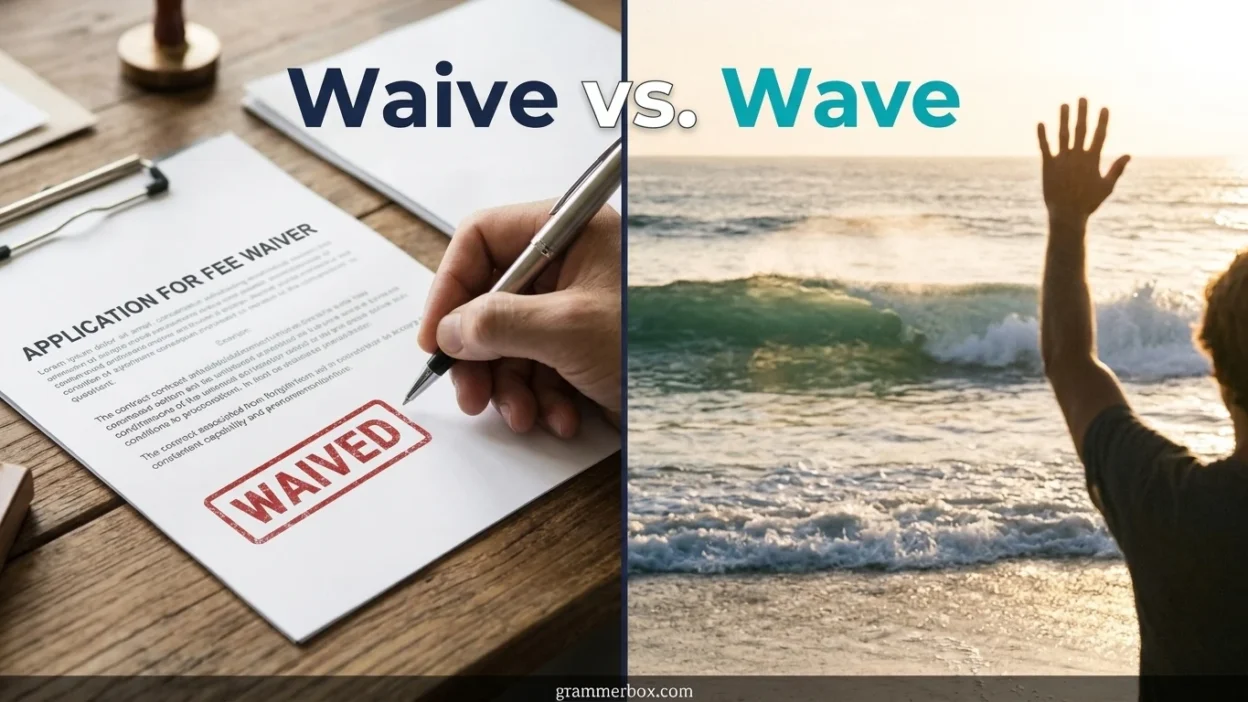
The English words waive and wave sound exactly alike, but they have completely different meanings. One is commonly used in legal, financial, and formal situations, while the other describes a familiar movement or something that moves through water or air. Because they share the same pronunciation, even confident English speakers sometimes mix them up in writing.
Understanding the difference between waive vs. wave can help you avoid spelling mistakes and communicate more clearly. If you are writing an email, completing a legal document, preparing an assignment, or improving your everyday English, knowing when to use each word matters. Although their pronunciation is identical, their meanings, grammatical roles, and sentence structures are quite different. In this guide, you will learn their definitions, practical uses, common mistakes, and examples to help you remember the difference easily.
Quick Answer
Waive means to voluntarily give up a right, claim, fee, or requirement. Wave means to move your hand as a greeting or signal, or refers to a moving pattern of water. They sound alike but have different meanings and spellings.
Why People Confuse Waive and Wave
People often confuse waive vs. wave because both words are pronounced the same way: /weɪv/. This makes them homophones, meaning words that sound alike but have different spellings and meanings.
Their similar pronunciation can make it difficult to choose the correct spelling, especially when writing quickly.
Here are the main reasons for the confusion:
- Identical pronunciation: Both words sound exactly alike in standard English.
- Different spellings: One contains the letter combination “ai,” while the other does not.
- Different meanings: Waive relates to giving up something, while wave relates to movement or gestures.
- Similar sentence positions: Both can function as verbs, making grammatical identification less obvious.
The easiest solution is to understand the meaning you want to communicate before choosing the spelling.
First Word: Waive
Waive is a verb that means to voluntarily give up, surrender, or choose not to enforce a right, privilege, fee, or requirement.
It is especially common in legal, financial, educational, and professional contexts. When someone waives something, they decide not to claim or require it.
Examples of Waive in Sentences:
- The university agreed to waive the application fee.
- She decided to waive her right to appeal.
- The company may waive the late payment charge.
- He asked the landlord to waive the security deposit.
- The customer requested that the bank waive the transaction fee.
- The organization agreed to waive its usual requirements.
- You cannot waive your responsibilities without permission.
- The school will waive tuition fees for eligible students.
- They decided to waive the cancellation penalty.
- The athlete agreed to waive certain contractual rights.
Common Expressions With Waive:
- Waive a fee
- Waive a right
- Waive a requirement
- Waive a penalty
- Waive a claim
- Waive a charge
- Waive an objection
- Waive a condition
Grammatical Forms:
| Form | Word |
|---|---|
| Base form | Waive |
| Third-person singular | Waives |
| Past tense | Waived |
| Past participle | Waived |
| Present participle | Waiving |
Example: The manager waived the additional fee for the customer.
Second Word: Wave
Wave can function as both a verb and a noun. As a verb, it means to move your hand, an object, or another body part back and forth, often as a greeting or signal.
As a noun, it refers to a moving ridge of water, a particular movement, or a sudden increase in something.
It is commonly used in everyday conversations, descriptions, science, and news reporting.
Examples of Wave in Sentences:
- She gave me a friendly wave from across the street.
- The children waved goodbye to their teacher.
- He raised his hand to wave at his friend.
- Huge waves crashed against the rocky shore.
- The audience gave the performer a wave of applause.
- I saw him waving from the train window.
- A wave of excitement spread through the crowd.
- The flag waved proudly in the wind.
- She waved her hand to get the driver’s attention.
- A powerful wave knocked the swimmer off balance.
Common Expressions With Wave:
- Wave goodbye
- Wave hello
- Wave your hand
- Ocean wave
- Sound wave
- Heat wave
- Wave of excitement
- Wave of protests
Grammatical Forms:
| Form | Word |
|---|---|
| Base form | Wave |
| Third-person singular | Waves |
| Past tense | Waved |
| Past participle | Waved |
| Present participle | Waving |
Example: The little girl waved at her parents as they left.
Waive vs. Wave: Comparison Table
Although waive and wave have the same pronunciation, their meanings and uses are completely different.
| Feature | Waive | Wave |
|---|---|---|
| Part of speech | Verb | Noun and verb |
| Meaning | Give up a right or requirement | Move back and forth; a moving pattern |
| Pronunciation | /weɪv/ | /weɪv/ |
| Common context | Legal, financial, formal | Everyday, nature, science |
| Past tense | Waived | Waved |
| Present participle | Waiving | Waving |
| Example | Waive a fee | Wave goodbye |
Easy distinction: If you are giving up a fee, right, or requirement, use waive. If you are greeting someone or describing moving water, use wave.
When to Use Each
Choosing between waive and wave becomes simple when you consider the meaning of your sentence.
When to Use Waive
Use waive when someone voluntarily gives up a right, fee, claim, privilege, or requirement.
Common situations include:
- Financial situations: A bank may waive a monthly maintenance fee.
- Legal situations: Someone may waive their right to a hearing.
- Education: A university may waive an application requirement.
- Business: A company may waive a cancellation charge.
- Personal agreements: A person may waive a contractual benefit.
Example: The hotel agreed to waive the additional booking fee.
When to Use Wave
Use wave when describing a hand movement, a physical movement, or a series of rising and falling patterns.
Common situations include:
- Greetings: She waved at her neighbors.
- Goodbyes: He waved goodbye before leaving.
- Nature: The ocean waves moved toward the beach.
- Weather: A heat wave affected several cities.
- Emotions: A wave of happiness filled her heart.
- Communication: The guard waved the vehicles forward.
Example: The teacher waved her hand to get everyone’s attention.
Examples of Waive vs. Wave in Sentences
The following examples show how these homophones work in different situations.
Waive Examples
- The bank agreed to waive the annual account fee.
- The professor decided to waive the attendance requirement.
- The customer asked the company to waive the additional charge.
- You may waive your right to receive a refund.
- The hospital agreed to waive part of the medical bill.
- The organization will waive registration fees for students.
- The landlord refused to waive the late payment penalty.
- The government may waive certain import duties.
- She chose to waive her claim to the property.
- The airline agreed to waive the ticket change fee.
Wave Examples
- The boy waved enthusiastically at his father.
- A large wave hit the side of the boat.
- She gave her friend a quick wave.
- The workers waved their flags during the parade.
- A wave of cold air entered the room.
- He waved his hand to attract attention.
- The ocean waves looked beautiful at sunset.
- The crowd waved banners during the celebration.
- A new wave of technology is changing education.
- The nurse waved the patient into the examination room.
Waive vs. Wave: Side-by-Side Examples
| Incorrect or correct contextCorrect sentence | |
|---|---|
| Waive a fee | The bank will waive the fee. |
| Wave a fee | Incorrect for giving up a fee. |
| Waive goodbye | Incorrect for a greeting gesture. |
| Wave goodbye | She waved goodbye to us. |
| Waive a right | He decided to waive his right. |
| Wave a right | Incorrect for surrendering a right. |
Common Mistakes
Even though waive and wave are easy to understand individually, writers sometimes use the wrong spelling because they sound identical.
Here are some common mistakes to avoid.
1. Using Wave Instead of Waive
Incorrect: The bank agreed to wave the service fee.
Correct: The bank agreed to waive the service fee.
Why? The bank is giving up its right to collect the fee, so waive is the correct word.
2. Using Waive Instead of Wave
Incorrect: She smiled and waived goodbye.
Correct: She smiled and waved goodbye.
Why? She is making a greeting gesture, so wave is correct.
3. Confusing Waive With Waving
Incorrect: The university is waving the application fee.
Correct: The university is waiving the application fee.
Why? Waiving means giving up the fee.
4. Using Waive for Physical Movement
Incorrect: The children waived their hands in excitement.
Correct: The children waved their hands in excitement.
Why? The sentence describes physical movement.
5. Forgetting the Different Past Tenses
- Waive becomes waived.
- Wave becomes waved.
Although both past-tense forms look similar, their meanings remain different.
Memory Trick: How to Remember Waive vs. Wave
A simple memory trick can help you remember these words without checking a dictionary every time.
Remember WAIVE = GIVE UP
Think of the phrase “waive a fee.” When someone waives a fee, they give up the right to collect it.
Remember WAVE = HAND MOVEMENT
Think of waving your hand when greeting a friend. The word wave is also associated with ocean waves.
Here is another easy way to remember:
- Waive has an “i” like in “give up” (think of the action of giving something up).
- Wave has no “i” and is associated with moving water or waving hands.
Quick memory sentence:
“I waive the fee, but I wave goodbye.”
This short sentence uses both words correctly and makes their meanings easier to remember.
American vs. British English
There is no spelling difference between American and British English when it comes to waive and wave.
Both varieties use the same spellings and meanings.
| Word | American English | British English |
|---|---|---|
| Waive | Waive | Waive |
| Wave | Wave | Wave |
| Waived | Waived | Waived |
| Waved | Waved | Waved |
| Waiving | Waiving | Waiving |
| Waving | Waving | Waving |
The pronunciation is also generally the same in both varieties, although individual accents may produce slight differences.
Whether you are writing for an American or British audience, use waive for giving up a right or fee and wave for movement or greetings.
Similar Words
Waive and wave are not the only English words that can confuse writers. Several other words have similar pronunciations or meanings but different spellings and uses.
Here are some related word pairs worth learning.
| Word pair | Difference |
|---|---|
| Accept vs. Except | Accept means receive; except means excluding. |
| Affect vs. Effect | Affect usually means influence; effect usually means result. |
| Allowed vs. Aloud | Allowed means permitted; aloud means spoken audibly. |
| Their vs. There | Their shows possession; there refers to a place or introduces something. |
| Brake vs. Break | Brake slows a vehicle; break means damage or separate. |
| Sale vs. Sail | Sale means selling something; sail relates to boats or traveling by water. |
| Principal vs. Principle | Principal means main or a school leader; principle means a rule or belief. |
| Weather vs. Whether | Weather refers to atmospheric conditions; whether introduces alternatives. |
Learning these confusing English words can improve your spelling, vocabulary, and overall writing skills.
FAQs:
1. What is the main difference between waive and wave?
Waive means voluntarily giving up a right, fee, or requirement. Wave means moving your hand or refers to moving water or another type of movement. Both words sound the same but have different meanings.
2. Is it waive or wave a fee?
The correct expression is waive a fee. It means choosing not to collect or require payment. For example, the bank agreed to waive my monthly account fee.
3. Is it wave or waive goodbye?
The correct expression is wave goodbye. It describes moving your hand to say goodbye to someone. For example, she waved goodbye before getting into the car.
4. Are waive and wave homophones?
Yes, waive and wave are homophones because they have identical pronunciations but different spellings and meanings. This is why people sometimes confuse them in written English.
5. What is the past tense of waive?
The past tense of waive is waived. For example, the company waived the additional service charge last month.
6. What is the past tense of wave?
The past tense of wave is waved. For example, the children waved at their parents from the school bus.
7. Is waive a formal word?
Yes, waive is commonly used in formal, legal, financial, and professional contexts. It describes voluntarily giving up a right, fee, claim, or requirement.
Final Verdict
The difference between waive vs. wave comes down to their meanings. Waive is a verb that means to give up or voluntarily surrender something, such as a fee, right, or requirement. Wave can be a noun or a verb that describes hand movements, ocean movements, or a sudden increase in something.
Although both words sound identical, they are not interchangeable. Use waive when discussing fees, legal rights, or requirements, and use wave when describing greetings, physical movements, or moving patterns. Remembering these simple distinctions will help you write more accurately and avoid common English spelling mistakes.
Remember This
W
WAIVE = GIVE UP
Waive a fee, waive a right, or waive a requirement.
W
WAVE = MOVE
Wave goodbye, wave your hand, or ocean wave.
Easy example: I waive the fee, but I wave goodbye.
Conclusion
Understanding the difference between waive and wave is important for accurate English writing. Although these words share the same pronunciation, they serve different purposes. Waive is associated with giving up something voluntarily, while wave describes movement, greetings, and patterns found in nature. Remembering their meanings will make it easier to choose the correct word in different situations.
The next time you write an email, complete a form, or communicate professionally, consider what you want to express before choosing between these two homophones. Use waive for fees, rights, and requirements, and wave for gestures and movement. With regular practice and attention to context, you can use both words confidently.