
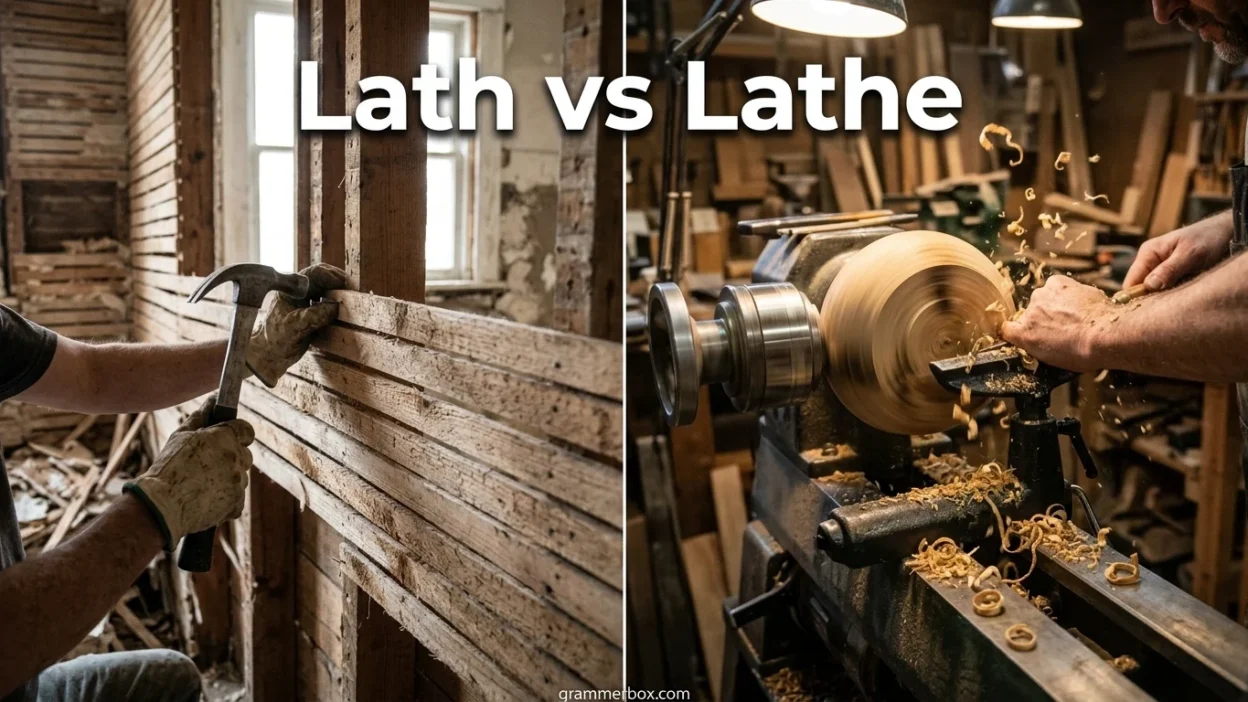
Have you ever seen the words lath and lathe and wondered if they mean the same thing? Although these two words look almost identical, they have different meanings and uses. Understanding the difference between lath vs lathe can help you improve your vocabulary, avoid spelling mistakes, and communicate more clearly when discussing construction, woodworking, or metalworking. The main difference is that lath refers to a thin, narrow strip of material used in construction, while lathe refers to a machine that rotates a workpiece so it can be shaped or cut.
These words can be confusing because they differ by only one letter, and their pronunciation is similar in many English accents. However, choosing the wrong word can change the meaning of a sentence completely. Whether you are a student, writer, DIY enthusiast, or someone learning English, knowing when to use each term is useful. In this guide, you will learn the definitions of lath and lathe, explore practical examples, compare their meanings, and discover a simple memory trick to help you remember the difference.
Quick Answer
Lath vs lathe: A lath is a thin strip of wood, metal, or another material used in construction, often as a supporting base for plaster. A lathe is a machine that rotates wood, metal, or another material while a cutting tool shapes it. Use lath for building materials and lathe for shaping machines.
Why People Confuse It
People often confuse lath and lathe because their spellings differ by only one letter. Both words are associated with practical work, tools, and materials, which makes it easy to mix them up.
Here are three common reasons for the confusion:
- Similar spelling: Both words begin with “lath,” but only lathe has a final silent-looking or lightly pronounced “e,” depending on the speaker’s accent.
- Related work environments: You might encounter both terms in a workshop, construction project, or home renovation.
- Unfamiliar vocabulary: These words are less common in everyday conversation than words such as wood, tool, or machine.
The easiest way to avoid confusion is to remember that a lath is a material, while a lathe is a machine.
First Word: Lath
Lath is a noun that refers to a thin, narrow strip of material, traditionally wood, used in construction. Laths are often attached to a wall, ceiling, or other supporting structure to provide a base for plaster or other finishing materials.
Although wooden laths are traditional, lath systems can also use metal or other materials.
Meaning of Lath
The word lath is commonly used in building and renovation contexts. In older buildings, wooden laths were often installed across wall or ceiling supports. Plaster was then applied over them to create a finished surface.
Examples:
- The carpenter replaced the damaged lath behind the wall.
- The old ceiling contained wooden laths covered with plaster.
- Workers installed metal lath before applying the protective coating.
When to Use Lath
Use lath when referring to:
- Thin strips of wood used in construction.
- Metal mesh or strips that support plaster or similar finishes.
- Traditional lath-and-plaster walls and ceilings.
- Materials used as a base for certain building finishes.
Example sentence: The contractor inspected the wooden lath before repairing the plaster ceiling.
Second Word: Lathe
Lathe is a noun that refers to a machine used to shape a workpiece by rotating it against a cutting tool or another shaping tool. Lathes are widely used in woodworking, metalworking, manufacturing, and machining.
A lathe can help create cylindrical objects, smooth surfaces, grooves, and other shapes, depending on its design and the tools used.
Meaning of Lathe
A lathe holds and rotates a workpiece while the operator or machine guides a tool against it. Common types include wood lathes, metalworking lathes, and computer-controlled CNC lathes.
Examples:
- The woodworker used a lathe to shape a wooden bowl.
- The machinist adjusted the lathe before cutting the metal rod.
- The factory purchased a modern CNC lathe for precise manufacturing.
When to Use Lathe
Use lathe when talking about:
- A machine used to shape wood or metal.
- Woodturning and metalworking equipment.
- Manufacturing processes that involve rotating a workpiece.
- Workshop machinery used to create rounded or cylindrical objects.
Example sentence: My grandfather taught me how to operate a wood lathe safely.
Comparison Table
| Feature | Lath | Lathe |
|---|---|---|
| Part of speech | Noun | Noun |
| Main meaning | A thin strip or construction material | A shaping machine |
| Common field | Construction | Woodworking and metalworking |
| Typical use | Supporting plaster or finishes | Shaping rotating workpieces |
| Example | The lath supports the plaster. | The lathe shapes the wood. |
| Related term | Lath-and-plaster | Wood lathe |
The key difference is simple: lath is a building material, whereas a lathe is a machine.
When to Use Each
Choosing the correct word becomes easier when you consider what you are describing.
Use Lath for Construction Materials
Choose lath when your sentence discusses wall construction, ceiling repairs, plaster, or supporting materials.
Examples:
- The builder replaced the broken lath.
- The plaster was applied over the metal lath.
- The renovation revealed an old lath-and-plaster wall.
Use Lathe for Machinery
Choose lathe when your sentence describes equipment used to turn or shape a material.
Examples:
- The student learned to use a lathe in the workshop.
- The machinist shaped the steel component on a lathe.
- A wood lathe can be used to make decorative table legs.
A Simple Grammar Tip
Both lath and lathe are countable nouns.
- Singular: a lath, a lathe
- Plural: laths, lathes
Remember that the plural forms also differ. If you are discussing several construction strips, use laths. If you are discussing several machines, use lathes.
Examples of Lath vs Lathe
The following sentences demonstrate how to use both words correctly.
Examples Using Lath
- The carpenter replaced a damaged lath before repairing the wall.
- The old house had wooden laths beneath its plaster walls.
- The contractor installed metal lath to support the finishing material.
- Moisture had damaged the wooden lath behind the ceiling.
- The renovation team carefully removed the broken laths.
- Traditional lath-and-plaster construction is found in many older buildings.
- The builder checked whether the lath was secure before applying plaster.
- The repair required new lath and a fresh layer of plaster.
Examples Using Lathe
- The woodworker used a lathe to turn a square piece of wood into a cylinder.
- The machinist operated the lathe to shape a metal component.
- A modern CNC lathe can produce accurately machined parts.
- My uncle keeps an old wood lathe in his workshop.
- The student learned how to secure a workpiece in the lathe.
- The factory uses several lathes to manufacture metal parts.
- She practiced turning a wooden handle on a small lathe.
- The technician inspected the lathe before beginning the machining process.
These examples show that the surrounding context usually makes the intended meaning clear.
Common Mistakes
Even experienced writers can confuse lath and lathe when typing quickly. Here are some mistakes to avoid.
1. Using Lathe for a Building Material
Incorrect: The contractor installed a wooden lathe behind the plaster.
Correct: The contractor installed a wooden lath behind the plaster.
Why? The sentence refers to a construction material, not a machine.
2. Using Lath for a Shaping Machine
Incorrect: The machinist used a lath to shape the metal rod.
Correct: The machinist used a lathe to shape the metal rod.
Why? The sentence describes a machine that rotates and shapes a workpiece.
3. Confusing Their Plural Forms
Incorrect: The workshop purchased three laths for shaping metal.
Correct: The workshop purchased three lathes for shaping metal.
Why? The plural of lathe is lathes, while the plural of lath is laths.
4. Assuming the Words Are Interchangeable
Although the words look similar, they cannot replace each other without changing the meaning.
Incorrect: The carpenter repaired the ceiling using a lathe.
Correct: The carpenter repaired the ceiling using lath.
Why? The correct word depends on whether you mean construction material or machinery.
Memory Trick: How to Remember Lath vs Lathe
Use this easy memory trick:
- Lath = Layer: Think of a thin strip used as part of a building layer.
- Lathe = Machine: Think of a machine that turns wood or metal.
You can also remember this sentence:
“Lath supports the wall; lathe shapes the wood.”
The two words have different jobs. A lath is installed as a material, while a lathe is operated as a machine.
Whenever you are unsure, ask yourself one question: Am I talking about construction material or shaping equipment? Your answer will help you choose the correct spelling.
American vs British English
The distinction between lath and lathe is generally the same in American and British English. Neither spelling is an American-versus-British variant of the other.
| Word | American English | British English |
|---|---|---|
| Lath | Thin construction strip or material | Thin construction strip or material |
| Lathe | Machine used for shaping materials | Machine used for shaping materials |
Both varieties use lath for the construction material and lathe for the machine.
Pronunciation may vary slightly among regional accents, but the spelling and basic meanings remain the same. Therefore, you do not need to choose one spelling for American readers and another for British readers.
Similar Words
Understanding related vocabulary can help you distinguish lath and lathe more confidently.
- Laths: The plural form of lath, referring to multiple strips used in construction.
- Lathes: The plural form of lathe, referring to multiple shaping machines.
- Plaster: A material applied to walls and ceilings, sometimes over laths.
- Wood lathe: A machine designed to rotate and shape wooden workpieces.
- Metal lathe: A machine used to cut or shape metal workpieces.
- CNC lathe: A computer-controlled lathe used for precise machining.
- Slat: A narrow, flat strip of wood, metal, or another material, often used in blinds, fences, or furniture.
- Lathing: The process of installing laths or the material system used to support a finish.
Notice that slat is another similar-looking word, but it often refers to strips arranged in objects such as blinds, bed frames, or fences. Its meaning overlaps with some uses of lath, but the words are not universally interchangeable.
FAQs:
1. What is the main difference between lath and lathe?
A lath is a thin strip of material used in construction, often to support plaster. A lathe is a machine that rotates a workpiece so it can be shaped or cut.
2. Is lath a real English word?
Yes. Lath is a standard English noun used in construction terminology. It commonly describes thin strips of wood or other materials used as a base for plaster and similar finishes.
3. Is lathe a tool or a machine?
A lathe is a machine used to shape materials such as wood and metal. It holds and rotates a workpiece while a cutting or shaping tool works against it.
4. What is the plural of lath?
The plural of lath is laths. For example, “The workers replaced the damaged laths in the old ceiling.”
5. What is the plural of lathe?
The plural of lathe is lathes. For example, “The factory operates several lathes to manufacture metal components.”
6. Are lath and lathe pronounced the same?
They are similar in pronunciation, but they are not always pronounced identically. The final “e” in lathe can affect its pronunciation, and regional accents may influence how both words sound.
7. Is the difference between lath and lathe the same in American and British English?
Yes. Both American and British English use lath for a construction material and lathe for a shaping machine. The distinction is not a regional spelling difference.
8. How can I remember lath vs lathe?
Remember that lath is used in layers of construction, while a lathe is a machine that turns materials. This simple association makes it easier to select the correct word when writing.
Final Verdict
The difference between lath and lathe comes down to their meanings and the contexts in which they are used. A lath is a thin strip of material associated with construction, especially traditional plaster walls and ceilings. A lathe is a machine used to rotate and shape materials such as wood or metal. Although the words look similar, they describe two different things.
When writing about building repairs, plaster, or construction materials, choose lath. When discussing woodworking, machining, or manufacturing equipment, choose lathe. Pay attention to the surrounding words, and the correct spelling will usually become obvious. With a little practice, you can use both terms confidently in everyday writing, technical documents, and English vocabulary exercises.
Remember This
- Lath = Construction material.
- Lathe = Shaping machine.
- Laths = Multiple construction strips.
- Lathes = Multiple shaping machines.
The easiest sentence to remember is: “A lath supports the plaster, and a lathe shapes the wood.”