Have you ever wondered whether to say “sorry for bothering you” or “sorry to bother you” when sending an email, asking a question, or interrupting someone? Both expressions are grammatically correct and commonly used in everyday English. However, they can communicate slightly different perspectives depending on the situation. Understanding the difference will help you sound more natural, polite, and confident in conversations and professional communication.
The main distinction is that “sorry for bothering you” often acknowledges an interruption or inconvenience that has already happened or is ongoing, while “sorry to bother you” is frequently used before making a request or interrupting someone. Both expressions are appropriate in formal and informal situations, including workplace emails, text messages, and face-to-face conversations. In this guide, you will learn how to use each phrase correctly, explore practical examples, and discover which expression works best when contacting a colleague, asking for help, or approaching someone who is busy.
Quick Answer
“Sorry for bothering you” usually acknowledges an interruption or inconvenience that has occurred or is happening. “Sorry to bother you” is commonly used before interrupting someone or making a request. Both phrases are correct, polite, and widely accepted in American and British English.
Why People Confuse It
People often confuse “sorry for bothering you” and “sorry to bother you” because both expressions communicate politeness, regret, and consideration for another person’s time.
They also share similar meanings and can sometimes be used in the same situation without significantly changing the message.
The confusion mainly comes from the grammatical structures that follow the word “sorry.”
- Sorry for bothering you: The word “for” is followed by a gerund, which is a verb ending in -ing that functions as a noun.
- Sorry to bother you: The word “to” introduces the infinitive form of the verb “bother.”
Although both structures are grammatically correct, their emphasis can differ.
For example:
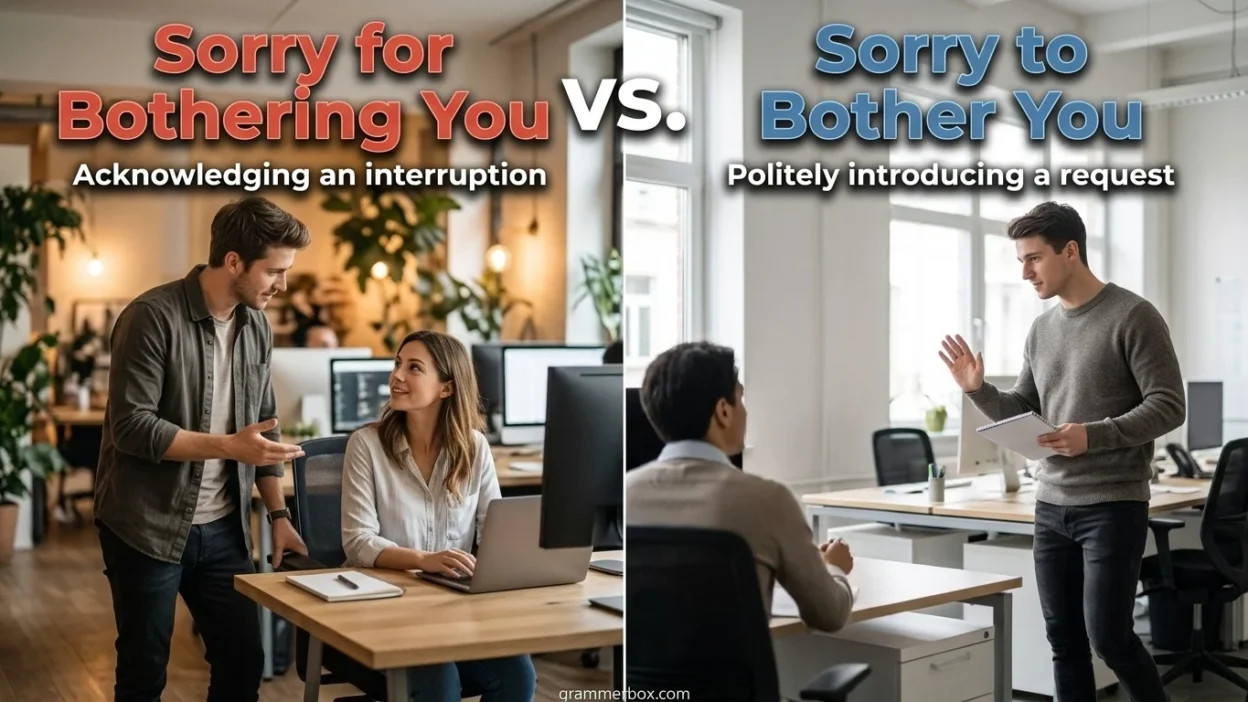
- “Sorry for bothering you while you were working.” This acknowledges an interruption or inconvenience.
- “Sorry to bother you, but could I ask a quick question?” This politely introduces a request.
The important thing to remember is that context determines which expression sounds most natural.
First Word: Sorry for Bothering You
“Sorry for bothering you” is a polite expression used to apologize for interrupting someone, taking their time, or causing inconvenience.
The phrase often focuses on the interruption itself rather than simply introducing a request.
Meaning of Sorry for Bothering You
The expression means that you regret disturbing someone or making a demand on their time or attention.
It can refer to something that has already happened or something that is currently happening.
For example:
- “Sorry for bothering you during your lunch break.”
- “I’m sorry for bothering you with so many questions.”
- “Sorry for bothering you again about the same issue.”
In these examples, the speaker acknowledges that their actions may have inconvenienced the other person.
When to Use Sorry for Bothering You
Use this expression when you want to recognize an interruption or apologize for repeatedly asking someone for assistance.
Common situations include:
- After interrupting someone: “Sorry for bothering you while you were on the phone.”
- When following up: “Sorry for bothering you again about the report.”
- When requesting repeated assistance: “I’m sorry for bothering you with another question.”
- In professional emails: “Sorry for bothering you during such a busy week.”
- When someone is occupied: “Sorry for bothering you while you’re working.”
This phrase can be particularly appropriate when you believe your actions have already caused some inconvenience.
Is Sorry for Bothering You Formal?
Yes. “Sorry for bothering you” is acceptable in professional communication, including emails, workplace messages, and conversations with supervisors or clients.
However, you do not always need to apologize simply for asking a reasonable question. In some professional situations, a direct and respectful request sounds more confident.
For example:
“Sorry for bothering you, but could you clarify the last point in the report?”
Alternatively:
“Could you clarify the last point in the report when you have a moment?”
Both are polite, but the second avoids an unnecessary apology.
Second Word: Sorry to Bother You
“Sorry to bother you” is a polite expression commonly used before interrupting someone, asking a question, or requesting assistance.
It often prepares the listener for a request while acknowledging that they may be busy.
Meaning of Sorry to Bother You
The expression means that you regret, or anticipate, potentially interrupting someone or taking up their time.
It is especially common when approaching someone who is working, concentrating, or occupied with another activity.
For example:
- “Sorry to bother you, but could you help me?”
- “Sorry to bother you, but I have a quick question.”
- “I’m sorry to bother you so late in the evening.”
In these examples, the speaker acknowledges the possibility of causing an interruption.
When to Use Sorry to Bother You
Use this phrase when you want to get someone’s attention politely or introduce a request.
Common situations include:
- Starting a conversation: “Sorry to bother you, do you have a minute?”
- Asking for help: “Sorry to bother you, but I need some assistance.”
- Sending a professional email: “Sorry to bother you, but could you review this document?”
- Approaching a busy colleague: “Sorry to bother you while you’re working.”
- Contacting someone outside regular hours: “Sorry to bother you this late, but I have an urgent question.”
The expression is particularly useful when you want to be considerate without making your request sound demanding.
Is Sorry to Bother You Polite?
Yes. “Sorry to bother you” is widely understood as a polite and considerate expression.
It works in professional emails, workplace conversations, customer service interactions, and everyday communication.
For example:
“Sorry to bother you, but could you tell me where the meeting room is?”
This sentence politely acknowledges the interruption before asking for information.
However, if you are making a routine request that does not inconvenience anyone, you can simply say, “Could you tell me where the meeting room is, please?”
Comparison Table
| Feature | Sorry for Bothering You | Sorry to Bother You |
|---|---|---|
| Basic meaning | Apologizes for an interruption or inconvenience | Politely introduces an interruption or request |
| Grammar | For + gerund | To + infinitive |
| Common timing | During or after an interruption; also for ongoing or repeated inconvenience | Before or while initiating an interruption |
| Main emphasis | The act of bothering someone | The possibility or act of interrupting someone |
| Professional emails | Appropriate | Appropriate |
| Informal conversations | Common | Common |
| Asking for help | Correct | Especially common before making a request |
| Repeated requests | Often useful when acknowledging repeated interruptions | Also possible, especially when introducing another request |
| American English | Correct | Correct |
| British English | Correct | Correct |
The key difference: “Sorry for bothering you” often emphasizes the inconvenience, while “sorry to bother you” frequently introduces a request or interruption. Neither phrase is inherently more polite than the other.
When to Use Each
Choosing between these expressions becomes easier when you consider the timing and purpose of your message.
1. Before Asking a Question
When you are about to ask someone a question, “sorry to bother you” is often the more natural choice.
Example:
“Sorry to bother you, but do you know when the meeting starts?”
The phrase prepares the listener for your question.
2. After Interrupting Someone
When you want to acknowledge an interruption that has already occurred, “sorry for bothering you” may be more appropriate.
Example:
“Sorry for bothering you while you were speaking with the manager.”
The sentence focuses on the interruption that took place.
3. When Sending a Follow-Up Email
Both expressions can work when following up on a previous message, but they emphasize slightly different things.
Using sorry for bothering you:
“Sorry for bothering you again about the application. I wanted to check whether you had received my documents.”
This wording acknowledges that you have contacted the person before.
Using sorry to bother you:
“Sorry to bother you, but I wanted to follow up on my application.”
This wording politely introduces the follow-up message.
4. When Contacting a Busy Colleague
Both phrases are suitable when contacting someone who is concentrating on work.
Examples:
- “Sorry to bother you, but could you check this spreadsheet?”
- “Sorry for bothering you while you were preparing the presentation.”
The first introduces a request. The second acknowledges an interruption during a specific activity.
5. In Formal Emails
Both expressions are acceptable in professional communication.
However, if you want to sound polished and confident, you can sometimes replace an apology with a considerate request.
For example:
Instead of:
“Sorry to bother you, but could you send me the meeting notes?”
You could write:
“Could you please send me the meeting notes when you have a moment?”
The second version is professional, direct, and respectful.
6. When Asking for Help Repeatedly
“Sorry for bothering you” can be particularly suitable when you recognize that you have asked for help several times.
Example:
“Sorry for bothering you again, but I need clarification on one more point.”
You can also use “sorry to bother you again” when introducing another request.
Both versions are natural and grammatically correct.
Examples of Sorry for Bothering You vs. Sorry to Bother You
The following examples demonstrate how each expression works in everyday English and professional communication.
Examples of Sorry for Bothering You
- “Sorry for bothering you during your lunch break.”
- “I’m sorry for bothering you with so many questions.”
- “Sorry for bothering you again about the project.”
- “I apologize for bothering you while you were working.”
- “Sorry for bothering you on your day off.”
- “I’m sorry for bothering you with another email.”
- “Sorry for bothering you while you were talking to your client.”
- “I feel bad for bothering you with such a small problem.”
- “Sorry for bothering you repeatedly about the same issue.”
- “I’m sorry for bothering you when you were trying to concentrate.”
- “Sorry for bothering you with these additional details.”
- “I apologize for bothering you during such a busy week.”
These examples emphasize an interruption, an inconvenience, or repeated requests for someone’s time.
Examples of Sorry to Bother You
- “Sorry to bother you, but could you help me with this question?”
- “I’m sorry to bother you, but I need your advice.”
- “Sorry to bother you, do you have a moment?”
- “Sorry to bother you, but could you explain this instruction?”
- “I’m sorry to bother you so late, but the issue is urgent.”
- “Sorry to bother you, but I can’t find the meeting room.”
- “I’m sorry to bother you, but could you review my application?”
- “Sorry to bother you while you’re working, but I need your signature.”
- “Sorry to bother you, but would you mind checking this document?”
- “I’m sorry to bother you during your break, but I have an important question.”
- “Sorry to bother you, but could you tell me where the nearest station is?”
- “I’m sorry to bother you, but I wanted to ask about tomorrow’s schedule.”
These examples show how the expression can introduce a request, seek someone’s attention, or acknowledge a potential interruption.
Examples Where Both Expressions Work
Sometimes, both phrases are natural in the same situation.
Situation: Asking a colleague for assistance
- “Sorry for bothering you, but could you help me with this spreadsheet?”
- “Sorry to bother you, but could you help me with this spreadsheet?”
Both sentences are correct. The first may emphasize the inconvenience, while the second more naturally introduces the request.
Situation: Contacting someone again
- “Sorry for bothering you again about the report.”
- “Sorry to bother you again about the report.”
Both are acceptable. The choice depends on whether you want to emphasize the repeated interruption or simply introduce another message.
Situation: Interrupting someone at work
- “Sorry for bothering you while you’re busy.”
- “Sorry to bother you while you’re busy.”
Both expressions can work because the interruption may be ongoing or just beginning.
The practical lesson is that these phrases are not always mutually exclusive. Their meanings overlap, so context and emphasis help determine which one sounds best.
Common Mistakes
Although both expressions are straightforward, English learners sometimes use them incorrectly or misunderstand their tone.
Mistake 1: Thinking Only One Expression Is Correct
Incorrect belief: “Sorry for bothering you” is correct, but “sorry to bother you” is grammatically wrong.
Correction: Both expressions are grammatically correct.
The first uses a gerund after “for,” while the second uses an infinitive after “to.”
Mistake 2: Using the Wrong Verb Form
Incorrect: “Sorry for bother you.”
Correct: “Sorry for bothering you.”
After the preposition “for,” use the gerund form “bothering” in this expression.
Compare:
- Correct: “Sorry for disturbing you.”
- Correct: “Sorry for interrupting you.”
- Incorrect: “Sorry for disturb you.”
Mistake 3: Assuming the Expressions Have Identical Emphasis
Although their meanings overlap, they can emphasize different aspects of a situation.
- “Sorry to bother you” often introduces a request.
- “Sorry for bothering you” often acknowledges an interruption or inconvenience.
These are tendencies, not strict grammatical rules.
Mistake 4: Apologizing Too Much in Professional Emails
Repeatedly apologizing for ordinary workplace communication can make a message sound unnecessarily hesitant.
For example:
“I’m so sorry to bother you, and I’m sorry for asking again, but I’m really sorry that I need your help.”
A more natural alternative is:
“Could you please clarify one point when you have a moment?”
Use apologies when appropriate, but remember that asking a reasonable question is not automatically an inconvenience.
Mistake 5: Forgetting Punctuation
When either phrase introduces a request, punctuation helps make the sentence clear.
Less clear:
“Sorry to bother you could you help me?”
Better:
“Sorry to bother you, but could you help me?”
You can also write:
“I’m sorry to bother you. Could you help me with something?”
Both forms are natural.
Memory Trick
Remember this simple rule to choose the right expression.
For = Focus on the act
“Sorry for bothering you” emphasizes the act of bothering someone or the inconvenience associated with it.
Think of it as acknowledging something you did or are doing.
Example: “Sorry for bothering you again.”
To = Introducing an action
“Sorry to bother you” often introduces an action you are about to take, such as asking a question or requesting help.
Example: “Sorry to bother you, but I have a question.”
An Easy Way to Remember
- For bothering: Think about the interruption or inconvenience.
- To bother: Think about approaching someone or making a request.
This is a helpful memory aid rather than an absolute grammatical rule. Both expressions can describe an interruption that is already happening.
American vs. British English
“Sorry for bothering you” and “sorry to bother you” are standard expressions in both American and British English.
There is no meaningful difference in grammatical correctness between the two varieties.
American English
American speakers commonly use both expressions in emails, text messages, and face-to-face conversations.
Examples:
- “Sorry to bother you, but could you check this?”
- “Sorry for bothering you during your lunch break.”
British English
British speakers also use both expressions in formal and informal communication.
Examples:
- “Sorry to bother you, but could I ask a quick question?”
- “Sorry for bothering you while you were working.”
Is One More Common in America or Britain?
Both expressions are familiar to speakers of American and British English. Their suitability depends more on the context, the speaker’s intention, and personal communication style than on regional grammar rules.
If you are writing for an international audience, you can confidently use either expression.
Similar Words and Expressions
Several other phrases can help you apologize for interrupting someone or request their attention politely.
| Expression | Meaning | Example |
|---|---|---|
| Excuse me | Politely gets someone’s attention or acknowledges an interruption | “Excuse me, could you help me?” |
| Pardon me | A polite way to interrupt, ask for repetition, or apologize | “Pardon me, could I ask a question?” |
| Sorry to interrupt | Acknowledges that you are interrupting someone | “Sorry to interrupt, but the meeting is starting.” |
| Sorry for the inconvenience | Apologizes for causing difficulty or extra effort | “Sorry for the inconvenience caused by the delay.” |
| I hope I’m not disturbing you | Politely checks whether your contact is inconvenient | “I hope I’m not disturbing you. Do you have a minute?” |
| Apologies for the interruption | A more formal apology for interrupting | “Apologies for the interruption, but I need your approval.” |
| Thanks for your time | Expresses appreciation for someone’s attention | “Thanks for your time and assistance.” |
| When you have a moment | Politely indicates that a request can wait until the person is available | “Could you review this when you have a moment?” |
Which Alternative Is Best for Professional Emails?
The best choice depends on what you want to communicate.
- For a polite request: “Could you please help me with this?”
- For an interruption: “Sorry to interrupt.”
- For a formal apology: “I apologize for the inconvenience.”
- For a nonurgent request: “When you have a moment, could you review this?”
- For a friendly message: “Sorry to bother you, but I have a quick question.”
These alternatives help you communicate respectfully without repeating the same apology in every message.
Frequently Asked Questions
1. Is It Correct to Say Sorry for Bothering You?
Yes. “Sorry for bothering you” is grammatically correct and widely used in everyday and professional English. It expresses regret for interrupting someone, taking their time, or causing inconvenience.
2. Is Sorry to Bother You Grammatically Correct?
Yes. “Sorry to bother you” is grammatically correct. It uses the infinitive “to bother” and is commonly used before asking a question, requesting help, or interrupting someone politely.
3. Which Is Better: Sorry for Bothering You or Sorry to Bother You?
Neither expression is universally better. “Sorry to bother you” is often a natural choice before making a request, while “sorry for bothering you” can emphasize an interruption or inconvenience. Both are appropriate in many situations.
4. Can I Use Sorry to Bother You in a Professional Email?
Yes. “Sorry to bother you” is appropriate in professional emails when you need to contact someone who may be busy. However, for routine requests, wording such as “Could you please review this when you have a moment?” can sound more direct and confident.
5. Should I Say Sorry for Bothering You Again or Sorry to Bother You Again?
Both are correct. “Sorry for bothering you again” emphasizes the repeated interruption or inconvenience, while “sorry to bother you again” politely introduces another request or message. Choose the version that best matches your intention.
6. Are These Expressions Different in American and British English?
No significant regional difference exists. Both expressions are standard in American and British English. Speakers in both varieties use them in professional emails, everyday conversations, and other situations requiring politeness.
7. Is Sorry to Bother You More Polite Than Excuse Me?
Not necessarily. Both can be polite, but they serve slightly different purposes. “Sorry to bother you” acknowledges a possible interruption or inconvenience, while “excuse me” commonly gets someone’s attention or introduces a brief interruption.
Remember This
Use “sorry to bother you” to introduce a request or interruption, and “sorry for bothering you” to acknowledge the act or inconvenience. Both are grammatically correct in American and British English.
Conclusion
Understanding the difference between “sorry for bothering you” and “sorry to bother you” can help you communicate more naturally and politely. Although both phrases express consideration for another person’s time, the first often emphasizes the inconvenience of an interruption, while the second frequently introduces a request. Learning when to use each expression will make your conversations, emails, and workplace messages clearer.
Ultimately, context matters more than memorizing a strict rule. Both expressions are widely accepted, and neither is automatically more formal or polite than the other. When you are unsure which phrase to choose, consider whether you are acknowledging an interruption or preparing to make a request. You can also use alternatives such as “Could you please help me?” or “When you have a moment” to sound professional, confident, and respectful.