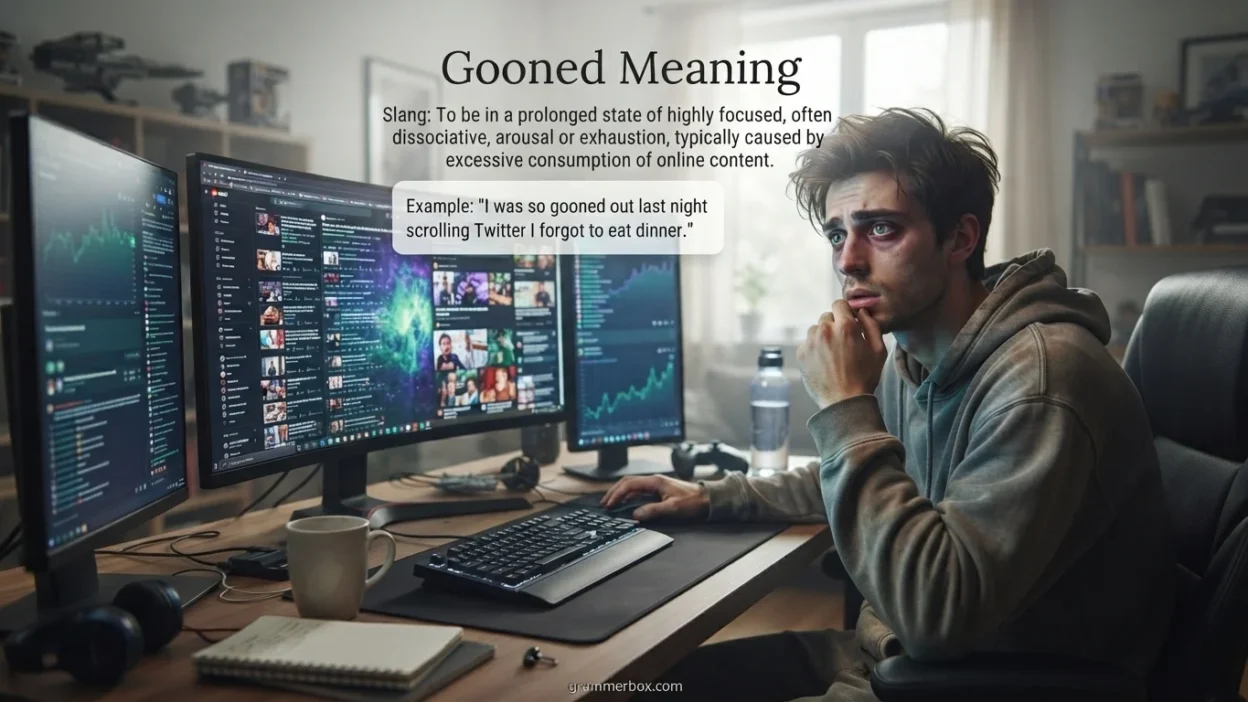
The word “gooned” is internet slang that can be confusing because its meaning depends heavily on context. You may see it in social media posts, memes, gaming conversations, or casual chats, and it does not always mean the same thing. In some contexts, it simply means acting foolish, being heavily intoxicated, or behaving like a “goon.” In newer online slang, however, gooned can have a distinctly sexual meaning.
Understanding the context is therefore essential before deciding what someone means by “gooned.” This guide explains the gooned meaning, where the word comes from, how it is used online, and how its different meanings compare.
You will also find realistic examples, common mistakes, similar slang terms, and a simple memory trick to help you recognize the intended meaning quickly.
Quick Answer
“Gooned” is informal internet slang with multiple meanings. It can describe someone acting foolish or like a goon, but in modern online slang it often refers to prolonged sexual stimulation or being absorbed in that activity. Context determines the intended meaning.
Why People Confuse It
People confuse gooned because the word has developed several meanings over time.
The traditional meaning comes from goon, a word that can describe a foolish, clumsy, or intimidating person. Meanwhile, internet communities have developed a newer sexual meaning for gooning and gooned.
For example:
- “He was gooning around” may suggest acting foolishly.
- “He got gooned” may have a completely different meaning in an adult online context.
- “Gooned” in a meme may simply be exaggerated slang with no precise definition.
Because slang changes quickly, the surrounding words are often more important than the word itself.
First Word: Gooned
Gooned is the past-tense or past-participle form of goon in informal usage.
In a general, nonsexual context, it can describe someone who behaved foolishly, awkwardly, or like a goon. For example:
“He was gooned up and acting ridiculous.”
However, online adult slang uses gooned differently. It can refer to someone being deeply absorbed in prolonged sexual stimulation, particularly the practice commonly called gooning.
The sexual meaning is explicit and is generally unsuitable for professional, academic, or family-friendly communication.
Second Word: Gooning
Gooning is the -ing form of goon and is especially associated with modern internet slang.
In ordinary slang, it can relate to acting like a goon or behaving foolishly.
In adult internet terminology, gooning refers to prolonged sexual stimulation in which a person becomes highly absorbed in the experience.
So, when you encounter “gooning” on social media, forums, or memes, do not automatically assume it means “acting silly.” The context can indicate the adult meaning.
Comparison Table
| Word | Common Meaning | Context | Formality |
|---|---|---|---|
| Goon | Foolish, clumsy, or intimidating person | General slang | Very informal |
| Gooned | Acted foolishly or behaved like a goon; also an adult slang term | General or adult internet slang | Informal |
| Gooning | Acting like a goon; also prolonged sexual stimulation | General or adult internet slang | Informal |
| Gooner | Someone associated with “gooning”; also has unrelated meanings in some contexts | Internet/adult slang | Very informal |
| Goon around | Fool around or behave foolishly | Casual conversation | Informal |
When to Use Each
Use gooned carefully because it is strongly associated with internet slang.
Use “gooned” in general slang when:
- You are describing foolish behavior.
- The conversation is clearly casual.
- The surrounding context supports the nonsexual meaning.
- You are discussing slang or internet language.
Be cautious with “gooned” when:
- You are writing for work or school.
- Your audience may not understand internet slang.
- The word appears in an adult-oriented context.
- You want to avoid an unintended sexual interpretation.
In formal writing, alternatives such as “acted foolishly,” “behaved recklessly,” or “looked ridiculous” are usually clearer.
Examples of “Gooned” in Context
Here are examples showing how context changes the meaning:
- “He completely gooned around during the party.”
Here, it suggests foolish or silly behavior. - “The movie had everyone acting like goons.”
“Goons” refers to foolish or rough characters. - “I was just gooning around with my friends.”
This can mean fooling around, depending on context. - “That meme uses ‘gooned’ in a completely different way.”
Here, the speaker is discussing internet slang. - “He looked like a total goon after the prank.”
This uses the traditional slang sense. - “You need to stop gooning around and finish your work.”
In this context, it means behaving foolishly or wasting time. - “The character is portrayed as a goofy goon.”
“Goon” describes a foolish character. - “I saw the word ‘gooned’ in an online discussion.”
The sentence itself does not specify which meaning is intended. - “That phrase has an adult meaning online.”
This demonstrates why context matters. - “Don’t use ‘gooned’ in a formal report.”
The word is too informal and potentially ambiguous. - “The comedian called himself a goon.”
Here, the word refers to foolish or ridiculous behavior. - “The slang became popular through online communities.”
This refers broadly to the development of internet slang.
Common Mistakes
1. Assuming “gooned” has only one meaning
This is the biggest mistake. The word has both general slang and adult internet uses.
2. Using it in formal writing
Avoid gooned in essays, business reports, applications, and professional communication unless you are specifically discussing slang.
3. Ignoring context
A meme, gaming chat, adult forum, and ordinary conversation may use the same word differently.
4. Confusing “gooned” with “gone”
Gooned and gone are completely different words.
- Gone: “She has gone home.”
- Gooned: Informal slang with meanings discussed above.
5. Assuming every internet use is sexual
Not necessarily. Some people use goon, gooned, or gooning humorously to mean acting foolish or messing around.
Memory Trick
Think:
GOONED = GOON + context
If the context involves someone acting foolishly, think “goon = fool.”
If the context is an adult internet conversation, remember that gooning can have a sexual meaning.
The easiest rule is:
American vs. British English
Gooned is primarily an informal slang term rather than a standard American or British English word.
The word goon itself is understood in both varieties of English, although its exact associations can differ by context.
Modern internet uses of gooned and gooning are largely driven by online communities rather than traditional differences between American and British English.
Therefore, you should not treat gooned as a standard American-versus-British spelling difference. It is better understood as evolving slang.
Similar Words
Depending on the intended meaning, several words may be related to gooned.
For foolish behavior:
- Fooling around
- Messing around
- Acting silly
- Acting foolishly
- Goofing around
- Being ridiculous
- Clowning around
- Behaving stupidly
For the adult internet meaning:
Gooning is the more common related term, while gooner is another internet slang term associated with that usage.
Because these terms can be explicit, they are best avoided in professional or family-friendly writing.
Final Verdict
Gooned is informal slang whose meaning depends on context. Traditionally, it can relate to behaving like a goon, meaning acting foolishly, clumsily, or ridiculously.
However, modern internet slang has given gooned another, explicitly sexual meaning connected with gooning. If you encounter the word online, check the surrounding conversation before interpreting it.
FAQs:
1. What does “gooned” mean in slang?
“Gooned” can mean acting foolishly or like a goon. In modern adult internet slang, it can also refer to being deeply engaged in prolonged sexual stimulation.
2. Is “gooned” a real word?
Yes, gooned is used as informal slang, although it is not appropriate for most formal writing. Its meaning varies according to context.
3. Is “gooned” a bad word?
It can be considered inappropriate depending on the context. Its modern internet meaning can be explicitly sexual, so it should be used cautiously.
4. What does “gooning” mean?
“Gooning” can mean fooling around in some casual contexts. In adult internet slang, it refers to prolonged sexual stimulation.
5. Is “gooned” appropriate for school writing?
Generally, no. If you are discussing the word itself in a language or slang lesson, you can mention it, but avoid using it casually in academic writing.
6. What is the difference between “goon” and “gooned”?
Goon is usually a noun describing a foolish, clumsy, or intimidating person. Gooned is an informal form used to describe an action or state and has developed additional internet-slang meanings.
7. Does “gooned” always have a sexual meaning?
No. Context matters. Some people use it to describe foolish behavior or simply as humorous internet slang.
Remember This
“Gooned” does not have one fixed meaning. In casual slang, it can relate to acting foolishly or like a goon. In adult internet slang, it has a sexual meaning associated with gooning.
When you see gooned, always check the surrounding context before deciding what the speaker means.
Conclusion
The meaning of gooned depends largely on where and how you encounter it. In traditional casual slang, it can describe foolish or ridiculous behavior connected with the word goon. Modern online communities, however, have popularized a separate adult meaning, making the word more ambiguous than it may initially appear.
If you are learning English or writing for a broad audience, context is your best guide. For professional and academic communication, choose clearer alternatives instead of relying on slang. Understanding both meanings will help you interpret social media posts, memes, chats, and informal conversations more accurately.