
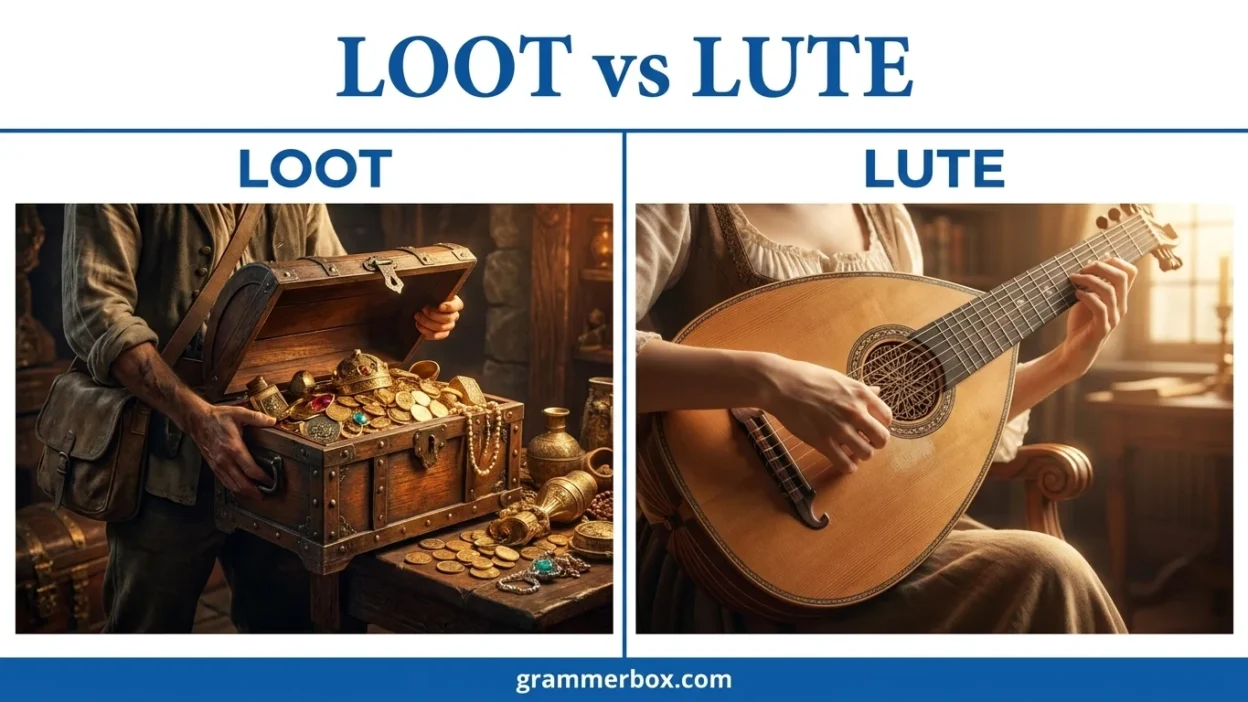
The words loot and lute may look similar, but they have completely different meanings, pronunciations, and uses in English. Loot usually refers to stolen goods or valuables taken during theft, war, or robbery. A lute, on the other hand, is a stringed musical instrument with a long neck and a rounded body.
Because these words differ by only one letter, they can sometimes confuse English learners, especially when reading or writing quickly. However, understanding their meanings is simple once you learn the context in which each word appears. This guide explains loot vs lute, including definitions, pronunciation, examples, common mistakes, and easy memory tricks to help you choose the correct word every time.
Quick Answer
Loot refers to stolen or illegally taken goods and can also mean taking valuable items by force. Lute is a stringed musical instrument, especially associated with historical and classical music. Remember: loot is something taken, while a lute is something played.
Why Do People Confuse Loot and Lute?
People confuse loot and lute mainly because the words have similar spelling and contain many of the same letters.
However, their meanings are entirely unrelated:
- Loot relates to stolen goods, robbery, or valuable items.
- Lute relates to music and stringed instruments.
Their pronunciations are also different. Loot rhymes with boot, while lute rhymes with mute.
Loot: Meaning and Definition
What Does Loot Mean?
Loot refers to goods, money, or valuables that have been stolen or taken illegally, especially during a robbery, war, or period of disorder.
It can be used as both a noun and a verb.
Loot as a Noun
As a noun, loot means stolen property or valuable items taken by force.
Examples:
- The thieves escaped with valuable loot.
- Police recovered most of the stolen loot.
- The soldiers carried away the loot from the city.
- The robbers hid their loot in an abandoned building.
Loot as a Verb
As a verb, loot means to steal goods, especially during chaos, conflict, or a disaster.
Examples:
- Several stores were looted during the unrest.
- The criminals looted the warehouse.
- People began to loot abandoned buildings.
- The museum was looted during the war.
Pronunciation of Loot
Loot is pronounced:
/luːt/
It rhymes with:
- Boot
- Root
- Suit
Lute: Meaning and Definition
What Does Lute Mean?
A lute is a stringed musical instrument with a rounded body and a neck. It has been used in many musical traditions and was especially popular in Europe during the medieval and Renaissance periods.
A lute is played by plucking its strings.
Examples of Lute
- The musician played a beautiful melody on the lute.
- The museum displayed an ancient lute.
- Renaissance musicians often performed with the lute.
- He learned to play the lute as part of his historical music studies.
Pronunciation of Lute
Lute is pronounced:
/luːt/
It is pronounced the same as loot in standard English.
This means loot and lute are homophones: they sound alike but have different spellings and meanings.
Loot vs Lute: Comparison Table
| Feature | Loot | Lute |
|---|---|---|
| Meaning | Stolen goods or valuables | A stringed musical instrument |
| Part of speech | Noun or verb | Noun |
| Pronunciation | /luːt/ | /luːt/ |
| Common context | Theft, robbery, war | Music, history, instruments |
| Example | The thieves hid the loot. | She played the lute. |
When to Use Loot and Lute
Use loot when talking about stolen goods, valuables taken during a robbery, or the act of stealing property.
Use lute when referring to the musical instrument.
Use Loot When:
- Talking about stolen property
- Describing goods taken during war
- Referring to robbery or theft
- Using the verb meaning “to steal”
Example: The thieves divided the loot.
Use Lute When:
- Talking about a musical instrument
- Discussing Renaissance or historical music
- Referring to a stringed instrument
Example: The performer played the lute beautifully.
Loot vs Lute Examples
Here are more examples to help you understand the difference between loot and lute.
- The police found the stolen loot hidden in a garage.
- The musician carefully tuned her lute before the performance.
- The robbers escaped with bags of valuable loot.
- He listened to a recording featuring the lute.
- Soldiers carried the loot away after the battle.
- The ancient lute was displayed behind glass.
- Detectives searched the building for the missing loot.
- She studied how the lute influenced Renaissance music.
- The criminals were arrested while transporting their loot.
- The musician gently plucked the strings of the lute.
- Valuable artwork was among the loot recovered by police.
- The historical band included a player who specialized in the lute.
Common Mistakes With Loot and Lute
1. Using Lute for Stolen Goods
❌ The thieves hid the lute.
✔ The thieves hid the loot.
Unless the thieves actually stole a musical instrument, loot is the correct word.
2. Using Loot for a Musical Instrument
❌ He played the loot at the concert.
✔ He played the lute at the concert.
A lute is the musical instrument.
3. Assuming Different Pronunciations Mean Different Spellings
Although loot and lute have different meanings and spellings, they are pronounced the same in standard English.
This makes them a useful example of homophones.
4. Forgetting That Loot Can Be a Verb
Many learners know loot as a noun but forget that it can also be used as a verb.
Example: The shops were looted during the chaos.
An Easy Memory Trick for Loot vs Lute
Think about the letter M in music.
A lute is connected with music, so remember:
Lute = musical instrument
For loot, think about a booty or treasure taken by thieves:
Loot = stolen valuables
You can also remember:
You play a lute, but you take loot.
American vs British English
The meanings and spelling of loot and lute are generally the same in both American and British English.
- Loot means stolen or illegally obtained goods in both varieties of English.
- Lute refers to the same type of stringed musical instrument in both varieties.
Both words are commonly pronounced /luːt/, making them homophones in standard American and British English.
There is no major American vs British spelling difference between these two words.
Similar Words and Related Terms
Several English words are related to the meanings of loot or lute.
Words Related to Loot
- Booty – valuable goods taken by force
- Plunder – goods stolen during war or conflict
- Spoils – valuable things gained or taken
- Stolen goods – property taken illegally
- Robbery – the crime of taking property by force
Words Related to Lute
- Lyre – an ancient stringed instrument
- Guitar – a popular modern stringed instrument
- Mandolin – a small stringed instrument
- Harp – a large instrument with strings
- Instrument – an object used to create music
Is Loot a Homophone of Lute?
Yes. Loot and lute are commonly considered homophones because they have the same pronunciation but different spellings and meanings.
- Loot = stolen goods
- Lute = musical instrument
This makes them useful examples when learning about English homophones.
FAQs:
What is the difference between loot and lute?
Loot means stolen goods or valuables, while a lute is a stringed musical instrument.
Are loot and lute pronounced the same?
Yes. In standard English, both loot and lute are pronounced /luːt/.
Is loot a noun or a verb?
Loot can be both. As a noun, it means stolen goods. As a verb, it means to steal or take goods illegally.
What kind of instrument is a lute?
A lute is a stringed musical instrument with a rounded body and a neck. It is played by plucking the strings.
Can I say “play the loot”?
No, unless you are using loot in an unusual or non-musical context. The correct phrase for the instrument is play the lute.
What is another word for loot?
Depending on the context, synonyms include booty, plunder, spoils, and stolen goods.
Are loot and lute homonyms?
They are more specifically called homophones because they sound the same but have different spellings and meanings.
Final Verdict: Loot or Lute?
The difference between loot and lute is simple once you know their meanings.
Choose loot when talking about stolen goods, valuables, or the act of stealing. Choose lute when referring to the historical stringed musical instrument.
Although they sound the same, context makes their meaning clear. If the sentence involves crime, robbery, or stolen property, use loot. If it involves music or instruments, use lute.
Conclusion
Understanding the difference between loot vs lute helps you avoid a common spelling mistake caused by their identical pronunciation. Loot refers to stolen goods and can also describe the act of stealing, while a lute is a stringed instrument associated with historical and classical music.
The easiest way to remember the difference is to focus on context. Thieves may steal loot, but musicians play the lute. Once you connect each word with its meaning, choosing the correct spelling becomes much easier.
Remember This
Loot is stolen or taken. A lute is played as a musical instrument.