
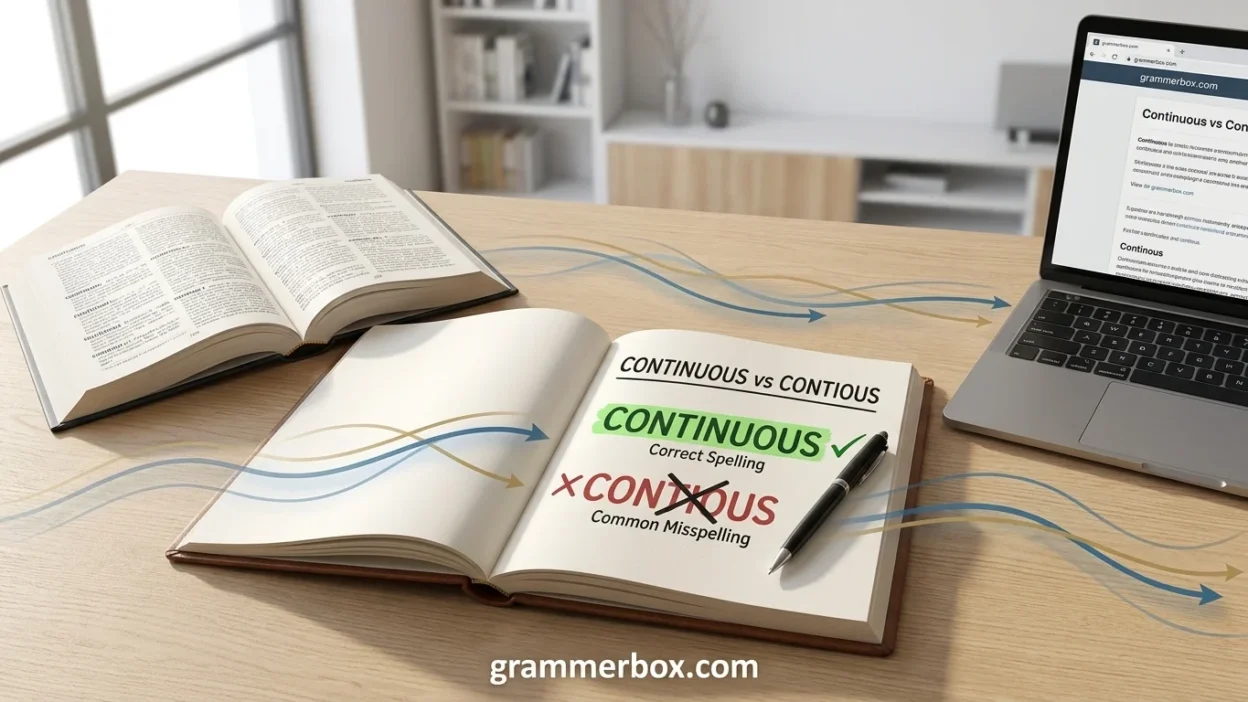
When you are writing quickly, it is easy to type “contious” instead of “continuous.” The two spellings look similar, and the missing letters can be easy to overlook. However, only one of them is the standard English spelling. If you have ever wondered whether to write continuous or contious, this guide will clear up the confusion.
The word continuous is a common adjective used to describe something that happens without stopping, interruption, or a break. It appears frequently in everyday English, academic writing, business communication, and technical contexts. Contious, on the other hand, is a misspelling and should not be used in standard English. Learning the correct spelling, pronunciation, meaning, and usage can help you avoid this common spelling mistake and write more confidently.
Quick Answer
Continuous is the correct spelling. Contious is incorrect and is usually a spelling mistake caused by leaving out the letters “nu.” Use continuous when describing something that continues without interruption or breaks.
Why People Confuse It
The confusion between continuous and contious usually comes from pronunciation and spelling patterns.
When spoken naturally, continuous can sound as though some of its middle letters disappear. This may lead writers to spell it phonetically as contious.
Another reason is that English contains many words with similar endings, such as:
- Curious
- Serious
- Various
- Previous
- Obvious
Because continuous has a similar sound pattern, it is easy to accidentally leave out “nu.”
The correct spelling is:
C-O-N-T-I-N-U-O-U-S
Continuous
Continuous is the correct English word.
It is an adjective meaning something that continues without stopping or interruption.
Examples of the meaning
- The machine requires continuous maintenance.
- We experienced continuous rain throughout the afternoon.
- The patient needs continuous monitoring.
- She made continuous improvements throughout the year.
The word can describe an action, process, sound, movement, condition, or situation that does not stop.
Continuous in a sentence
The continuous noise made it difficult to concentrate.
Here, continuous describes noise that keeps occurring without a significant interruption.
Contious
Contious is not the standard spelling of the English word.
If you intend to describe something that continues without interruption, the correct form is continuous.
❌ The machine produces a contious sound.
✅ The machine produces a continuous sound.
Therefore, when checking your spelling, replace contious with continuous.
Comparison Table
| Word | Correct? | Meaning | Example |
|---|---|---|---|
| Continuous | ✅ Yes | Continuing without interruption | We had continuous rain. |
| Contious | ❌ No | Misspelling of continuous | Avoid this spelling. |
The key difference is simple: continuous contains “nu” after conti.
When to Use Each
Use “continuous” when:
Use continuous when something keeps going without a break or interruption.
For example:
- Continuous rainfall
- Continuous communication
- Continuous improvement
- Continuous operation
- Continuous movement
- Continuous support
- Continuous monitoring
Do not use “contious”
Contious should not be used in standard English writing.
If you see this spelling in an email, assignment, article, or document, it is most likely an accidental misspelling of continuous.
Examples of Continuous
Here are more examples to show how continuous works in everyday sentences:
- The continuous rain flooded several streets.
- The company focuses on continuous improvement.
- The device provides continuous temperature monitoring.
- We heard a continuous buzzing sound.
- The road requires continuous repairs.
- Her continuous efforts eventually produced results.
- The patient remained under continuous observation.
- The computer needs a continuous power supply.
- The factory operates through continuous production.
- The teacher encouraged continuous learning.
- The river provides a continuous source of water.
- The team maintained continuous communication during the project.
Notice that continuous generally emphasizes something that continues without a meaningful break.
Common Mistakes
1. Writing “contious”
❌ Contious improvement is important.
✅ Continuous improvement is important.
The incorrect version leaves out “nu.”
2. Forgetting the “nu”
A useful way to remember the spelling is to break it into parts:
con + tin + u + ous
Or simply remember:
conti + nu + ous
The “nu” is the part commonly missed.
3. Confusing continuous with continual
Although these words are related, they can have different meanings.
Continuous generally refers to something happening without interruption.
Continual can refer to something happening repeatedly, often with interruptions.
For example:
- Continuous rain = rain that does not stop.
- Continual complaints = complaints occurring repeatedly.
Memory Trick
Here is an easy spelling trick:
Continuous has “NU” in the middle.
Think:
CONTIN + U + OUS
Or remember the phrase:
Continuous = no break + “NU”
If you remember that continuous contains “nu,” you are much less likely to write contious.
A simple visual reminder:
CONTINUOUS ✅
CONTIOUS ❌
Whenever you are unsure, look for the NU.
American vs British English
There is no spelling difference between American and British English for this word.
Both varieties use:
continuous
For example:
- American English: The machine operates continuously.
- British English: The machine operates continuously.
The spelling contious is not an accepted American or British variant.
Similar Words
Several words are related to continuous, but they should not automatically be treated as interchangeable.
Continuous
Means continuing without interruption.
The system provides continuous updates.
Continual
Usually means happening repeatedly, often with breaks.
The continual interruptions distracted me.
Constant
Means occurring regularly or remaining unchanged, depending on context.
She needs constant support.
Ongoing
Means continuing or currently in progress.
The investigation is ongoing.
Uninterrupted
Means not stopped or broken.
We enjoyed three hours of uninterrupted conversation.
Understanding these distinctions can make your writing more precise.
FAQs:
Is “contious” a correct word?
No. Contious is a misspelling. The correct spelling is continuous.
How do you spell continuous?
The correct spelling is C-O-N-T-I-N-U-O-U-S.
What does continuous mean?
Continuous means continuing without stopping or without interruption.
Why do people spell continuous as contious?
People often omit the “nu” because the middle of continuous can be difficult to hear clearly in normal pronunciation.
Is continuous an adjective?
Yes. Continuous is an adjective used to describe something that continues without interruption.
What is the difference between continuous and continual?
Continuous generally means without interruption, while continual often means happening repeatedly, with possible interruptions.
Is continuous spelled differently in British English?
No. Continuous has the same spelling in both American and British English.
Remember This
Continuous = correct spelling ✅
Contious = incorrect spelling ❌
Continuous means continuing without interruption or a break.
Conclusion
If you are deciding between continuous vs contious, choose continuous every time. The word is commonly used to describe uninterrupted activity, movement, communication, monitoring, improvement, or other ongoing processes. The spelling contious is simply a common error.
Remember the middle “nu” in continuous, and this spelling problem becomes much easier to avoid. If you are writing an academic assignment, business email, website content, or everyday message, using continuous will keep your writing accurate and professional.